
CYP action plan
The Surrey Children and Young People’s Emotional Wellbeing, Mental Health and Suicide Prevention Action Plan: 2024-2025
Summary
A 5-year action plan has been developed to address the needs identified in the Children and Young People’s Emotional Wellbeing and Mental Health Strategy 2022-2027; a collaboration between partners from health, education, social care, Mindworks Surrey, and third sector colleagues, informed by engagement with Surrey’s Children, Young People and Families. The action plan aligns with recommendations within the Surrey All-Age Suicide Prevention Strategy and the Surrey Thematic Review of Child Deaths by Probable Suicide.
Figure 1: Children and Young People’s Emotional Wellbeing, Mental Health and Suicide Prevention Partnership
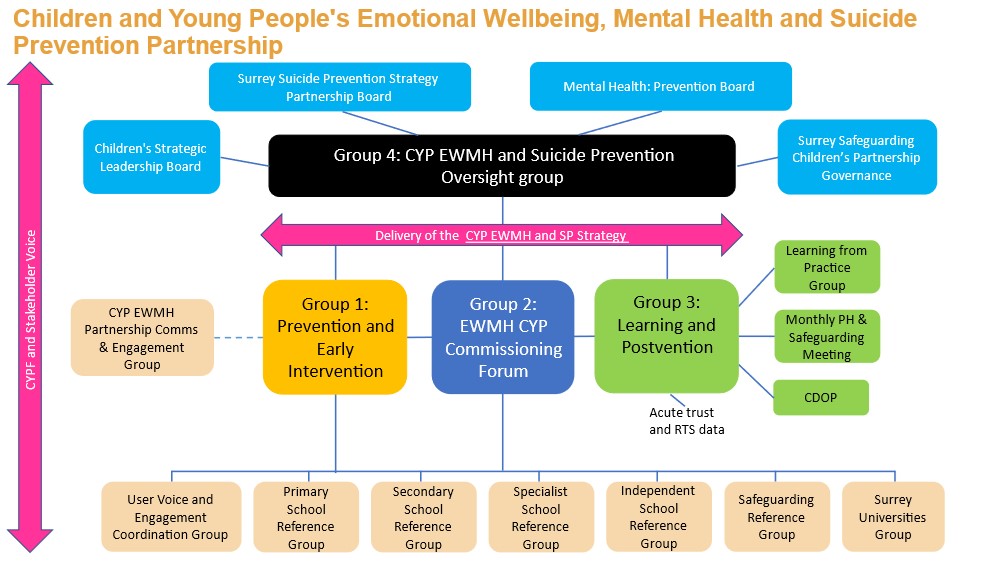
The actions, which are driven by local intelligence and national research, adapt as evidence is reviewed and new insights are captured e.g. in the fortnightly Group 3 (Learning and Postvention) meeting, or via reports which are circulated across the partnership. Outputs demonstrate the breath of work happening to address these actions and are updated in the bimonthly Group 1 (Prevention) meeting.
Principles of the action plan
All actions are guided by the set of principles outlined below:
- Activity will be proportionate to need, with support tailored to children and young people most at risk of poor mental health.
- Emerging evidence around vulnerable groups and risk factors will be used to strengthen and adapt actions as necessary.
- Activity will be evidence-based and informed by NICE, OHID and DfE guidance.
- A strong governance structure will be used to ensure activity is delivered and challenges are escalated when needed.
- Actions will align with existing strategies to reinforce and strengthen the support available for children, young people and families.
Partnership’s Core Actions
The Partnership’s current core actions are as follows:
- Develop and promote key websites with up-to-date, evidence-based EWMH (emotional wellbeing and mental health) resources and signposting.
- Develop resources that support CYP (children and young people) to take care of their EWMH.
- Target signposting to EWMH support to populations most at risk.
- Ensure self-help information is informed by CYPF (children, young people and families) feedback.
- Ensure signposting to EWMH and PH support reaches CYP where they are.
- Support settings to create a culture of EWMH and physical health support where CYP share concerns with trusted adults.
- Embed THRIVE common language within all signposting activity.
- Provide support for CYPF while they wait for EWMH appointments.
- Work across settings to improve communication about CYP EWMH concerns.
- Provide settings with a framework for addressing online harm.
- Work in a co-ordinated way to mitigate the risk of self-harm and suicide contagion.
- Provide and promote safe spaces for CYP online and in person.
- Upskill professionals to understand additional needs and disabilities and the best ways to support CYP EWMH.
- Upskill professionals who support CYP EWMH to use a trauma-informed approach.
- Upskill professionals to take an evidence-based approach to supporting CYP EWMH including self-harm and suicidality.
- Support professionals’ wellbeing before and throughout the Coroner’s process.
- Support settings to use a relevant framework to address suicide prevention and postvention.
- Ensure CYP who have been bereaved are signposted to appropriate support.
- Upskill professionals to take an evidence-based approach to supporting CYP who experience gender dysphoria.
- Implement a Core20PLUS5 approach to reducing healthcare inequalities.
With thanks to the children, young people and families who participated in the engagement work to help shape the strategy that informed this action plan.
For more information, contact: [email protected]