
Surrey Violence Against Women and Girls Needs Assessment 2024-2025
Violence Against Women and Girls
Surrey Needs Assessment 2024-2025
This Needs Assessment was coordinated by the Surrey Office of Data Analytics.
If you or someone you know has been the victim of violence please use this support link: How to get help | Healthy Surrey
Executive summary
Violence Against Women and Girls (‘VAWG’) remains one of the most widespread and devastating forms of abuse, both globally and nationally. In the UK, the National Policing Statement for VAWG, commissioned by the National Police Chiefs’ Council and College of Policing, outlines the scale of the issue.
| More than one million VAWG-related crimes were recorded in 2022/23, accounting for 20% of all police-recorded crime. Police-recorded VAWG offences increased by 37% between 2018 and 2023. At least 1 in 12 women is estimated to experience VAWG annually, though this is likely an underrepresentation. Reports of child sexual abuse and exploitation rose by 400% between 2013 and 2022. Between August 2022 and July 2023, 41,540 offences of child sexual abuse and exploitation were recorded against girls aged 10 to 17. An estimated 1 in 20 adults in England and Wales (around 2.3 million people) are perpetrators of VAWG crimes each year. |
The National Police Chiefs’ Council has warned that VAWG is increasing in both prevalence and complexity, inflicting profound harm on victims, survivors, families, and communities.
This needs assessment was undertaken between July 2024 and March 2025 in collaboration with the Surrey Office of Data Analytics (SODA). Its primary aim is to build a clearer understanding of the prevalence, impact, and complexity of VAWG in Surrey, and to identify current gaps in service provision. The findings are intended to inform future planning, partnership working, and the commissioning of services to better support victims and prevent harm.
This report summarises key insights from the assessment and offers a series of evidence-informed recommendations to strengthen Surrey’s collective response to VAWG. These recommendations focus on improving data sharing and analysis, enhancing access to specialist support, increasing prevention and early intervention efforts, and addressing systemic gaps that leave some groups particularly vulnerable.
For more information or to discuss the findings in detail, please contact the Safer Communities team email: [email protected].
Contents
Legislative and Strategic Context
Violence against Women and Girls: Surrey Statistics
Surrey VAWG Services, Programmes and Other Initiatives
Key findings
No coordinated mechanisms of intelligence sharing for service planning
Although we found evidence of partnership working at the local level (district and borough), there are no coordinated mechanisms for intelligence sharing and service planning across the multi-agency networks at a Surrey-wide level.
Barriers of accessibility to services could lead to under-reporting
While agencies like Surrey Police have processes to identify high-risk victims and offenders, the intersectional nature of VAWG offences makes them challenging to detect, leading to significant intelligence gaps and expected underreporting.
Underreporting is likely driven by a lack of confidence in services’ ability to meet individual needs, fear of discrimination by the police, justice system, or other professional services, and the perception that some VAWG incidents may not be prosecuted, making them seem acceptable.
| StreetLight UK shared examples of individuals they supported who were hesitant to report due to language barriers. The Sexual Assault Referral Centre (SARC) reported a decline in public confidence in the criminal justice system, with stakeholders across Surrey expressing concerns about the lengthy delays in court cases and low conviction rates. These factors were identified as significant barriers to encouraging people to report offences and/or attend the SARC, where applicable. |
Stalking and Harassment are the most common offences linked to Violence Against Women and Girls in Surrey, particularly in town centres
An unpublished 2022 Surrey Police VAWG problem profile highlighted concerns in areas such as streets, supermarkets, parks, gardens, car parks, and petrol stations. Given the limitations in the data received, no specific hotspots could be identified in this analysis, and the drivers of violence remain unclear.
Incidents related to Violence Against Women and Girls are often challenging to identify within data from partner organisations
Many agencies within the VAWG partnership, which play a key role in prevention and support, do not collect gendered data and instead rely solely on Police data to inform service delivery. This approach leads to an inaccurate understanding of VAWG prevalence and perpetration in these settings.
| Identifying information on Violence Against Women and Girls in education was challenging. While some data is available (see section on Education data) much of the information collected in schools does not differentiate by gender. In health settings, data categorisation primarily focuses on a patient’s physical symptoms, often without considering the underlying causes. This makes it difficult to identify Violence Against Women and Girls. Due to the complexity of the NHS in Surrey and related health services, the focus was placed on Accident and Emergency (A&E) data, which provides a limited understanding of Violence Against Women and Girls in health settings. We were also unable to obtain information on services available for individuals responsible for committing Violence Against Women and Girls crimes, either those in prison or those released into the community after serving their sentence. This area requires further exploration. |
Gaps in data collection relating to Violence Against Women and Girls have been identified
For agencies that collect data, information on the protected characteristics of victims and survivors (such as ethnicity, gender identity, and sexuality) is often incomplete. The result of these gaps is that survivors from minoritised groups remain invisible.
| Barriers to collecting accurate demographic data include victims’ active choice not to disclose, professionals not asking for certain information (e.g. Police may not ask victims about their sexuality), or relying on assumptions rather than self-reported data. In some cases, key characteristics are not recorded at all, for example, gender is not included in schools’ termly data returns. |
High-harm offenders who repeatedly receive no further action present a risk
Although the needs assessment data did not provide conclusive evidence, Surrey Police has identified this issue in their 2022 Violence Against Women and Girls problem profile. This concern has also been observed at a national level, making it an important finding that warrants further investigation.
In terms of services, the current offer focuses on supporting adult and child victims of sexual abuse
Despite the critical importance of this area, most services remain reactive, responding only after harm has occurred. There is a notable lack of early intervention for young people, particularly those in the under-18 and 25–34 age groups, where a significant proportion of perpetrators are found. Aside from Assessment Consultant Therapy (ACT) and the What is Sexual Exploitation (‘WiSE’) intervention worker, few services support young people to develop healthy relationships and address harmful behaviours. Existing programmes such as Youth Using Violence and Abuse (‘YUVA’) and Respect are largely focused on violence within family contexts, leaving a gap in broader relational support.
Our analysis identifies several gaps or areas of limited provision
These include the absence of universal prevention services, especially around stalking, exploitation, and accessibility for those with additional needs, targeted support for honour-based abuse, and LGBTQIA+ specific provision [LGBTQIA+ is an acronym used to represent the diverse spectrum of sexual orientations and gender identities. It stands for Lesbian, Gay, Bisexual, Transgender, Queer/Questioning, Intersex, Asexual/Aromantic, and the “+” indicates that it’s an inclusive term that encompasses other non-binary genders and orientations]. It is unclear whether these gaps reflect a lack of need or a lack of visibility for the affected groups. Additionally, there is a widespread need for improved VAWG training across services. Partners highlighted that many professionals lack awareness of how VAWG presents, limiting effective recognition and response. Strengthening training and embedding a VAWG-informed approach are essential to improving support for Surrey’s residents.
Recommendations
Making VAWG a core part of Community Safety work
Tackling VAWG must be a central statutory priority within Surrey’s approach to reducing serious violence and promoting community safety. Alongside this, there should be a dedicated partnership group focused specifically on preventing VAWG, ensuring actions are coordinated, targeted, and effective. Preventing and addressing VAWG requires a whole system approach and demands commitment at every level of Surrey’s partnership to ensure progress. This should include raising public awareness and actively challenging the cultural attitudes and norms that perpetuate or normalise such violence.
Collecting the right data to improve insight on need
A unified, partnership-wide approach is needed to agree what data should be collected across agencies. This will support consistent monitoring of need, progress, and outcomes for Surrey residents. Data should be disaggregated by key characteristics such as gender, age, ethnicity, disability, and type of abuse, so that services can better understand and respond to the needs of residents, particularly minoritised groups who are the most disproportionality impacted by VAWG, yet often overlooked or underserved. Just as important is the need for partners to come together to interpret this data collectively, turning it into shared insight that can drive coordinated action and avoid siloed responses.
Improving support for online VAWG
Online abuse is increasing, including in local schools and colleges. Services need more tools and resources to support victims, families, and schools. These should be easy to access, inclusive, and based on an understanding of trauma. Support should be flexible and help people feel safe and listened to.
Managing repeat offenders effectively
We need to understand how many VAWG cases end without further action and how often those offenders harm again. This will help improve how we manage and rehabilitate repeat offenders. Better communication between services and clearer referral routes will also make it easier to support victims and prevent further harm.
Identifying unsafe areas in communities
There’s currently little information about where VAWG-related offences happen in public spaces. A mapping exercise should be carried out to identify hotspot areas. This will help us focus prevention work and create safer spaces, led by the needs of local communities.
Reviewing support in Prisons and Probation Services
A service mapping exercise should be conducted to evaluate the support available for both perpetrators and survivors of VAWG within the prison and probation system. This should include an assessment of how trauma-informed and accessible these services are, particularly for those with complex needs or who require reasonable adjustments. This should also include identifying community services to support individuals released into the community.
Training all professionals on VAWG
All staff who work with the public should receive training on VAWG. This training should help them understand the impact of abuse, how to spot warning signs, and how to respond in a way that makes people feel heard, safe, and supported.
Making VAWG education in schools fair and consistent
Some schools in Surrey have not had the same access and/or awareness of VAWG education and training as others. These schools should be identified and supported with learning materials, such as the “OK to Ask?” campaign and PSHE on demand training. All children and young people should be given the tools to recognise abuse, understand what healthy relationships look like, and know where to go for help.
Introduction
About this needs assessment
This is Surrey VAWG Partnership’s first needs assessment, providing a comprehensive overview of national and regional legislation, alongside Surrey’s specific VAWG landscape. It highlights existing services, identifies gaps, and outlines priorities for future planning to reduce VAWG and its impacts.
The assessment is based on quantitative data from multiple Surrey agencies and qualitative research commissioned by the Serious Violence Reduction Partnership Fund. An independent agency, Solutions Research, gathered qualitative insights through in-depth interviews with survivors that had engaged with Surrey services and survivors that had never reported their experiences, stakeholder workshops, a Surrey-wide survivor survey, and interviews with practitioners that work with perpetrators.
Solutions Research’s aim was to address the following research questions
|
1. How safe do women and girls feel in Surrey, and how frequently do they report experiencing offences linked to VAWG? What forms do these offences typically take? 2. For those who have accessed support services, including both survivors and perpetrators, what were their experiences? What aspects of support worked well, and where were the shortcomings? 3. What were the experiences of individuals who were unable to access support services, whether survivors or perpetrators? What barriers prevented them from receiving help? 4. How can the insights from this research be used to shape and improve future services aimed at preventing and responding to VAWG? |
Details on the qualitative research methodology can be found in the Appendix. Direct quotes from participants are integrated throughout this assessment to illustrate key findings.
Surrey has also completed a Domestic Abuse Needs Assessment in 2023, alongside a Serious Violence Needs Assessment and Strategy. As a result, domestic abuse is not addressed within this needs assessment to avoid duplication and ensure a clear focus on other aspects of VAWG. These assessments underpin strong partnerships between the local authority, statutory agencies, specialist service providers, and community groups, fostering a collaborative and coordinated approach to preventing and addressing serious violence across Surrey.
What is Violence Against Women and Girls?
The term ‘Violence Against Women and Girls’ refers to acts of violence or abuse that disproportionately affect women and girls. These crimes occur in both public and private spaces and include rape, sexual offences, domestic abuse, intimate partner violence, and so-called ‘honour’-based abuse (such as female genital mutilation, forced marriage, and ‘honour’ killings). VAWG also encompasses stalking, online abuse, upskirting, image-based sexual abuse, and harassment. For detailed definitions, please see the Glossary.
VAWG is deeply rooted in gender inequality, sexism, misogyny, and societal norms that normalise violence against women. It is a widespread issue that affects women throughout their lives, with multiple forms and incidents of abuse, in particular sexual violence being the most common form of abuse experienced by women.
Globally, men’s violence against women is a leading cause of premature death for women. In the UK, the National Policing Statement for VAWG, commissioned by the National Police Chiefs’ Council and College of Policing, highlights the scale of the problem
|
– Over one million VAWG-related crimes were recorded in 2022/23, making up 20% of all police-recorded crime. – Between 2018 and 2023, police-recorded VAWG crimes increased by 37%. – At least 1 in 12 women experiences VAWG annually, though the real number is likely much higher. – Child sexual abuse and exploitation increased by 400% between 2013 and 2022. – Between August 2022 and July 2023, there were 41,540 child sexual abuse and exploitation offences against girls aged 10-17. – 1 in 20 adults in England and Wales (2.3 million people) perpetrate VAWG crimes annually. |
The National Police Chiefs’ Council warns that VAWG is growing in prevalence and complexity, causing immense harm to victims, survivors, and society.
The Hidden and Overlooked Scale of Violence Against Women and Girls
VAWG is a continuum of harm that can affect individuals at every stage of life. While its prevalence is significant, the true scale remains unknown due to the hidden nature of many offences and the normalisation of societal attitudes that sustain gender inequality. Although any girl or woman can be affected, factors such as gender identity, socioeconomic status, ethnicity, religion, disability, sexuality, age, and mental health increase the likelihood of experiencing violence and create additional barriers to justice and support. In Surrey, there is a clear commitment to providing safe, inclusive services where victims and survivors can speak openly, be heard, and receive practical and emotional support tailored to their needs. This person-centred approach also strengthens the response for male victims and those from LGBTQIA+ and ethnic minority communities. By acknowledging the diverse and intersecting experiences of victims, services can be better equipped to meet a wide range of needs. While the term ‘violence against women and girls’ is used throughout this assessment, it refers to all victims and survivors of these crimes.
Legislative and Strategic Context
National picture
In the UK, VAWG is considered a national emergency. National government aims to halve it within ten years by targeting perpetrators, addressing the root causes, and introducing specialist rape and sexual offences teams in every police force (see also The Labour Party’s Manifesto). They will pursue harmful perpetrators with tactics used against terrorists and organised crime, create a new offence for spiking, strengthen stalking protection orders, fast-track rape cases, and ensure schools address misogyny and teach healthy relationships. They will also protect whistle-blowers in the workplace.
Recent reports highlight VAWG crimes in the workplace, particularly within Police, NHS, and private businesses, showing its prevalence and minimal consequences. The Angiolini Enquiry 2021, for example, found normalised abusive behaviour within the Police, calling for leaders to fundamentally rethink their approach.
The Review of Sexual Abuse in Schools and Colleges (Ofsted 2021) found that sexual harassment and online sexual abuse is also prevalent in children and young people, and that schools and colleges cannot tackle sexual harassment and sexual violence on their own.
The HM Government’s Tackling Violence Against Women and Girls Strategy (2021) and the National Statement of Expectations (2022) call for a coordinated response from all agencies. The Home Office allocated £43 million to tackle VAWG, including £25 million for addressing perpetrators and funding for the Rape Review.
The Department for Health and Social Care’s Women’s Health Strategy (2022) prioritises early identification, support in workplaces, awareness of specialist clinics, and upskilling healthcare professionals. The Tackling Child Sexual Abuse Strategy (2021) calls for a government-wide approach to strengthen responses to child sexual abuse.
Legislation that addresses VAWG include:
- Domestic Abuse Act (2021): Defines domestic abuse and recognises children as victims.
- Female Genital Mutilation Act (2003): Criminalises Female Genital Mutilation (‘FGM’) and related activities.
- Sexual Offences Act (2003): Defines sexual offences, including those against children.
- Modern Slavery Act (2015): Consolidates laws against slavery and trafficking.
Other Strategies: Operation Soteria (2021) aims to improve the criminal justice response to rape cases. The Suicide Prevention Strategy (2023) recognises VAWG crimes as factors leading to higher suicide risks. The Online Safety Act (2023) addresses harmful online content impacting women and girls. The Victim’s Code of Practice (2005) sets out key rights for victims within the criminal justice system.
Surrey policies and strategies
Surrey’s approach to addressing VAWG
Surrey adopts the World Health Organisation Prevention Unit’s intersectional approach to addressing VAWG. This means using an integrative strategy to prevent and understand VAWG, support survivors, and challenge perpetrator behaviour. It recognises the multifaceted and intersecting needs across society, from individuals to communities.
Policy and Legislative framework
Under the Serious Violence Duty, introduced in the Police, Crime, Sentencing and Courts Act (2022), local agencies must prioritise tackling serious violence, including VAWG. The government also amended the Crime and Disorder Act (1998), requiring Community Safety Partnerships (police, fire, probation, and other services) to develop strategies to combat violent crime, including VAWG.
Surrey’s VAWG Partnership
Surrey has an established VAWG partnership, comprising:
- Public sector organisations – Surrey County Council, Surrey Police, Office of the Police and Crime Commissioner, Surrey Fire and Rescue Service, National Health Service (‘NHS’), education, housing, adult and children’s services
- Community and third-sector organisations – Specialist support services, community safety partnerships
This partnership oversees Surrey’s progress in addressing VAWG.
Public Health approach to VAWG
Aligned with the Serious Violence Duty, Surrey applies a Public Health approach across three levels of prevention:
- Primary prevention – Universal interventions for the entire population.
- Secondary prevention – Targeted support for at-risk groups.
- Tertiary prevention – Rehabilitation and long-term care for those affected.
Surrey’s VAWG Strategy (2023-2025)
The Surrey Partnership Violence Against Women and Girls Strategy (2023) ensures a multi-agency approach. It was developed with input from Surrey’s Domestic Abuse Expert by Experience Network, therefore reflecting survivor-led insights.
The strategy focuses on four key objectives:
- Preventing VAWG – A shared understanding among partners, community empowerment, and early intervention in education.
- Supporting Victims and Survivors – Challenging victim-blaming, centring survivors in responses, and building trust between services and communities.
- Partnership Working – Equipping professionals to respond confidently, adopting best practices, and ensuring shared responsibility.
- Holding Perpetrators to Account – Providing intervention for behaviour change and supporting professionals in challenging perpetrators.
For an overview of Surrey’s VAWG Partnership structure and teams, see in the Appendix.
Additional strategies supporting Surrey’s VAWG response
Surrey County Council
- Surrey’s Against Domestic Abuse Strategy (2024 – 2029)
- Domestic Abuse Support in Safe Accommodation Strategy (2021-2024)
- Surrey Suicide Prevention Strategy (2023 – 2026)
Surrey Police and OPCC (Office of the Police and Crime Commissioner)
- Serious Violence Reduction Strategy (2024-2026)
- OPCC Police and Crime Plan VAWG (currently under consultation)
Local Districts & Borough Councils
- Each district and borough incorporate VAWG into its Community Safety Plan.
For example, Elmbridge Borough Council raises awareness and signposts national support services via its website.
This needs assessment was developed with contributions from police, office of the police and crime commissioner, health, education, adult and children’s services, and community organisations.
At the time of writing, some organisations in Surrey lack internal VAWG policies or guidance, creating gaps in data collection and standardisation. Addressing this is critical for a cohesive and effective response.
Violence against Women and Girls: Surrey Statistics
VAWG offences in Surrey
Accurately measuring the prevalence of Violence Against Women and Girls (VAWG) in Surrey remains a challenge. Many offences go undetected, are under-reported, or are not consistently shared across organisations, making it difficult to capture the true scale of the issue. This is reflected in Surrey’s survey findings where 94% of survey respondents had experienced at least one type of VAWG, with 49% of respondents never reporting the offence to the police or any other specialist support service.
However, national estimates provide a stark indication of the reality. According to the July 2024 National Policing Statement, at least 1 in every 12 women will experience VAWG each year, though the real number is likely much higher. Additionally, more than 1 in 20 people will commit a VAWG-related offence per year. When applied to Surrey’s population, this means:
- Over 50,000 women and girls in Surrey were affected by VAWG last year.
- Almost 30,000 men committed VAWG-related offences.
These figures highlight the urgent need for a coordinated response. While multiple agencies work to tackle VAWG, Surrey Police holds the most comprehensive data on recorded offences. The next section provides an overview of VAWG incidents reported between 15 April 2023 and 15 April 2024, offering further insight into the scale of the issue locally.
Surrey Police: recorded VAWG offenses
Important notes on available data, and an overview of the offences in each category presented are available in the Appendix.
Between April 2023 and 2024, Surrey Police registered a total of 9,187 recorded crimes linked to Violence Against Women and Girls, marking a 3.2% increase from the previous year. The most significant rise was in ‘other sexual offences’ (+53.2%), while ‘serious sexual offences’ saw a slight decrease (-0.4%).
Approximately half of survey respondents reported a VAWG-related offence to the Police. The reasons for reporting include fear and feeling in danger, looking for help and/or to help others, to record it, and others made contact e.g. parents, neighbours.
“A man tried to see which apartment block I was going into. This led me to be very scared and I thought the Police might be able to investigate.”
“A man followed my 18-year-old daughter and made her feel unsafe. I wanted the Police to log this as it was unacceptable behaviour.”
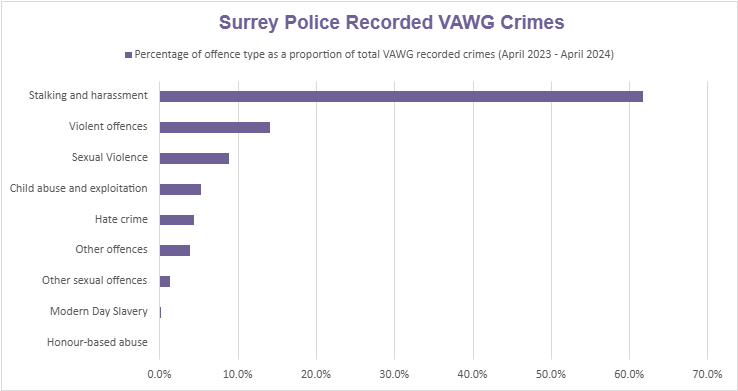
In the chart below, an indication of the percentage of occurrence of each type of VAWG crimes is provided against the yearly total.
For a detailed breakdown of the data and definitions of offence categories, please see in the Appendix.
Key Findings
Harassment (61.7%) – The most commonly recorded offence, including intentional harassment, stalking, malicious communication, and breaches of restraining orders or injunctions. Many victims experience repeat offences.
| These findings reflect our qualitative research survey results as the most common offence, with 62% of respondents being made to feel unsafe in a public place, 47% experiencing harassment, and 44% experiencing sexual harassment. Furthermore, 25% reported witnessing sexual harassment very/frequently. |
Between August 2023 and August 2024, the Victim Witness and Care Unit (VWCU) supported 62 victims of stalking. At the time of this assessment, data on the gender of victims and perpetrators was unavailable. There is no current waiting list for VWCU support.
“I’ve been flashed at before now, threatening behaviour, harassment on tubes and stuff. Yeah, by men sort of leaning over me inappropriately and stuff.”
“There’s been times where like I’ve been in like a club and men have grabbed my arse or something like that and you turn around and then they get angry at you because you’ve obviously not wanted that.”
|
Low reporting and low charge conversion rates for rape
Rape remains widely under-reported, with estimates suggesting that only 22% of rapes are reported to the Police each year. In Surrey, it is estimated that 2,824 rapes and attempted rapes occur annually involving individuals aged 16 and over. However, only 614 cases were reported to police. The charge conversion rate is extremely low, with just 3.7% of all reported rapes (across all ages) resulting in a charge decision. While conviction rates are relatively high after charges are filed, ultimately, only 2.3% of recorded rape cases lead to a conviction. |
“As someone who has been a victim of varying degrees of SA [sexual assault]/rape on numerous occasions, I know the statistics are so grim that it is almost pointless to report as VAWG is basically legal.”
Violent offences (14.2%) – Includes Grievous Bodily Harm (‘GBH’), non-fatal strangulation, suffocation, assault, wounding, the use of corrosive substances, and administering poison or substances with intent to harm.
Sexual Violence (8.8%) – Covers rape, attempted rape (females aged 16+), sexual activity without consent, and sexual assaults (with or without penetration).
Other Sexual Offences (1.4%) – Includes inciting sexual activity without consent, exposure, voyeurism, upskirting, and sharing or threatening to share intimate images to cause distress or humiliation. When combined with serious sexual offences, sexual offences account for 10.3% of all recorded VAWG-related crimes.
While not strictly categorised as VAWG, child abuse, child sexual exploitation, and rape of a child have been included in this analysis and represent 5.3% of VAWG recorded offences in Surrey. Many of these crimes involve young girls and women, often perpetrated by family members, siblings, or acquaintances. Due to the nature of these offences, many reports refer to historic incidents.
|
Between August 2023 and July 2024, Sexual Trauma Assessment Recovery and Support (‘STARS’) received: – 117 referrals for their Children & Young People’s Independent Sexual Violence Advisor (‘CISVA’) service, of which 95 were for females and 22 for males. – 22 referrals for their Independent Sexual Violence Advisor (‘ISVA’) service for 18–25-year-olds, including 21 females and a non-binary survivor. |
Recorded Rapes Against Children: Decline in Surrey
In 2022/23, the Home Office reported a 42% decrease in recorded rapes against children in Surrey compared to 2017/18. However, it is unclear whether this drop reflects a genuine decline or changes in National Society for the Prevention of Cruelty to Children (‘NSPCC’) reporting practices for non-recent offences. Nationally, recorded child sexual offences more than doubled between 2012/13 and 2016/18, rising from 17.4 to 41.3 per 10,000 children. Surrey police noted a decline in reaching young female victims, particularly those that are subject to sexual exploitation, they stated this reflects a national decline in reports.
| Change in Recorded Rapes Against Children by Police force area | 2017/18 | 2022/23 | Percentage change 2017/18 to 2022/23 |
|---|---|---|---|
| Hampshire | 685 | 496 | -28% |
| Kent | 731 | 538 | -26% |
| Surrey | 285 | 164 | -42% |
| Sussex | 408 | 330 | -19% |
| Thames Valley | 577 | 506 | -12% |
| Regional total | 2,686 | 2,034 | -24% |
| England and Wales | 18,413 | 15,062 | –18% |
Hate Crime in VAWG Offences
Of all recorded VAWG offences in Surrey, 4.4% were flagged as hate crimes, with race-related hate crimes being the most prevalent.
A single offence may have multiple hate crime flags applied.
| Hate crime category | Number of offences | Proportion of all VAWG offences |
|---|---|---|
| Race | 467 | 5.1% |
| Disability | 96 | 1.0% |
| Sexual orientation | 70 | 0.8% |
| Gender identity | 44 | 0.5% |
| Overall | 682 | 7.4% |
Modern Slavery: a hidden crime
Modern slavery is heavily under-reported due to its hidden nature. Surrey receives 200–300 reports annually, covering offences such as:
- Sexual exploitation
- Domestic servitude
- Criminal exploitation
- Labour exploitation
Industries linked to modern slavery include hand car washes, construction sites, agriculture, nail bars, domestic service, sexual services, fast food, hospitality, and private care sectors. Modern slavery offences accounted for just 0.2% of recorded crimes in Surrey, but community awareness and reporting remain crucial to identifying and addressing these cases.
Honour-based abuse is under-reported
Honour-based abuse occurs in Surrey but remains significantly under-reported. It accounts for 0.1% of recorded offences, including:
- Female genital mutilation
- Forced marriage
Stalking, actual bodily harm, threats to kill, and sexual assault, which are often linked to honour-based abuse.
Perpetrators and survivors’ characteristics
VAWG is deeply rooted in gender inequality, reinforced by various intersecting factors that contribute to its normalisation. These include male entitlement, inadequate criminal justice responses, ‘honour’ codes, discrimination, and media-driven depictions of violence. Gender inequality also intersects with broader structural inequalities, such as age, gender identity, sexual orientation, ethnicity, culture, and disability, shaping the lived experiences of women and girls.
Research consistently shows that victims and survivors from marginalised communities are less likely to seek police support, despite experiencing higher rates of gender-based violence. Barriers to reporting include fear of discrimination from services and inadequate responses to their specific communication needs.
For interventions to be effective, they must be tailored to the local context, considering population demographics and community needs.
Gender and sexuality
While VAWG refers to acts of violence that disproportionately affect women and girls, it is important to recognise that such violence can also be experienced by people of all genders. For example, men and boys can be victims of domestic abuse, sexual violence, and coercive control, though these are often underreported due to stigma. LGBTQIA+ individuals, particularly trans and non-binary people, may also experience gender-based violence that is rooted in misogyny, homophobia, or transphobia.
However, the term VAWG highlights the structural and systemic nature of violence that is overwhelmingly directed at women and girls by men, reflecting broader patterns of gender inequality and power imbalance. Acknowledging this does not exclude others’ experiences but ensures targeted action where the greatest harm and societal impact are concentrated, while still allowing space for inclusive, trauma-informed support for all survivors (Crown Prosecution Service).
Gender identity refers to a person’s internal sense of their gender, which may or may not align with their sex registered at birth. The 2021 Office for National Statistics (‘ONS’) Census, the first to include gender identity questions—revealed that in Surrey (Census 2021):
- 94.9% of respondents stated their gender identity matched their sex at birth.
- 0.37% answered ‘No’. Among them:
- 0.08% identified as trans men
- 0.08% as trans women
- 0.05% as non-binary
- 0.03% wrote in a different gender identity
- 0.14% did not specify.
Regarding sexual orientation, among Surrey residents aged 16 and over (Census 2021):
- 91.78% identified as straight or heterosexual.
- 1.17% as gay or lesbian.
- 1.05% as bisexual.
- 0.08% as pansexual.
- 0.05% as asexual.
- 0.02% as queer.
- 0.1% selected ‘all other sexual orientations’.
- 6.8% did not answer.
Although Surrey reports lower LGBTQIA+ representation compared to national statistics, the available data for survivors and perpetrators suggests figures are even lower than expected.
Survivor and Support Service Data
“Accessing support changed my life. I have gone on to work with the NHS to produce resources to help children and parents/carers who experience CSA”
The majority of survey respondents had accessed domestic abuse services. However, professionals noted that while survivors may initially seek support for domestic abuse, this often reveals a wider range of challenges. Most domestic abuse survivors were also found to have experienced multiple forms of VAWG, highlighting the interconnected nature of these harms.
The Sexual Assault Referral Centre (‘SARC’) provides immediate medical care, forensic examinations, crisis support, and referrals to ongoing services for survivors of sexual violence.
Under-18 Cases:
- Nearly 600 children and young people Under 18 accessed SARC services in 2022-23, making up over a third of recorded rapes in Surrey.
- The vast majority were female (77%), followed by male survivors (22%), with a very small number identifying as non-binary (0.2%).
Adult Cases:
- Over 300 adults accessed SARC services in 2022-2023.
- Most were female (85%), with a smaller proportion of male survivors (14%) and a small number of cases involved non-binary individuals or those who self-described their gender identity (2%).
The data suggests that women and girls continue to be disproportionately affected, though services are also accessed by male and non-binary survivors.
Rape and Sexual Abuse Support Centre (‘RASASC’) provides specialist one-to-one counselling for adults who experienced sexual harm. Most adults receiving specialist counselling in 2023 were female (85%), with a small but increasing number of non-binary survivors (3%) compared to the previous year.
“[I] accessed support through RASASC – long term counselling which was absolutely brilliant… but I had to wait 10 months on their waiting list which was really hard. I’ve tried to access counselling through NHS but this is Cognitive Behavioural Therapy-based which I personally find does not help when dealing with trauma.”
Streetlight UK specialises in supporting women affected by sexual exploitation, including those involved in survival sex, the commercial sex industry, or experiencing coercion and trafficking. Their services include outreach, crisis intervention, emotional support, and practical assistance with housing, employment, and legal matters. They engaged with over 2,000 women during the year 2023-24, providing direct support to more than 100. Between January and June 2024, most service users who disclosed their sexual orientation identified as bisexual, followed by heterosexual women. No data was available for lesbian women, highlighting potential gaps in data collection and representation.
LGBTQIA+ Communities and the Risk of Violence
National and international research highlights that LGBTQIA+ individuals face disproportionately high rates of sexual violence, hate crimes, and other forms of abuse. These risks increase when combined with other intersecting factors such as race, ethnicity, disability, and health status. Anecdotal evidence also suggests that LGBTQIA+ survivors often feel unsupported and uncertain about where to seek help following violence. This underscores the urgent need for inclusive, accessible, and specialised support services.
Age
Surrey’s population has increased at a slower pace compared to the rest of England, reaching 1,203,108 people in 2021, a 6.2% increase compared to the 2011 Census. It is an ageing population, with the largest cohort being the 45-54 age group. (Surrey-i 2023)
Perpetrators
According to Surrey Police (2023–2024), nearly one in five identified perpetrators of VAWG offences were aged 35–44, followed by those aged 24–34. Notably, the proportion of under 18 suspects is remarkably high, aligning with national trends indicating that both victims and perpetrators of VAWG are getting younger (2024, p. 45).
Offender profiles vary by offence type. For serious sexual offences, the largest suspect group is under 18 (22%), followed by 18–24-year-olds (18%) and 35–44-year-olds (18%).
|
Assessment Consultant Therapy (A.C.T.) For more information on this service is, see the Surrey VAWG Services’ section. Between August 2023 and August 2024, A.C.T. received 113 named enquiries. The majority (83.2%) were for male children, with most (102) aged over eight. More than two-thirds (74.3%) were from a white background. A.C.T. has seen a decline in enquiries in recent years and currently has no waitlist. This reduction is attributed to A.C.T.’s training for schools, which enhances staff skills in managing low-level concerns and making appropriate referrals. Key statistics |
Between April 2023 and 2024, 11% of VAWG offenders were linked to offences against multiple women, primarily non-intimate partners, including associates, neighbours, and strangers.
Involvement in non-VAWG criminality
The NPCC Strategic Risk Assessment (2024) highlights that some VAWG offenders are also involved in non-VAWG criminality, a finding reinforced by the Operation Soteria Bluestone report. In Surrey, between 41.4% and 58.8% of offenders were linked to multiple offences across various crime types.
Survivors
The victim profile closely mirrors that of perpetrators, with the highest number of VAWG victims in the 35–44 age group, followed by 25–34. However, age distribution varies by offence type and does not necessarily reflect the overall age structure of women and girls in Surrey.
- Harassment: Predominantly 35–44.
- Violence with injury: Most common among 25–34 and 35–44.
- Sexual offences: Primarily 11–20, with under-18s accounting for 35% of all reported incidents.
- Child exploitation: Mainly affects 15–18-year-olds.
Safeguarding professionals noted more of 19–24-year-old cohorts were reporting their experiences; they inferred that this is due to increased media interest and the #metoo movement.
|
Rape and Sexual Abuse Support Centre (RASASC) In the financial year 2023/24, RASASC supported victims/survivors across various age groups: – 25% were aged 18–34. – 16.5% were aged 35–54. – 4.76% were aged 13–17. – 3.86% were aged 55–74. – 0.26% were aged 75 or over. – Nearly half (49.4%) did not disclose their age. Between January and June 2024, the largest age group accessing Streetlight UK services was 22–30, followed by 31–40. Additionally, 13 women aged 51+ and 54 women aged 18–21 sought support. |
Ethnicity
In 2021, three-quarters of Surrey residents identified as White British, with an additional 8.9% identifying as ‘White Other’. In total, 14.5% of residents identified as non-White, with the largest non-White group being Asian (7.7% of the total population), followed by those of mixed or multiple ethnicities (3.4%) and Black residents (1.7%).
Surrey’s ethnic diversity has increased over time. By 2021, 17.9% of residents were born outside the UK—an increase of 26% since 2011. The most common countries of birth for foreign-born residents were India, South Africa, and Poland, with growth particularly evident in Surrey’s towns (Surrey-i).
Gypsy, Roma, and Traveller (GRT) women and girls are among the most socially excluded groups in Britain, facing higher rates of ill health, lower educational attainment (by settled community measures), and increased poverty. They form Surrey’s largest ethnic minority group, with 2,680 residents identifying as Gypsy or Irish Traveller and 1,675 as Roma. The Census recorded a higher rate of Gypsy or Irish Travellers in Surrey (2.2 per 1,000 residents) compared to England (1.2), while the proportion of Roma residents was lower (1.4 per 1,000 in Surrey vs. 1.8 in England).
Perpetrators
Ethnicity is unknown or unrecorded for one in five records. Consistent with Surrey’s population statistics, 67% of identified VAWG offences are linked to White suspects, followed by 5% Black and 4% Asian perpetrators.
Survivors
Ethnicity is unknown or unrecorded for one in three survivor records, largely due to inconsistencies in data collection. Among survivors whose ethnicity is recorded, 59% are White, while Black, Asian, and other ethnic minority communities account for just 8.4%, indicating under-representation in VAWG reporting in Surrey.
| Between January and June 2024, most women accessing Streetlight UK services identified as White or Other White, followed by South American, Latina, and White British. The least engaged ethnic groups were Black, Asian, and Mixed. |
Nationally, capturing accurate VAWG data remains a challenge, and Surrey’s experience reflects this issue.
Spaces of VAWG
VAWG occurs across all settings, from private life to public spaces, education, and online platforms. This section presents findings on VAWG in Surrey beyond police-reported incidents, incorporating insights from other public services, including Children’s Social Services.
Other public services
Children social services
Key Findings
- Girls aged 10-14 are the most affected by adult-on-child sexual abuse, child sexual exploitation, and child-on-child sexual abuse.
- Inaccuracies were identified in the recording of female genital mutilation, along with a recording gap for so-called ‘honour’-based abuse.
- Children’s Services in Surrey lack specific VAWG policies, making it challenging to assess the full impact of gendered abuse and the safeguarding response.
Surrey Children’s Social Care and the Family Safeguarding Model
Surrey has adopted the Family Safeguarding Model, integrating professionals from substance use, mental health, and domestic abuse services into a multidisciplinary team. Social workers operate within a multi-agency framework, referring cases to Surrey’s community specialist support services where appropriate. Specialist social care teams exist for looked-after children, children with disabilities, and adolescents.
|
Contacts to Social Care concerning girls (April 2023 – March 2024) See definition of ‘contact’ in the Glossary. Child Sexual Exploitation (CSE): Sexual Abuse (Adult-on-Child): Sexual Abuse (Child-on-Child): Female Genital Mutilation (FGM): 13 cases recorded. Children & Families assessments of girls (April 2023 – March 2024) Child Sexual Exploitation (CSE): Sexual Abuse (Adult-on-Child): Sexual Abuse (Child-on-Child): These findings highlight critical gaps in VAWG-specific policies within children’s services and reinforce the need for improved recording and safeguarding responses to gendered forms of abuse. |
In education
Understanding how VAWG plays out in schools has been challenging, mainly because the statutory data schools submit does not include gender information. As a result, it is difficult to identify who is most affected or responsible for incidents.
Despite this gap, survey findings suggest that many girls feel unsafe after dark and often experience inappropriate or unwanted behaviour. Harassment and discrimination appear to be common in school environments and, at times, treated as normal.
Safeguarding professionals have also raised concerns about a growing number of cases, and increased discussion, around non-fatal strangulation in both children’s services and school settings. Reporting often depends on whether this behaviour is recognised as a serious offence, and there are troubling signs that it may be becoming normalised among young people.
This assessment also shows that most sexual offences involve those under 18, both as victims and as those causing harm. This highlights the urgent need for schools to improve how they collect and report data, including gender and other demographic characteristics, to better understand and respond to the risks and needs of students.
Although national guidance exists, its implementation is left to individual schools. Without a consistent, gender-informed approach across the system, it remains difficult to track patterns, intervene early, support those affected, and ensure reliable reporting of VAWG in educational settings.
Statutory Termly Data Collection in Schools
Schools are required to report on a range of safeguarding concerns linked to VAWG. These include referrals for honour-based abuse, forced marriage, female genital mutilation (FGM), child sexual and criminal exploitation, serious youth violence, sexual violence and harassment between students, and allegations against staff.
Key national guidance, including Keeping Children Safe in Education, Exclusion Guidance (Department for Education), and Ofsted’s work on Harmful Sexual Behaviour and Harassment in Schools, does not require gender-specific reporting. As a result, the termly data collected does not break incidents down by gender or other key demographic factors.
While schools may collect demographic details on those involved in incidents, this information is not routinely linked to the data reported. This limits the ability to understand gendered patterns of harm and reduces the effectiveness of targeted interventions.
Below is a table presenting the termly data collection for the 2023–2024 academic year across key VAWG-related categories.
| Reporting data | Academic year 2023-2024 |
|---|---|
| Female Genital Mutilation | <5 |
| Forced Marriage and Honour-based abuse | <5 |
| Risk of / vulnerable to abuse and/or harm | 29, 224 |
| Children Single point of Contact (C-SPA) Contacts | 2, 886 |
| CCE, CSE & Trafficking | 85 |
| Youth Violence | 145 |
| Sexual violence and Harassment | 1,555 |
| Hate Crime | 1,857 |
| Allegations against adults | 555 |
Health, wellbeing, and inclusion Surveys
Several surveys commissioned by Surrey County Council and the Schools Alliance for Excellence assess student health and wellbeing across Surrey. While they do not include VAWG-specific questions, they provide valuable insight into gender-based disparities in wellbeing, safety, and exposure to harmful content.
Key findings from the Surrey County Council’s Health-Related Behaviour Survey (2022):
- Girls are less likely to report being happy with their life.
- Girls experience higher levels of worry across various issues.
- Girls are more likely to feel bullied due to their appearance.
- Female, trans, and single-parent students report feeling less safe going out after dark, a decline from the 2017 survey.
- Fewer students feel they have a trusted adult to talk to.
- More students are exposed to upsetting online content, including material intended for adults.
Findings from the Schools Alliance for Excellence’s Belonging and Inclusion Survey (2022):
- 61.7% of boys reported feeling comfortable being their authentic self, compared to only 49% of girls.
- 40.4% of girls and women reported experiencing inappropriate behaviour and language on a weekly basis.
- Only 29.3% of girls self-disclosed experiencing harassment and/or discrimination, suggesting potential gaps in students’ understanding of these behaviours or a normalisation of abuse.
These findings highlight the need for a more gender-responsive approach to student wellbeing, with a focus on safety, mental health, and awareness of abusive behaviours.
Adult social services
Certain forms of abuse, such as physical, psychological, domestic, and sexual abuse and exploitation, disproportionately affect females.
Although Adult Social Care is a member of the VAWG Partnership and has expressed a commitment to addressing violence against women and girls, it currently lacks dedicated policies or data monitoring systems specific to VAWG. This absence makes it difficult to build a clear understanding of how VAWG affects adult social care users and limits the service’s ability to develop an effective safeguarding response that addresses gendered risks of harm.
Completed Section 42 Safeguarding Enquiries in 2023/24
See definition of ‘Adult Social Care’s Section 42 Enquiry’ in the Glossary
In 2023/24, Surrey County Council completed 11,556 Section 42 Safeguarding Enquiries, with 60% of these enquiries involving females. Please note that a single Section 42 enquiry may record multiple types of risk. The tables below outline the volume of risk types reported, broken down by gender.
| Type of Risk | Female | Male | Total |
|---|---|---|---|
| Neglect | 59% | 41% | 6,949 |
| Physical | 61% | 39% | 3,380 |
| Organisational | 58% | 42% | 2,896 |
| Psychological | 66% | 34% | 2,432 |
| Financial | 58% | 42% | 1,610 |
| Domestic Abuse | 77% | 23% | 1,368 |
| Self-neglect | 56% | 44% | 488 |
| Sexual | 80% | 20% | 445 |
| Discriminatory | 50% | 50% | 78 |
| Sexual Exploitation | 70% | 30% | 61 |
| Modern Slavery | 38% | 62% | 13 |
Health settings
In Surrey, life expectancy, healthy life expectancy, and disability-free life expectancy are all higher than the England and South-East averages. Women in Surrey, on average, live longer than men, with a life expectancy at birth of almost 85 years compared to 81 for men. Additionally, women in Surrey spend a greater proportion of their lives in good health. This differs from the national trend, where, according to Office for National Statistics data, the years lived with disability increased more for women (6%) than men (4%) between 2015-17 and 2018-20 (Surrey-i).
During the research phase for this needs assessment, several challenges were identified. One of the key difficulties is that health is a vast and complex area in Surrey, involving numerous agencies, providers, and areas of focus. For this analysis, we chose to focus on data from Surrey hospitals, particularly Accident and Emergency (‘A&E’) activity and unplanned hospital admissions.
Another challenge is that the categorisation and description of cases tend to centre on the physical presentation of the patient. As a result, the underlying causes of these presentations, such as violence against women and girls, are not always immediately apparent, making identification more difficult.
Key notes on the available data, along with an overview of relevant definitions, are provided in Appendix.
A&E Activity shows an even split between male and female patients.
Between January 2022 and October 2024, a total of 785 cases of A&E activity recorded ‘physical aggression’ and ‘victim of sexual aggression’ diagnosis codes.
| Under 25 | M | F | % of females | Over 25 | M | M | % of females |
|---|---|---|---|---|---|---|---|
| 2022 | 41 | 47 | 53.4 | 2022 | 61 | 77 | 55.8 |
| 2023 | 63 | 53 | 45.7 | 2023 | 101 | 81 | 44.5 |
| 2024 | 43 | 51 | 54.3 | 2024 | 94 | 73 | 43.7 |
- Most patients are over 25 years of age, and the gender split is, on average, only slightly higher for females.
- The districts with the highest number of cases involving female residents in this group in 2024 are Guildford (for 25 and under), and Spelthorne (for those aged over 25).
Unplanned hospital admissions
Between January 2022 and October 2024, a total of 557 patients presented in Surrey hospitals for cases of assault.
| Under 25 | M | F | % of females | Over 25 | M | F | % of females |
|---|---|---|---|---|---|---|---|
| 2022 | 64 | 8 | 11.1 | 2022 | 111 | 32 | 22.4 |
| 2023 | 61 | 8 | 11.6 | 2023 | 76 | 30 | 28.3 |
| 2024 | 49 | 13 | 21.0 | 2024 | 79 | 26 | 24.8 |
- Most cases involved male patients. On average, females were the 14.6% for patients under 25, and 25% for those over 25.
- More than 2 out of 3 of the female patients were 25 years and older.
- The districts with the highest number of cases involving female residents in this group in 2024 are Guilford, and Reigate and Banstead (for patients under 25 years of age), and Runnymede (for those over 25).
Female Genital Mutilation (‘FGM’)
Surrey Heartlands reported that there have been no direct admissions for FGM as the primary diagnosis (i.e., the main condition responsible for the patient’s admission). However, since April 2019, there have been 9 emergency admissions where the patient had a recorded history of FGM. These admissions are related to unplanned care and emergency cases only. In addition, there have been several non-emergency admissions, primarily maternity-related, where the patient has a prior history of FGM.
This indicates that while FGM is not typically the immediate cause of emergency admissions in Surrey, there is a notable presence of patients with a history of FGM seeking unplanned care, particularly in emergency situations. The data also suggests that the impact of FGM is present in maternity-related non-emergency admissions, which may imply that women with a history of FGM are accessing care for pregnancy-related or other health issues.
Alcohol was a factor in sexual offences
Hospital admissions for alcohol misuse in Surrey are slightly below the England average, except for Spelthorne and Guildford. Alcohol has been a factor in several sexual offences, as outlined in the table below. However, the data does not specify whether alcohol was involved with the perpetrator, the victim, or both.
| Offence description | Proportion of each offence recorded as ‘alcohol-related’ |
|---|---|
| Exposure and voyeurism | 8.4% |
| Causing sexual activity without consent | 8.9% |
| Rape of a female child under 16 | 9.3% |
| Sexual assault on a male aged 13 and over | 13.3% |
| Sexual assault on a female aged 13 and over | 14.9% |
| Rape of a male aged 16 and over | 17.2% |
| Rape of a female aged 16 and over | 18.7% |
| Other sexual offences | 23.1% |
Sex work and Opiate and Crack Use (‘OCU’)
There is a strong correlation between opiate and crack use (OCU) and commercial sex work.
The estimated rate of OCUs in the Surrey police force area is 5.0 per 1,000 population, which is notably lower than the England average (9.5 per 1,000) and other Southeast police force areas (6.6 per 1,000). Despite Surrey’s relatively low community prevalence, the proportion of individuals with likely substance misuse issues attending the Sexual Assault Referral Centre (SARC) is also low.
In 2022-23, 63,025 people in Surrey accessed NHS-funded secondary mental health, learning disabilities, and autism services. Of these, 53% were female and 44% were male, though this varies by age group. Males make up the largest proportion in children under 11, while girls and women are particularly prevalent in the teenage years and in their 30s.
For more information on specific areas, please refer to the relevant Joint Strategic Needs Assessment (‘JSNA’) chapters:
| Learning Disabilities | Emotional and Mental Wellbeing |
| Additional Needs and Disabilities | Substance misuse |
Prison settings
Surrey’s unique position within the UK includes having multiple women’s prisons, with five prisons in total, three of which are dedicated to women. As a result, Surrey has a larger women’s prison population compared to the national average.
This has emerged as a key gap in knowledge within Surrey, and it is recommended that the VAWG Partnership consider including prisons as stakeholders in future workstreams.
Why is this relevant?
- Research from the charity Women in Prison highlights that 79% of the women who use their services have experienced domestic violence and/or sexual abuse during their lives.
- Although women represent fewer than 5% of the total prison population, they are often incarcerated for non-violent, low-level offences, typically sentenced to shorter prison terms compared to men.
- Studies indicate that individuals residing in prison are at higher risk of sexual assault but may hesitate to report these incidents. Nevertheless, reports of sexual assaults in prisons are on the rise. According to the HMIP annual report, 2% of women prisoners reported sexual assaults by other prisoners, while another 2% reported assaults by staff members.
- Female offenders are among the most vulnerable in society, with many having faced mental health issues, substance misuse, homelessness, and a history of abuse and trauma.
The Ministry of Justice’s 2018 Female Offender Strategy acknowledges these challenges, aiming to reduce the number of women entering the criminal justice system, cut down on the use of short sentences, and ensure that more women are managed successfully within the community, while improving conditions for those in custody.
Considering this context, it is estimated that approximately 39 women in Surrey’s prisons may experience assault annually.
Public spaces
Most VAWG offences occur in and around town centres, with Guildford borough reporting the highest number of rapes. However, this assessment identified a gap in understanding seasonal patterns, times of day, and place-based VAWG perpetration. Offences occurring between strangers in public spaces are often opportunistic and typically involve incidents of public fear, sexual assault, or violence resulting in injury.
When five or more suspects are involved, these offences are often linked to public space crimes such as harassment and violence with injury, and several such cases were reported between April 2023 and 2024. The highest incidence of violence with injury offences occurs in Guildford, Reigate & Banstead, and Spelthorne, especially around town centres. Guildford remains the borough with the highest number of reported rapes.
Call It Out Survey: Public perception of Surrey
The Surrey Police Performance & Consultation Unit conducted the Call It Out Survey between 12th April and 10th May 2021, receiving 5,427 responses from women in Surrey regarding their feelings of safety and personal experiences.
A key finding was that the primary reason women did not report VAWG incidents was the belief that the police would be unable to take action or would not take them seriously. Additionally, a lack of understanding about what constitutes a crime (such as wolf-whistling, on-street harassment, and inappropriate behaviour) further discouraged reporting.
These responses highlight the need for improved public awareness of VAWG, as well as increased trust and confidence in the police to handle and act upon VAWG-related crime reports. The survey also pointed to a tendency for some women to not report incidents due to the perception that certain forms of VAWG are considered acceptable behaviours.
Online platforms
VAWG in online spaces should be viewed as part of a broader continuum of violence, rather than a separate “virtual” issue. This form of violence is deeply interconnected with offline violence, both arising from and perpetuating various forms of harm in the physical world.
This assessment highlights a significant gap in data and understanding regarding the perpetration of VAWG in online environments. Services currently rely on national data to guide their approach, as Surrey-specific data on online VAWG offences is scarce.
Surrey Police’s ability to report on online VAWG crimes is limited by challenges such as unreliable flagging systems, the interchangeable use of terminology, and the complex, cross-cutting nature of these offences. This makes it difficult to capture accurate and comprehensive data on online VAWG incidents in the region.
Barriers to reporting and accessing services
A significant barrier to reporting public space VAWG offences is the perception that women believe they will not be taken seriously by the police, leading to a lack of reporting.
“…because police does not take these things seriously and will not take any action.”
When harm goes unrecognised: findings from Solutions Research
Survey participants commonly shared that contacting the police had not occurred to them at the time of the incident. This was often because they had not yet fully acknowledged, understood, or identified what had happened to them. This theme was particularly strong in conversations with young women in their early twenties reflecting on experiences from their teenage years.
Professionals interviewed also emphasised that a lack of awareness about what constitutes VAWG contributes to underreporting. According to Solutions Research, this gap in understanding is present across all age groups.
“As a younger teen you don’t realise how bad they are. It’s only when you look back you realise how bad it was.”
“Never crossed my mind to contact the police… if I had felt scared, at risk of physical harm then I would contact them. Or if the threats had continued or if he had stalked me for longer.”
“It’s just how things are”: the normalisation of experiences
A key theme linked to the difficulty in recognising harmful experiences was the extent to which such behaviours are normalised for women and girls. Survey participants described a sense that certain experiences should be ignored or tolerated, with behaviours often seen as part of everyday life rather than something requiring attention. This included situations such as harassment, being followed, everyday sexism, and controlling behaviour in relationships. Professionals echoed this in workshops, noting that women and girls often do not identify as victims. They also highlighted how social media can reinforce this normalisation, creating constant exposure and opportunities for contact and control.
“I’ll say it like so many times, but the normality, I don’t know if that’s the word, the normalcy. The situations aren’t right at all. But I think all women have grown so accommodating to it and it shouldn’t be.”
“If you were in a post office or like a shop, but if someone did that, put that hand under… I think you would report it straight away. But because it’s in a nightclub, it kind of becomes normalised that kind of behaviour and it shouldn’t be.”
Fear, doubt, and silence: why many don’t report
A significant barrier to reporting VAWG offences was the internal questioning shared by participants: Will I be believed? What can they actually do? Many felt that without a physical component to the experience, police action was unlikely. Professionals echoed this, highlighting a general lack of understanding about police powers and what a ‘good response’ should look like. Concerns were also raised about safety and trust in engaging with police, particularly among older women and those from minoritised ethnic communities.
“But often, sometimes it’s difficult to report those things when it’s almost a one off [that] happens. And then, you know, I’ve heard it’s kind of people question what the police can do. Will they be able to track that person down?”
“I didn’t even consider the police, what could they do about it?”
Emotional obstacles to disclosure
Shame was commonly identified by participants as a barrier to disclosing what had happened to them. Fear also emerged as a significant obstacle to reporting to the police. Both participants and professionals highlighted a range of fears that can prevent individuals from coming forward: fear of not being believed or taken seriously, fear of judgment or blame, fear of attending court, and fear of the unknown, including uncertainty about what will happen next. Some feared that authorities might inform their family, while others felt embarrassed about discussing personal or sexual experiences with strangers. Additional fears included reprisals or escalation, and the potential loss of vital support networks, particularly for older people, where family and social ties may be more deeply entrenched.
“There’s the fear of not being believed, the fear of being laughed at, the fear of that embarrassment of it all. It’s loads of things, really.”
“I think shame is a huge barrier. You don’t want people to know that this happened to you. That you weren’t able to stop it.”
Barriers of mistrust: perceptions of police and justice
Respondents reported negative experiences with their engagement with Police. Their experiences included not being believed, their experiences being minimised and not being taken seriously and victim blamed. This led to survivors reluctant, or not wanting to report in the future. In addition, media narratives around low conviction rates for rape and stalking were often pointed to as evidence of how the police and criminal justice system were not able to provide the action and support they would want. Some participants did have low confidence in the police more generally, driven by either a lack of visibility in their local area or by less positive experiences of them.
“I was working in a pub when I was physically attacked by a drink (potentially on drugs) customer. Police said perhaps pub work wasn’t for me.”
“[I was] Assaulted on public transport. I was terrified. BTP (British Transport Police) detective was sexist and discriminatory. He made excuses for the male stranger that assaulted me. Her offender was married with children and the detective felt he should not be punished as it would affect his family.”
“Decided it was important to report the man who sexually assaulted me to the police in case he did it to anyone else. I had a terrible experience with Surrey police and as a result would not report again if something happened in future.”
Further barriers from survey respondents include waiting list times and capacity of existing services, accessibility particularly regarding neurodivergence and disability, and participants did not feel like they ‘fit’ service criteria or service thresholds.
Suggested Service Improvements and challenges
Service users identified four key themes in improving VAWG services in Surrey. These are: greater awareness of available services, better signposting and a joined-up approach across organisations, increased service capacity, and access to more tailored or specific types of support.
“Better advertising of services to everyone.”
“Doctors offices should give out information; mine gave me a leaflet but the services were outdated or not applicable e.g. one turned out to be just for Londoners.”
“It was quite difficult to get into stars, an easier referral system would be helpful.”
“What specific services are there for child exploitation? I wouldn’t identify my experience as DA.”
Participants also included what they would like to see from the Police:
“Better training. Root out misogyny within the police force. Hire more women.”
“Female police officers who are well trained and empowered.”
“Sex-based women and girls supported by adult human female women – it is shameful and ridiculous that I have to even state this is required, but as it is not always the case not having this only furthers and perpetuates abuse of women and girls when they are at their most vulnerable.”
Service providers and professionals highlighted a shifting and increasingly complex landscape in supporting survivors of VAWG. They identified a growing need to address intersecting challenges in survivors’ lives, many of which are being used either as coping mechanisms or are exploited as forms of control. Key issues raised include:
- A rise in substance use, online gambling, and other behaviours used to cope with trauma or coercion.
- Increasing complexity in cases, with many survivors having experienced trauma involving multiple perpetrators and different forms of abuse.
- The withdrawal or reduction of statutory services has led VAWG providers to hold cases for longer periods, often managing needs that fall outside their traditional remit.
- Perpetrators often exploit existing vulnerabilities, such as previous involvement in the care system, substance use, or internalised victim-blaming, which need more targeted support.
- Due to high demand and limited capacity, some VAWG services are only able to respond to the immediate offences, rather than the wider context and complexity of a survivor’s life.
- Specific groups, such as sex workers, expressed a desire to exit sex work but faced barriers such as lack of food, shelter, and financial stability.
- A newly emerging area of concern is digital abuse, with professionals noting a gap in both awareness and resources to address this effectively.
These findings underline the importance of trauma-informed, holistic responses that take account of wider structural and individual vulnerabilities.
Impact of VAWG on Surrey’s Women and Girls
The impact of VAWG on individuals is significant, long lasting, and radiates into every aspect of a survivor’s life (Riger, 2002). VAWG not only impacts the survivor, but effects our social networks, our communities, and wider society. Survivors that are subject to VAWG may be impacted by, emotional and mental health needs, substance misuse, homelessness, chronic health issues, suicidal ideation, unwanted pregnancy, sexual health needs, psychological distress, physical injury. VAWG also impacts on a survivor’s capacity to form and maintain relationships, engage with their communities, maintain their education and/or work. Although VAWG is an almost universal experience for women and girls, their experiences of VAWG are not the same and are shaped by their identities, and characteristics.
Participants were invited to rate how much they agreed or disagreed with each statement, using a scale from “strongly disagree” to “strongly agree”.
The table below shows the findings from their responses.
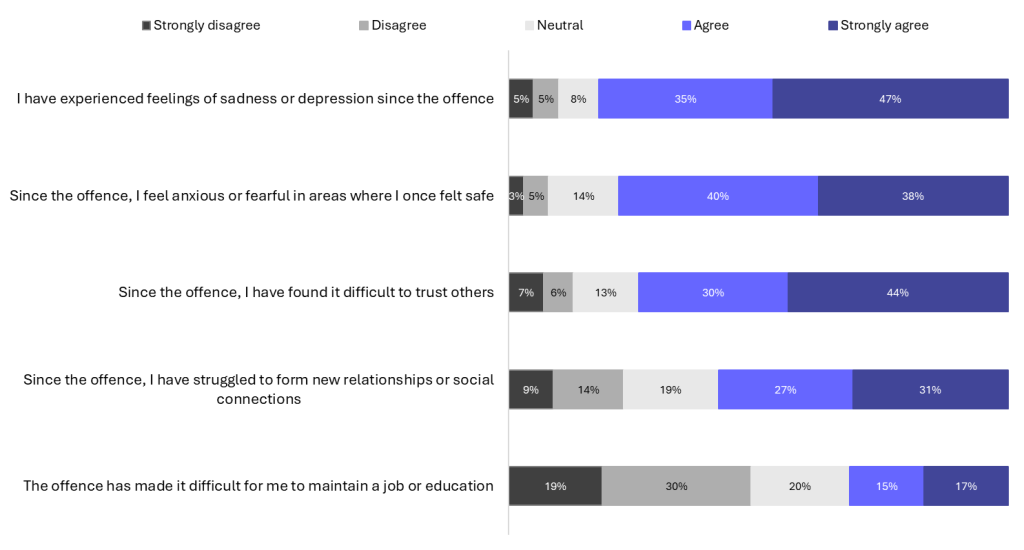
The majority of survey respondents reported feeling sad/depressed, fearful and finding it difficult to trust others after being subject to VAWG.
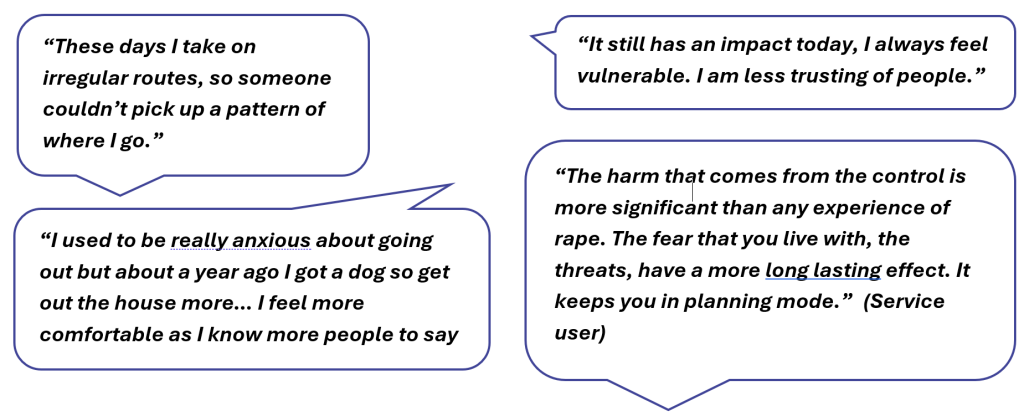
The in-depth interviews evidenced the commonality for women to reflect on adapting their behaviour with the aim of protecting themselves from future harm.
Surrey VAWG Services, Programmes and Other Initiatives
In this section, we review the services, programmes, and initiatives that Surrey has in place for the prevention of VAWG and the support of all parties involved. To ensure a comprehensive understanding of available services in Surrey, a workshop was organised in October 2024. Several agency representatives were invited to contribute information on services for:
| Prevention and training | Support for adult and children survivors of VAWG | Young people using violence | Adult perpetrators |
An overview of the available services is presented in tables. It is important to note that while national organisations play a crucial role in delivering valuable work within the community, they have not been included. The focus of this needs assessment is to identify gaps in commissioned services within the VAWG partnership.
Prevention and training
| Service | Target audience | Geography | Description | |
|---|---|---|---|---|
| Preventing VAWG and Supporting Children (‘PVSC’) Project |
In Autumn 2022, Surrey’s Police and Crime Commissioner secured nearly £1 million in Government funding to support initiatives aimed at combating violence against women and girls in the county. The funding, provided by the Home Office’s What Works Fund until March 2025, has been allocated to several projects designed to build self-confidence in young people, with the goal of enabling them to live safe and fulfilling lives. This funding has supported three key projects: the Surrey Healthy Schools’ Personal, Social, Health and Economic Education (PSHE) training creating a county-wise network of PSHE champions, the OK to Ask Campaign, and funding of VAWG prevention and engagement workers. | |||
| OK to Ask Campaign | CYP, parents | Surrey-wide | Anti-VAWG Public Behaviour Change Campaign: to support children and young people to become increasingly confident and competent in staying healthy (especially in relationships), safe and prepared for life. | |
| Surrey Healthy School Personal, Social, Health and Economic (PSHE) training | Teachers | Surrey-wide | Specialist training for teachers delivering Personal, Social, Health and Economic (PSHE) education via the Healthy Schools approach. Service partners across Surrey and 146 teachers benefitted from the training. On demand training packages and resources were produced to support the provision of high quality PSHE in schools. Alongside the training, targeted support involving specialist victim support services is offered to every school in Surrey. | |
| Operation Shield (OPSHIELD) | The project includes initiatives to identify and reduce VAWG related crimes and a knife intervention project, with funding from the Serious Violence Partnership ending in March 2025. Prevention services aimed at perpetrators include Surrey Police bespoke behavioural observation training and perpetrator support services. | |||
| Surrey Police Staff training | Surrey Police staff (overt / covert officers) in nighttime economy | Surrey-wide | Behavioural detection training of overt and covert officers to proactively identify inappropriate sexual behaviour in nighttime economy, and potential VAWG perpetrators, moving suspected perpetrators on and signposting to services such as Circles South-East (see Adult Perpetrator’s section). This also includes the identification of vulnerable people in the nighttime economy. | |
| Rape and Sexual Assault Support Centre (RASASC) Youth ISVA in schools | Mainly children and young people in Y9-Y11, but also university and colleges | Guildford and Waverley | RASASC’s Youth ISVA actively engages with schools and young people and as part of the Preventing VAWG and Supporting Children (PVSC) project. RASASC’s youth ISVA is in the process of setting up an online forum for school leadership/PHSE teams to promote the VAWG school’s package. The package will include: The concerns and needs of schools in relation to sexual harm in their school communities. An overview of the problem (data, stats, RASASC work and perspectives). An outline of how RASASC can support with this (specifically in relation to the PSHE project) | |
| x4 SDAP VAWG Workers | Teachers, children and young people and service providers, charities | Surrey-wide | As well as offering and presenting the co-produced presentations to school staff across the whole of Surrey, they also offer: Targeted group work with young people Case consultation Staff training, such as online misogyny, impacts of coercive controlling behaviours, child sexual exploitation Collaborate on collecting the voices and experiences of young people Inform & represent at public engagement days for teachers | |
| YMCA WiSE VAWG Prevention worker | Teachers, children and young people and service providers, charities | Surrey-wide | ||
| Surrey Youth Commission | Surrey Police, OPCC, Multi-agency VAWG partnership | Surrey-wide | The OPCC established a Surrey Youth Commission on Policing and Crime in partnership with charity Leaders Unlocked. Made up of young people aged between 14 and 25, it plays a lead role in ensuring our office and Surrey Police include the priorities of children and young people in policing. The Youth Commission hold meetings and consult widely with children and young people across Surrey. Following a year of research, the Commission present their findings to key stakeholders at the BIG Conversation Conference. | |
| YMCA WiSE Early Intervention worker (EIW) | All school-age children identified as ‘at risk’ of sexual exploitation by schools, youth clubs, and statutory services. | Surrey-wide | This initiative builds upon existing specialist child sexual exploitation support work that YMCA WiSE currently deliver across Surrey. The EIW provides short term trauma informed holistic support either through one-to-one brief educational interventions or peer group work. WiSE also provide consultation and training for professionals working with children and young people who are subject to sexual exploitation. | |
| Streetlight UK Outreach | Sex workers | Surrey-wide | Streetlight UK offers one-to-one support for women involved in prostitution. The service includes outreach to women working on the streets, providing care packs and promoting safety. During police operations, Streetlight UK conducts welfare checks with women known to be involved in prostitution, including sharing alerts about potentially dangerous individuals. The organisation also delivers a course titled You Choose, designed specifically for men arrested for soliciting or “curb crawling” for on-street sex. Aimed at first-time offenders, the course seeks to educate and deter future offending behaviour. | |
| Operation Make Safe | Taxi drivers and hotel staff | Surrey-wide | A police initiative aimed at raising awareness among the business sector about the early warning signs of child exploitation—both criminal and sexual. This initiative encourages individuals in sectors such as hotels, pubs, cafes, taxis, and premise licensed to sell alcohol to recognise these signs and report concerns to the Police, helping to intervene and protect vulnerable young people from harm. | |
| Taxi driver training | Taxi drivers | Surrey-wide | Private hire and hackney carriage drivers have a crucial role in safeguarding children and vulnerable individuals at risk of abuse. As part of the licensing process, all applicants are required to complete safeguarding training, designed to help them recognise the signs of potential risk. This training, mandated by all Surrey councils, is provided by the children’s charity Barnardo’s and must be completed before a license is granted. The course covers safeguarding for both adults and children at risk of sexual exploitation. | |
Support for adult and children survivors of VAWG
| Service | Target audience | Geography | Description |
|---|---|---|---|
| Rape and Sexual Assault Support Centre (RASASC) Counselling services | Survivors of sexual abuse (Young people 13+ and adults) | Surrey-wide | RASASC is an inclusive service supporting survivors of all genders aged 13 and over across Surrey who have experienced rape, sexual abuse, or unwanted sexual experiences. They offer one-to-one counselling and therapy groups to help survivors heal and rebuild their lives. |
| Surrey Fire and Rescue Service (‘SFRS’) Safe Havens |
Survivors of abuse | Specific fire stations (location not disclosed) | Several SFRS fire stations serve as safe spaces where individuals seeking shelter can find safety. Some stations have enhanced training to support survivors, developed through partnerships with outreach organisations. These locations are not publicly advertised to protect the safety and confidentiality of those who use them. |
| Sexual Assault Referral Centre (SARC) | Survivors of sexual abuse (Children, young people and adults) | Surrey-wide | A free, confidential healthcare service in Surrey offers compassionate support to people of all ages who have experienced sexual assault, including rape, at any point in their lives. The service is available 24/7, 365 days a year. |
| STARS Child Independent Sexual Violence Advisor (ISVA) | Survivors of sexual abuse (Children and young people under 25) | Surrey-wide | The ISVA provides practical help, advice, and advocacy for children and young people (up to age 25) who have been sexually assaulted or raped. The service, known as STARS, is part of Mindworks Surrey and is funded by the Office of the Police and Crime Commissioner (OPCC). |
| Streetlight UK | Women engaged in sex work | Surrey-wide | Front-line specialist support service that provides 1:1 support to women to address the physical and emotional trauma related to prostitution, sexual violence, mental health, and isolation. |
| Surrey Victim and Witness Care Unit (VWCU) | Survivors of sexual abuse (Children, young people and adults) | Surrey-wide | Surrey Police and the OPCC fund the VWCU, a specialist service that aims to help victims of crime cope and, as far as possible, recover from their experience. Advice and support are offered to every victim of crime in Surrey, for as long as they need it. |
| non-intimate stalking advocate | Surrey OPCC commission and fund a non-intimate stalking advocate within the Surrey Victim & Witness Care Unit. | ||
| SMEF Trust Project | Minoritised ethnic women, survivors of sexual abuse and violence | Surrey-wide | The Surrey Minority and Ethnic Forum delivers the Trust Project, which provides dedicated support to ethnic minority survivors of abuse. A specialist advocate helps those with no access to public funds, working closely with other agencies to ensure their needs are met. The project is commissioned by the Office of the Police and Crime Commissioner. Beyond this, the Forum also works in areas such as health, perinatal and mental health (including autism), offers English language and sports activities through the ‘Many Hands’ initiative, runs a Hate Crime panel, and supports Surrey’s faith communities. |
| YMCA WiSE project | Young people affected by exploitation (up to 25) | Surrey- wide | The WiSE project supports young people affected by exploitation by raising awareness, providing education, and empowering them. Funded by the Surrey Office of the Police and Crime Commissioner, the project includes roles such as early intervention workers and specialist advisors who support children and young people up to age 25 who have been raped, sexually assaulted, or are at risk of sexual exploitation. They offer trauma-informed casework and contribute to the Preventing Violence Against Women and Girls and Supporting Children Project, which is funded by the Home Office. |
Young people using violence
| Service | Target audience | Geography | Description |
|---|---|---|---|
| Assessment consultant therapy (ACT) | Children presenting with sexually harmful behaviours (age 8-18) | Surrey-wide | ACT stands for Assessment, Consultation, Therapy. ACT is part of the Countywide Surrey Children’s Services, established in 1995. They are a team of Forensic Psychologists, Assessment and Intervention Workers, Social Workers and Administrators who work with children and young people displaying sexually harmful behaviours. ACT offer: Consultation meetings Assessment, Intervention and moving on utilising the AIM3 framework. Post intervention support. Specialist Reviews. Parents and carers support group. |
Adult perpetrators
| Service | Target audience | Geography | Description |
|---|---|---|---|
| circles south-east
(part of Operation shield) |
Adult sex offenders, individuals in nighttime economy showing risky behaviour | Surrey-wide | Intervention for individuals at risk of engaging in sexually harmful behaviour. There will be a focus on supporting Operation Shield deployments, the intervention will be available through a referral process as agreed by Surrey Police and Circles SE. Training, Education and Empowerment for key staff working in this field. Phase one will support training for Surrey Police with phase two focusing on the Nighttime Economy and Higher Education establishments i.e. university. |
| Compulsive Obsessive Behaviour Programme (COBI) | Stalkers (with some limitations for predatory stalkers), where the relationship is non intimate. | Surrey-wide | The Surrey Steps to Change Hub offers a safe, localised space for specialist support aimed at increasing survivor safety and reducing harm from domestic abuse and stalking. As part of this service, the COBI (Change Obsessive Behaviour Intervention) programme addresses stalking behaviours through a structured, evidence-based intervention. Rooted in Dialectical Behaviour Therapy, COBI is an intensive programme delivered by trained Behaviour Change Officers. It includes a detailed assessment followed by twelve one-to-one sessions (up to 2.5 hours each), delivered either in person or remotely, depending on individual needs. |
| Circles of Support and Accountability | Adult Sex Offenders Adult perpetrators who have also been subject to sexual harm | Surrey-wide | A Circle of Support and Accountability is a group of trained and supervised volunteers working with a single sexual offender (Core Member) supporting them to integrate safely and appropriately into the community, sometimes following lengthy prison sentences. The Circle is managed by the Circle Coordinator who in turn maintains links with the relevant statutory professionals (Police, Probation, Local Authorities). Counselling Services for perpetrators who have been subject to sexual harm, projects for offenders who have personality disorder, Sexual Harm Risk Assessments, bespoke interventions. |
Positive Experiences with Services
Survivors who accessed support services frequently described feeling validated and believed, which had a powerful impact on their recovery. Feeling heard and supported helped to rebuild a sense of safety and trust.
“Being believed. Feeling safe again. Having time to come to terms and move on in life.”
“The person I spoke to was extremely validating and made me feel heard.”
In addition to emotional support, survivors appreciated the expertise of professionals and the holistic approach taken to meet their wider needs. This included assistance navigating the criminal justice system, support with education and employment, and clear signposting to other relevant services. Importantly, they also highlighted the autonomy they were given to shape their own support.
“If I mentioned something specific, she will then do all her research and look into it. And I had troubles with my college, with telling my college and my work. And she’s come straight away. Often can come in, give them a bit of training on how to deal with this situation.”
“I can contact, I’ve got her number and if I have anything, I could just give her a text or a call. And it’s like, it’s just so good.”
Gaps analysis
Prevention and training
There is a need to incorporate a VAWG-specific lens into training delivered to services that are not primarily focused on VAWG. This includes campaigning around key VAWG-related crimes such as stalking, harassment, online abuse, hate crime, and honour-based abuse.
Education
While training on VAWG is available, not all schools receive the same level of VAWG-related education. It is recommended that those schools which have not yet received external training be identified and provided with relevant materials from the OK to Ask Campaign and other training initiatives.
“Education of teenagers of both genders to teach them what constitutes violence such as emotional, sexual and physical violence and teach them how to negotiate these issues.”
There needs to be more emphasis on bystander intervention awareness and training across the VAWG Partnership and within Surrey’s communities. A growing area of practice in the UK, research by the Youth Endowment Fund has shown that such training can reduce the likelihood of participants engaging in sexual assault by 14%. Participants identified the need to teach men and boys to be an ally, and call behaviours out with peers and friends.
“A campaign targeting men, so that they support each other in saying that it’s not OK to mistreat women. Campaigns within schools, colleges and universities to educate male students regarding the same.”
Participants identified that there needs to be more education for women and girls; to identify VAWG, to address ‘normalisation’ of behaviours, awareness of specialist support before they need it, including education in workplaces.
“I believe the most important is education at all levels: schools, places of work and also for the one offering the services…”
A strong theme from participants was to focus on education for men and boys, around respect, boundaries and harmful behaviours, along with need to address ‘toxic’ masculinity, support and encourage schools to talk about these topics.
“Education of boys/young men so they understand the impact of comments made towards women and for both boys, girls, men and women to call out the low-level harassment as well as the more serious incidents.”
Building Trust
A common theme from participants was to build trust in the criminal justice system and police reporting. Responses included: training for police to improve the experience for victim-survivors (e.g. remove victim-blaming language), meaningful investigations of reports, understanding and empathy from police officers involved in cases, more prosecutions, stronger punishments (as deterrent), training for judges/magistrates/solicitors/barristers to understand VAWG in more depth.
“They weren’t trained in how to deal with something like that at all… like having a talk about how to spot victim blaming, how to stop it, how to recognise the odd behaviour. Because then I wouldn’t… have dismissed my feelings straight away.”
“Stronger punishments as a deterrent and action taken quickly to prevent escalation.”
“We need to see action and be shown we can trust law enforcement.”
Support for adult and children survivors of VAWG
Support for Survivors
- Lack of Tailored Services: There are no commissioned services specifically designed for victims of honour-based abuse or hate crime, nor for LGBTQIA+ survivors of VAWG. Participants felt that they didn’t ‘fit’ services or meet their criteria.
- Minoritised Communities: There is limited support available to women from minoritised ethnic backgrounds, with services reporting low numbers of survivors from these groups.
- Counselling Services: There are long waiting lists for counselling services for survivors of sexual abuse, indicating that demand exceeds service capacity. Participants called for access to therapy, counselling and mental health services to help them process their experiences.
“There needs to be help for the impact on your mental health. It isn’t just about making sure you are now safe, it’s to help you process what’s happened. And for some, to build a new support network.”
- Online Abuse: Reporting of online harassment, malicious messaging, and the distribution of private sexual images without consent is mainly done through the police or by contacting social networks. Given the prevalence of such abuse, particularly in schools, there is a need for more locally accessible resources to support victims and their families. Professionals identified a lack of awareness of digital and online abuse, they noted a lack of knowledge around specific offences.
- Alternative reporting routes; participants shared the need to ‘log’ their experiences without necessarily having police intervention.
“[…] like an anonymous helpline. Because obviously some people like maybe even a text, a text chat or WhatsApp chat, you know, not everyone likes to actually talk.”
Young people using violence
A significant proportion are under 18 or aged 25-34. However, outside of specific initiatives like A.C.T and the Wise Intervention worker, there are no services dedicated to challenging misogyny and harmful behaviour in extrafamilial settings. Most services currently focus on children using violence within family contexts.
Adult perpetrators
The largest age group identified for VAWG crimes is 35 to 44. Despite this, there are limited services available to adult perpetrators, such as Circles South-East and COBI. This was also reflected in findings from participant interviews, with calls for perpetrator intervention, and more resources specifically aimed at men and boys.
“Intervention programmes for perpetrators because I know a lot of women whose partners reoffend because they are not aware of how their behaviours are causing harm to women- either that or they don’t care.”
“More adverts targeting MEN and how MEN should behave. Classes in schools teaching them how to treat women, stand up for women etc to stop the root of the cause, not just support women whilst the problem continues.”
Service providers reflected on the importance of post intervention reviews, to ensure that individuals continued to use the skills and tools from the programmes. Concerns raised where social services might close the case to hand over to perpetrator programme, which can mean individuals are more likely to drop out if not being ‘monitored’ by social services.
“Just because someone has completed the course, doesn’t mean they are using the skills. It’s important there are other agencies checking in on them.”
This highlights a gap in how the VAWG partnership monitor and evaluate perpetrators desistance from using abuse and violence.
Several themes were found through conversations with professionals working on behaviour change programmes in Surrey:
- Accessibility of service provision
- Timing of intervention was found to be important, there appears to be a gap in a joined-up approach in offering support at the right time for the individual. Neurodivergence and the flexibility of an individualised approach.
- Barriers for meaningful engagement
- These include shame, guilt, denial, lack of support from loved ones, not want to face consequences.
- Holistic support
- All professionals highlighted that there was a need to support individuals with other areas of their life to enable them to engage with the intervention – sometimes this needs to happen prior to the programme to ensure they are in a stable place.
“There is a real need to stabilise their lives as that is a huge factor in reoffending.”
Prison and Post-release Support
There is a gap in information about services for those who have committed VAWG crimes and are either incarcerated or have been released. This is an issue that the VAWG Executive will need to address.
Addressing VAWG
Professionals highlighted the need to improve how victims and survivors experience support from the police, courts, and other services. This includes:
Bringing in more diverse voices: The VAWG working group and leadership structures should include people from a wider range of backgrounds, including more men and people from ethnic minority communities. Men should be encouraged to work alongside women as visible allies and active champions for change.
Tackling victim-blaming attitudes: Training should be provided for police officers, court staff, and other professionals on how to avoid language or actions that blame victims. The way professionals talk about survivors and cases matters—it shapes how others in the system treat them.
Improving the court process: Delays in the justice system can cause real harm to victim-survivors. Work is needed to reduce these delays and improve how cases are handled, including better communication and emotional support for those involved.
Reducing the number of victims dropping out: Many survivors disengage from the justice process before their case is resolved. Services should look at why this happens and make changes that help survivors feel safe, believed, and supported to stay engaged.
Appendices
Acronyms in the needs assessment
| Acronym | Full meaning |
|---|---|
| ACT | Assessment, Consultation, Therapy |
| BTP | British Transport Police |
| CNWL | Central and North West London NHS Foundation Trust |
| CSA | Child Sexual Abuse |
| CSE | Child Sexual Exploitation |
| DA | Domestic Abuse |
| DARDR | Domestic Abuse Related Death Review |
| DfE | Department for Education |
| EIW | Early Intervention Worker |
| FGM | Female Genital Mutilation |
| FM | Forced Marriage |
| HBA | Honour-based Abuse |
| IDSVA | Independent Domestic and Sexual Violence Advisor |
| ISVA | Independent Sexual Violence Advisor |
| NHS | National Health Service |
| NPCC | National Police Chiefs’ Council |
| OPCC | Office of the Police and Crime Commissioner |
| PSHE | Personal, Social, Health, and Economic (Education) |
| RASSO | Rape and Serious Sexual Offences |
| RASASC | Rape and Sexual Abuse Support Centre |
| SARC | Sexual Assault Referral Centre |
| SASP | Surrey Anti-Slavery Partnership |
| SCC | Surrey County Council |
| SHS | Surrey Healthy Schools |
| SMEF | Surrey Minority and Ethnic Forum |
| SPR | Strategic Policing Requirement |
| VWCU | Victim & Witness Care Unit |
| VAWG | Violence Against Women and Girls |
| WiSE | What is Sexual Exploitation (YMCA project) |
| YMCA | Young Men’s Christian Association |
Partnership structure
Community Safety and Prevention Board
The Community Safety and Prevention board aims to create resilient, inclusive, and safe communities in Surrey where residents are protected and supported through proactive prevention, education, and collaboration. The board fosters partnerships between local agencies, to reduce crime, disorder and anti-social behaviour, prevent harm, and ensure a sustainable environment of trust, respect, and shared responsibility. The Board has several key objectives aimed at improving the safety and well-being of residents in Surrey: leadership and accountability, data and intelligence sharing, collaboration and partnership working, early intervention and prevention, support for vulnerable groups, promoting community cohesion.
VAWG & Domestic Abuse Executive
Tackling VAWG requires a multiagency, whole system response, which in Surrey is co-ordinated through the VAWG and DA Executive Group. This includes partners from Health, Surrey Police, the Office of the Police and Crime Commissioner (OPCC), Housing, Specialist Support Services for victims and survivors, Adult Social Care, and Children’s Social Care. The Executive oversees the VAWG Working Group and subsequent workstreams.
The VAWG and DA Executive is also linked with the Serious Violence Reduction Partnership and feeds into the Adult Safeguarding partnership and the Children’s Safeguarding Partnership. The VAWG and DA Executive meets quarterly and is jointly chaired by Surrey County Council and Surrey Police.
VAWG Working Group
Surrey’s VAWG working group is co-chaired by Surrey County Council and Surrey Police, the group has operational oversight of VAWG activity across the county. The working group was created to develop these needs assessment and will evolve to oversee subsequent partnership action plans. The group consists of partners including, Police, OPCC, Surrey Fire and Rescue Service, third sector organisations, health, education, district and boroughs, child and adult safeguarding. The working group is overseen by the VAWG Executive, any risks, issues, and sign off work will be taken to the Executive board.
Anti-Slavery Partnership
Surrey’s Anti-Slavery Partnership (SASP) consists of Police, trading standards, crime stoppers, Surrey County Council, and health. This is not an exhaustive list and includes representation from NGOs and charities. The partnership is chaired by a representative from Reigate Archdeaconry Social Justice Forum (RASJF). The key aims of the partnership is to raise awareness of slavery in Surrey and provide training to professionals. SASP delivers at least one public event per annum, holds webinars for small businesses, with the associated business pledge against slavery and they attend various community forums to promote its work.
The Safer Communities Team
The Safer Communities Team in Surrey County Council consists of portfolio leads for VAWG, Domestic Abuse, Anti-Social Behaviour, Prevent (counter terrorism), Hate Crime and Community Cohesion, Serious Violence, and Domestic Abuse Related Death Reviews (‘DARDRs’), to improve the lives of Surrey’s residents to live a life free from abuse and violence. The team ensure a co-ordinated response to community safety within their subject areas across the county, in partnership with the multi-agency network. Overlaps of portfolio work are also identified to engage in joint working, and identify innovative ways improve safety within Surrey’s communities.
Adolescent Service (SCC)
The Adolescent Service brings together the Target Youth Support Service and the Safeguarding Adolescent Service to form the new Adolescent Service as well as combining our resources alongside that of systems partner, to transform how we help and protect adolescents, families and communities impacted by complex difficulties and extra-familial harm. Ensuring that children and families in Surrey can access the “right service at the right time.”
The Office of the Police and Crime Commissioner (OPCC) for Surrey
As part of their responsibilities for local policing and crime prevention strategies, Police and Crime Commissioners (PCCs) seek to improve the local response for victims and survivors of VAWG, who often require support from multiple services. PCCs can achieve this by having the right data for addressing different types of VAWG crimes, receiving funding from the Home Office, as well as through supporting public and voluntary sector provision, and creating multi-agency partnerships (NPCC Report, 2023). The OPCC has a statutory responsibility to commission victim services.
NHS Sexual Health team
Central and Northwest London NHS Foundation Trust (CNWL) Sexual Health Service is an open access sexual health service for adults in Surrey, also providing support for under 19-year-olds.
Domestic abuse enquiry is a routine part of the service, their team includes an IDSVA (Independent Domestic and Sexual Violence Advisor) that supports service users who have been subject to domestic abuse and/or sexual violence and abuse. They work closely with community and statutory multiagency networks in Surrey to safeguard children and adults and provide signposting for ongoing support where appropriate
All the services provided can be found on their website Surrey Sexual Health and Contraception | CNWL Sexual Health
Surrey Police
Since December 2021, the government recognised VAWG as a strategic national threat, with devastating and long-term impact on the public. The strategic policing requirement (SPR) in February 2023 included VAWG as one of the national threats to public safety.
Surrey Police have adopted the new Policing Violence Against Women and Girls – National Framework for Delivery 2024-2027 VAWG delivery framework incorporating the 4P strategic aims:
- Prepare: forces must have the right culture, skills and resources
- Protect: action is being taken to protect individuals, families and communities
- Pursue: perpetrators of violence are being relentlessly pursued
- Prevent: policing must work with partners as part of a whole-system approach
Surrey Police prioritise the five critical VAWG threats which will have the greatest impact as outlined in the national strategic threat and risk assessment (STRA) namely; domestic abuse, stalking and harassment, rape and serious sexual offences, child sexual abuse and exploitation and online tech-enabled VAWG.
Surrey Police is implementing the new national operating model for rape and serious sexual offences (RASSO) under Operation Soteria which is a long-term programme of change to transform how they investigate these offences taking a victim-centred, suspect-focused and context-led approach. This approach has already significantly enhanced their force RASSO outcomes. Operation Soteria principles and six pillars provide the best practice, evidence-based framework that will be implemented across other vulnerability crimes.
Surrey Police is determined to turn the tide on violence and abuse faced by women and girls. Preventing VAWG requires an enhanced coordinated partnership response, with a focus on early prevention within which we will administer our safeguarding and data sharing responsibilities to a high standard.
Surrey Police has been judged regional winner in the first National Police Chiefs’ Council (NPCC) and College of Policing’s recognition event for police officers, staff and volunteers who are working to tackle VAWG.
How VAWG is defined in Surrey
We have identified variations in organisational understanding of VAWG, arising from differences in definitions and the inclusion criteria of offences. Below are the key definitions of VAWG recognised across Surrey
VAWG is defined as gender-based violence and/or abuse that results in, or is likely to result in, physical, sexual, emotional, and/or psychological harm, distress, or suffering to women and girls, whether this occurs in public or private life. VAWG is considered a human rights violation and is recognised in Surrey as a national emergency.
Surrey Police
VAWG refers to acts of violence or abuse that disproportionately affect women and girls. It includes crimes such as rape, sexual offences, domestic abuse, stalking, honour-based abuse (including female genital mutilation, forced marriage, and honour killings), and various other offences, including those committed online.
British Transport Police
Violence Intimidation Against Women and Girls (VIAWG) encompasses all offences with a female victim, covering violence, sex offences, and public order offences.
Education
“Child on child sexual abuse” includes sexual violence such as rape, assault by penetration, sexual assault, sexual harassment, online sexual harassment, upskirting, and youth-produced sexual imagery. The Department of Education defines “Harmful Sexual Behaviour” as sexual behaviours expressed by children and young people under 18 that are developmentally inappropriate, may be harmful to themselves or others, or abusive towards another individual, whether child, young person, or adult.
Qualitative research methodology
Solutions Research is an independent research agency commissioned through the Serious Violence Reduction Fund. At the request of Surrey’s VAWG Partnership, the agency undertook primary research to explore the experiences of women and girls in Surrey who have been victims of violence against women and girls’ offences.
The aim was to identify gaps in service provision and barriers to accessing support. The research was conducted between December 2024 and March 2025.
| Planned 2 x workshops with service providers 10 x depth interviews with VAWG survivors and who are service users 6 x depth interviews with VAWG survivors not accessed services (or proxies) Online survey among women and girls across Surrey Engagement with perpetrators – online form and depth interviews |
| Primary research conducted 2 x workshops with service providers 3 x depth interviews – service users 9 x depth interviews – not accessed services 451 responses to online survey 3 x depth interviews – professionals working in behaviour change with perpetrators |
We were unable to engage directly with individuals who have perpetrated VAWG offences. The research team inferred that this may be due to evaluation fatigue following multiple engagements with services in Surrey. Additionally, concerns around self-incrimination likely contributed to the low engagement. In line with ethical considerations, no incentives were offered for participation. As a partial alternative, the research team engaged with practitioners who work directly with perpetrators to gather relevant insights.
We also faced challenges in securing the intended number of interviews with service users. Some services raised concerns about the trauma-informed nature of the research process and expressed reluctance to risk re-traumatising survivors.
Sample
| Non-service users | Service users | Professionals |
|---|---|---|
| – Aged 21-60. – Mix of ethnic backgrounds including White British, Arab, African, White Other. – Included 2 x disabled people. – None had reported to police or engaged with any VAWG services. – Free-found recruitment using specialist recruitment agency. |
– Had engaged with VAWG services (not all had reported to police). – An online form was distributed by SCC partner organisations who support victims of VAWG offences. Individuals could express interest to participate to ensure anonymity and informed consent. – 11 expressions of interest were received (mainly from individuals with DA experiences). |
– Included professionals working in organisations involved in the Surrey VAWG Partnership (e.g. SCC, OPCC, DA services, Housing, Safeguarding, sexual health). – Professionals worked in a mix of frontline and strategic roles. |
Online survey respondent’s demographic
Audience was for people that identified as women and girls who live in Surrey, aged 16 and over. 99% of were female and 98% identified as the same sex as they were registered at birth, 1% preferred not to share their sex and gender. Those that identified as Males, and respondents aged 15 and under were screened out.
Table: Age Breakdown of Respondents (in 10-Year Intervals)
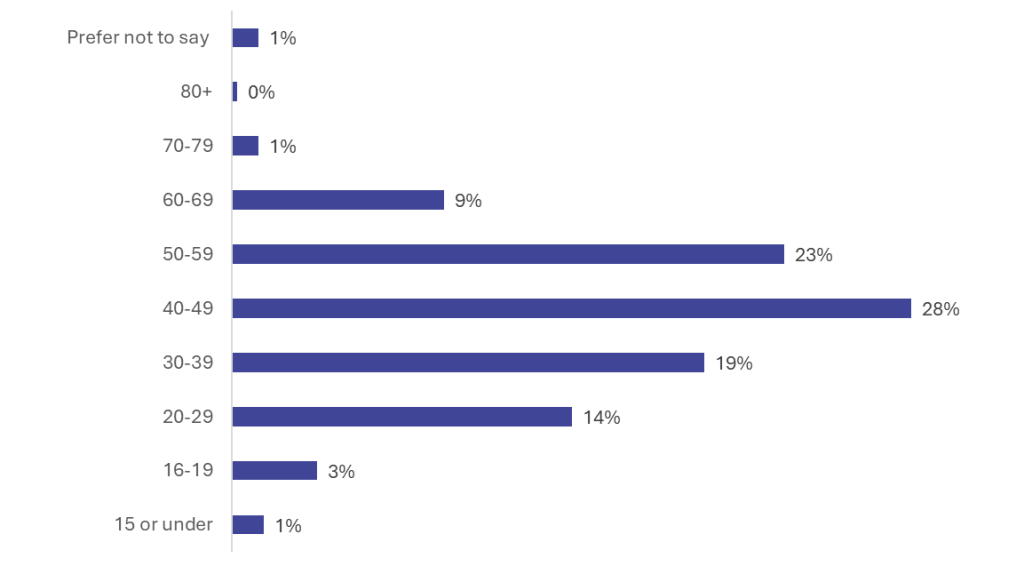
Research question summaries
Perceptions of Safety and Prevalence of VAWG (Research Question 1)
Women and girls in Surrey report feeling less safe in public spaces, particularly at night and on public transport. VAWG experiences are widespread, with many changing their behaviours to feel safer. The impacts—emotional distress, anxiety, and mistrust—are profound, and there is growing engagement from young adults (19–24). Services and community responses must address both the prevalence and psychological toll of VAWG, ensuring safety is not just physical but felt.
Experiences of Accessing Services (Research Question 2)
Many survivors who experienced VAWG had not accessed services. For those who did, key positives included being believed, consistency, and autonomy in how support was delivered. Improvements are needed in awareness-raising, system navigation, and capacity. Engagement routes varied and were not always initiated by the survivor themselves. A more joined-up, trauma-informed approach across services is vital.
Barriers to Accessing Services (Research Question 3)
Barriers are both emotional and practical. Normalisation of harm and difficulty identifying it as VAWG were common. Concerns about not being believed or taken seriously, particularly for ‘lower-level’ incidents, discouraged reporting. Service gaps, especially around stalking, exploitation, and accessibility for those with additional needs, require attention. Awareness of available services also remains low.
Implications for Future Service Design (Research Question 4)
This research highlights the need for:
- Greater public education to support early identification and challenge normalisation of VAWG.
- Trauma-informed, accessible, and inclusive services that build trust and offer flexible support.
- Clearer service pathways and more consistent communication across providers.
- Targeted interventions for under-served groups, including younger adults, disabled individuals, and those experiencing specific forms of abuse.
- Continued investment in community-led responses and safe public spaces.
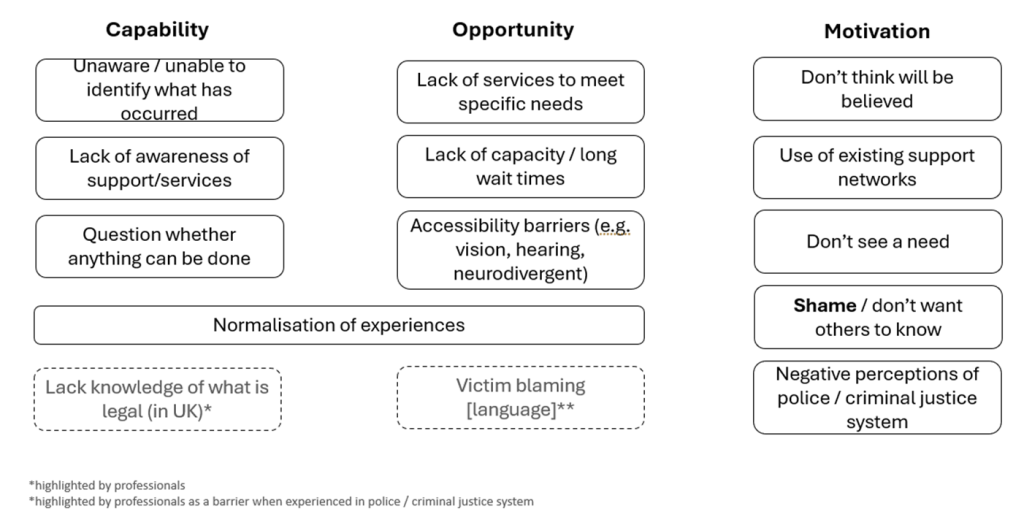
Data limitations
In compiling this needs assessment, several data limitations have been identified that must be considered when interpreting the findings:
Police
Surrey Police Classification
Surrey Police follows the NSPCC definition, categorising VAWG offences separately for ‘girls’ (aged 10-18 years) and ‘women’ (aged 18+). Data for individuals under the age of 10 is categorised differently. Relevant offences related to child abuse and exploitation have been included in this analysis. However, domestic abuse data was excluded from all datasets examined.
Data Quality Issues
There are inconsistencies in the quality of crime data, such as inconsistent flag usage, incomplete victim codes, missing characteristics, and location details. This hampers the ability to analyse specific data categories like ‘public space’ and ‘online’ incidents. Additionally, there is underreporting in relation to LGBTQIA+ populations and individuals from Black, Asian, and ethnic minority backgrounds.
Online Crimes
Online crimes, although recognised as part of VAWG, cannot be included in this analysis due to a lack of specific labels to identify them as cyber-enabled crimes in the reporting system.
The list of crimes Surrey Police includes as VAWG can be broken down in the following categories:
| Violence without injury | Violence with injury | Serious sexual offences | Other sexual offences |
|---|---|---|---|
| Assault without injury (common assault and battery) | Assault with injury | Abuse of children through sexual exploitation | Abuse of position of trust for a sexual purpose |
| Controlling or coercive behaviour | Assault with injury on a constable | Causing sexual activity without consent | Exploitation of prostitution |
| Harassment | Assault with injury on an emergency worker (other than a constable) | Rape of a female – multiple undefined offenders | Exposure and voyeurism |
| Malicious communications | Assault with intent to cause serious harm | Rape of a female aged 16 and over | Incest or familial sexual offences |
| Modern slavery | Endangering life | Rape of a female child under 13 | Sexual activity involving child under 16 |
| Public fear, alarm or distress | Murder | Rape of a female child under 16 | Sexual grooming |
| Racially or religiously aggravated harassment | Racially or religiously aggravated assault with injury | Sexual activity with a person with a mental disorder | Other miscellaneous sexual offences |
| Racially or religiously aggravated public fear, alarm or distress | Sexual activity involving a child under 13 | ||
| Stalking | Sexual assault on a female aged 13 and over | ||
| Threats to kill | Sexual assault on a female child under 13 |
Health
Source and Classification
Data used in this assessment comes from NHS Surrey Heartlands and is based on two sources: A&E Activity and Unplanned Hospital Admissions, where assault is recorded as a secondary diagnosis.
Distinguishing Domestic Abuse from VAWG
To distinguish domestic abuse from broader VAWG incidents, any secondary diagnosis where the admission was caused by a parent, or partner has been excluded from the analysis.
A&E Activity Data
The data is drawn from the Chief Complaint field, which includes diagnosis codes such as ‘physical aggression’ and ‘victim of sexual aggression.’ Other complaints, such as injuries to the stomach, upper extremities, or head, are not considered here, as their cause cannot be determined.
Unplanned Hospital Admissions
The data is extracted from the ICD-10 Diagnosis classification, focusing on assault-related codes (X85 to X99, Y00 to Y099). As VAWG is not a specific classification, these assault codes have been used to identify relevant incidents.
Education
Demographic Profiles
Schools maintain data on the demographic profiles of perpetrators and survivors, but these profiles are not gender-specific, which may limit detailed analysis of gender-based patterns.
Impact of Non-Gender Specific Guidance
Some national guidance, such as the Department for Education’s Keeping Children Safe in Education and Exclusion Guidance, and Ofsted’s Harmful Sexual Behaviour and Harassment in Schools, are not gender specific. This has implications for the collection and analysis of data on gendered violence in educational settings.
Additional Resources and Strategic Guidance Informing Surrey’s VAWG Response
Anti-Victim Blaming Guidance
Definition of Victim Blaming
Victim blaming is the act of attributing partial or full responsibility for a crime, discrimination, harassment, abuse, or violence onto the victim. This can be direct, explicit, or indirect and unconscious, applying to both children and adults.
Surrey County Council’s Response
The Council has identified victim blaming as a common issue across agencies, which acts as a barrier for victims to seek help, while simultaneously concealing perpetrators. To address this, the Safer Communities Team created the Anti-Victim Blaming Guidance as part of the VAWG Partnership Strategy. This guidance aims to shift the focus of blame, fault, and accountability onto the perpetrators, supporting the learning and development of practitioners in Surrey. It was developed in partnership with practitioners and the Surrey Survivor Steering Group.
Ofsted (2021). Learning from practice. Harmful Sexual Behaviour and Harassment in Schools. This joint review explores sexual harassment and physical abuse in Surrey’s education settings, in response to allegations of sexually harmful behaviour. The review assessed the effectiveness of safeguarding policies, staff training, reporting frameworks, and pupil involvement in tackling sexual harassment and abuse. The review recommended the implementation of timely wellbeing plans, risk assessments, better communication with children and parents, and an information management system to track sexually inappropriate behaviour.
Department for Education (2023). Keeping children safe in education
Statutory Guidance for Schools and Colleges. This guidance is crucial for schools and colleges in England, outlining how they should safeguard and promote the welfare of children under the age of 18. It includes management of safeguarding, recruitment, staff concerns, and how to handle child-on-child sexual violence and harassment.
Policing Harmful Sexual Behaviour Among Young People in Schools (Setty et al, 2024). This analysis focuses on addressing harmful sexual behaviour (HSB) among young people in schools, emphasising the collaboration between schools and the police. It includes case studies, best practices, and recommendations for policy and practice, aiming to improve the response to HSB through strong police-school partnerships. This guidance was produced in collaboration with Surrey Police and aims to inform both policy and practice regarding the prevention and management of HSB.
Glossary
Adult Social Care’s Section 42 Enquiry
As specified by the Care Act 2014, Section 42 Enquiry is started when a concern raised meets the following three criteria:
- The adult has needs for care AND support (whether the authority is meeting any of those needs or not) AND
- The adult is experiencing, or is at risk of, abuse or neglect AND
- As a result of those needs is unable to protect himself or herself against the abuse or neglect or the risk of it.
Children’s Social Care Contact
A contact is recorded when a member of the public or professional contacts social care with concerns about a child. A child can have one or multiple factors identified in a contact.
Children’s Social Care Assessment
An assessment is carried out to identify the needs of the child and any impact of any parental behaviour on them as an individual. A child can have one or multiple factors identified at the end of an assessment.
Child sexual abuse
Involves forcing or enticing a child or young person to take part in sexual activities, whether the child is aware of what is happening or not. The activities may involve physical contact, including assault by penetration (for example, rape or oral sex) or non-penetrative acts such as masturbation, kissing, rubbing and touching outside of clothing.
They may also include non-contact activities, such as involving children in looking at, or in the production of, sexual images, watching sexual activities, encouraging children to behave in sexually inappropriate ways, or grooming a child in preparation for abuse (including via the internet).” – HM Government, 2015 Glossary – Women and Girls Network (wgn.org.uk)
Child sexual exploitation
Child sexual exploitation is a type of sexual abuse. Children in exploitative situations and relationships receive something such as gifts, money or affection because of performing sexual activities or others performing sexual activities on them. Children or young people may be tricked into believing they’re in a loving, consensual relationship. They might be invited to parties and given drugs and alcohol. They may also be groomed online. Some children and young people are trafficked into or within the UK for the purpose of sexual exploitation. Sexual exploitation can also happen to young people in gangs. NSPCC Glossary – Women and Girls Network (wgn.org.uk)
Domestic abuse
Domestic abuse as an incident or pattern of incidents of controlling, coercive, threatening, degrading and violent behaviour, including sexual violence, in most cases by a partner or ex-partner, but also by a family member or carer. Domestic abuse can include, but is not limited to: Coercive control (a pattern of intimidation, degradation, isolation and control with the use or threat of physical or sexual violence, psychological and/or emotional abuse, physical or sexual abuse, financial or economic abuse, harassment and stalking, online or digital abuse.
Exploitation of prostitution
Involves exploitative situations, contexts and relationships where someone receives ‘something’ (e.g. food, drugs, alcohol, cigarettes, affection, protection money) because of them performing, and/or another or others performing on them, sexual activities. Violence, coercion and intimidation are common, involvement in exploitative relationships being characterised in the main by the person’s limited availability of choice resulting from their social/economic and/or emotional vulnerability. (Department for Education, 2017)
Female Genital Mutilation (FGM)
Female genital mutilation comprises all procedures involving partial or total removal of the external female genitalia or other injury to the female genital organs for non-medical reasons.
Forced marriage
A forced marriage is where one or both people do not or cannot consent to the marriage and pressure or abuse is used to force them into the marriage. It is also when anything is done to make someone marry before they turn 18, even if there is no pressure or abuse.
Grooming
Grooming is when someone builds a relationship, trust and emotional connection with a child or young person so they can manipulate, exploit and abuse them. Children and young people who are groomed can be sexually abused, exploited or trafficked. Anybody can be a groomer, no matter their age, gender or race. Grooming can take place over a short or long period of time – from weeks to years. Groomers may also build a relationship with the young person’s family or friends to make them seem trustworthy or authoritative.
Harassment
The Protection from Harassment Act 1997 indicates that someone’s actions amount to harassment when they make the victim feel distressed, humiliated, threatened or fearful of further violence. The main goal of harassment is to persuade victims either not to do something that they are entitled or required to do or to do something that they are not obliged to do. Actions listed under the Protection from Harassment Act include, but are not limited to phone calls, letters, emails, visits, stalking, verbal abuse of any kind, including on social media, threats, damage to property, bodily harm. Such actions amount to harassment when they occur more than once
Harmful practices
Harmful practices are forms of violence which have been committed primarily against women and girls in certain communities and societies for so long that they are considered, or presented by perpetrators, as part of accepted cultural practice. The most common are forced or early marriage, so called ‘honour’ based violence and female genital mutilation or cutting (FGM).
Hate crime
Hate crime is defined as any criminal offence which is perceived by the victim or any other person, to be motivated by hostility or prejudice, based on a person’s disability or perceived disability; race or perceived race; or religion or perceived religion; or sexual orientation or perceived sexual orientation or transgender identity or perceived transgender identity.
Honour-based abuse
Although there is no statutory definition of so called ‘honour-based’ abuse in the UK a common definition across agencies is ‘A crime or incident which has, or may have been, committed to protect or defend the honour of the family and/ or community’.
Indecent exposure
Legally called just ‘exposure’, and sometimes known as ‘flashing’, this crime occurs when someone deliberately exposes their genitals to frighten or upset someone else.
Night-time economy
The Office for National Statistics (ONS) definition of ‘night’ includes everything between 6pm and 6am, and the ‘night-time economy’ relates to all activities that happen during this period. For the purposes of this publication activities are offences / crimes against women and girls.
Modern slavery
Modern slavery is defined as the recruitment, movement, harbouring or receiving of children, women or men using force, coercion, abuse of vulnerability, deception or other means for the purpose of exploitation. It is a crime under the Modern Slavery Act 2015 and includes holding a person in a position of slavery, servitude forced or compulsory labour, or facilitating their travel with the intention of exploiting them soon after.
Outraging public decency
Common law offence that occurs when a person commits a lewd, obscene, or disgusting act in public that is capable of outraging public decency. The act must take place in the presence of at least two members of the public who could have witnessed it, even if they did not actually see it.
This offence is intended to protect shared public standards of decency and can apply to behaviour that is grossly indecent or offensive to reasonable members of the public, such as sexual acts or explicit conduct carried out in public view.
Other sexual offences
There are a range of crimes that can be considered as sexual offences, including non-consensual crimes such as rape or sexual assault, crimes against children including child sexual abuse or grooming, and crimes that exploit others for a sexual purpose, whether in person or online.
Public fear, alarm, distress
Under the Public Order Act 1986, offences that cause fear, alarm or distress are primarily covered by Sections 4A and 5. These offences typically involve threatening, abusive or insulting words or behaviour that are likely to cause members of the public to feel fear for their safety, experience emotional disturbance, or suffer distress in a public setting.
Specifically:
- Section 4A (Intentional harassment, alarm or distress): Involves the use of threatening, abusive or insulting words or behaviour, or disorderly behaviour, with intent to cause a person harassment, alarm or distress, and where such distress is actually caused.
- Section 5 (Harassment, alarm or distress): Covers similar conduct, but does not require proof of intent or actual harm—only that the behaviour was likely to cause harassment, alarm or distress to someone within hearing or sight.
These provisions are designed to maintain public order and protect individuals from behaviour that is disruptive, threatening, or emotionally harmful in public spaces.
Rape
The legal definition of rape is when a person intentionally penetrates another’s vagina, anus or mouth with a penis, without the other person’s consent. Assault by penetration is when a person penetrates another person’s vagina or anus with any part of the body other than a penis, or by using an object, without the person’s consent.
Sexual violence
Rape Crisis England and Wales defines Sexual Violence as Sexual violence is any kind of sexual activity or act (including online) that was unwanted or involved one or more of the following: pressure, manipulation, bullying, intimidation, threats, deception, force. In other words, any kind of sexual activity or act that took place without consent. There are lots of different types of sexual violence, including child sexual abuse, rape and sexual assault. In some views, such as Streetlight UK, sex work is also viewed as sexual violence, as it often involves some form of exploitation of vulnerability, coercion and control. Consent is often implied; however, it cannot be assumed.
Stalking
Section 2A (3) of the Protection from Harassment Act 1997 outlines examples of behaviours associated with stalking. These include following a person, contacting or attempting to contact a person by any means, publishing any statement or other material relating to, purporting to relate to, or purporting to originate from a person, monitoring a person’s use of the internet, email, or any other form of electronic communication, loitering in any place, whether public or private, interfering with property in a person’s possession, watching or spying on a person.
This is not an exhaustive list. Prosecutors are advised to consider the full context and whether the behaviour reflects the nature of “stalking”. The Crown Prosecution Service (CPS) defines stalking more broadly as a pattern of Fixated, Obsessive, Unwanted, and Repeated (FOUR) behaviour that is intrusive and causes distress or fear.
Upskirting
Upskirting is where someone takes a picture under a person’s clothing without their permission.
If you or someone you know has been the victim of violence please use this support link: How to get help | Healthy Surrey