Place Packs – East Surrey

Place Packs – East Surrey

Date produced: 17/12/2024

Contents

Demographics

Population pyramid

In East Surrey, the total population is 197,534 with a median age of 41 years. This median age is 1 years younger compared to Surrey and 2 years older compared to England.

  • The population of East Surrey is ageing
  • 23.5% of East Surrey’s residents are over the age of 60, which is a difference of -1.1% if compared to Surrey and a difference of -0.2% if compared to England
  • 1.0% are over the age of 90, a difference of -0.1% if compared against Surrey and a difference of +0.2% if compared against England
  • Most patients aged 90+ are female
  • There are 1360 female patients aged 90 and over in East Surrey, which is 2.1 times greater than the number of males (657)
  • The number of males and females below 25 is roughly similar

Population pyramid of East Surrey
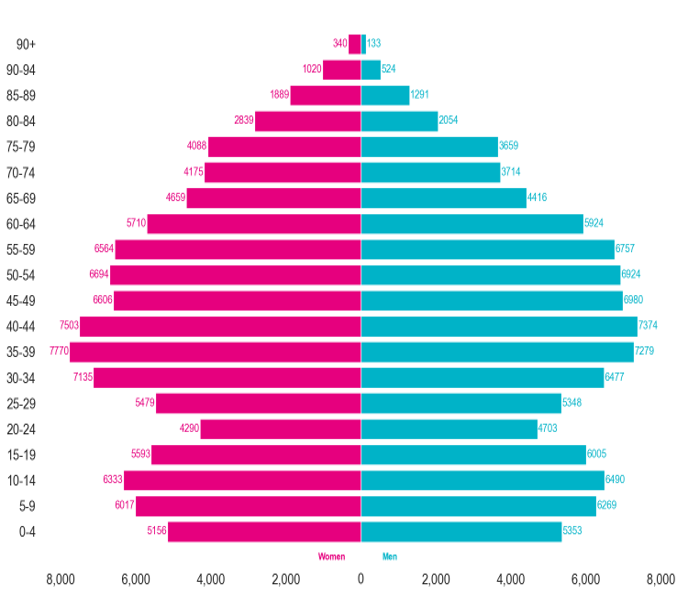
Population pyramid showing the population of East Surrey place. East Surrey place has a high population of 35-59 year olds, and a lower population of 20-29 year olds and 80+ year olds. East Surrey place has a higher male population in under 65s, but a higher female population in ages 65+.

Data Source: ONS Census 2021

Sex and age by health status

In East Surrey, there was no difference between males and females in reporting ‘very good health’.

  • The number of males in ‘very good health’ is 1.7% higher than for females
  • The number of females in ‘very bad health’ is 0.1% higher than for males
  • The number of people in “very bad health” increases with age

Health status for females in East Surrey
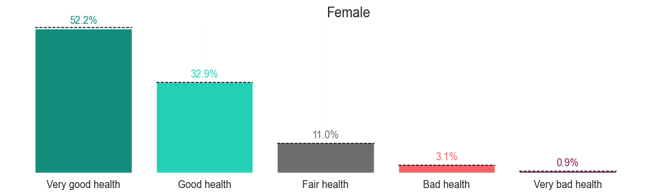
Proportions of females reporting levels of health. Most females report very good health at 52.2%. 32.9% report good health, 11.0% report fair health, 3.1% report bad health, and 0.9% report very bad health.

Health status for males in East Surrey
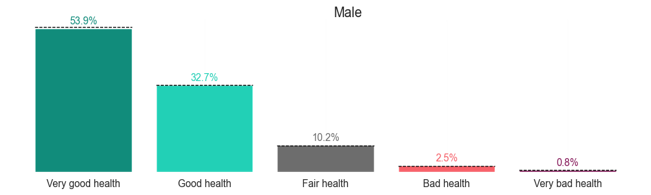
Proportions of males reporting levels of health. Most males report very good health at 53.9%. 32.7% report good health, 10.2% report fair health, 2.5% report bad health, and 0.8% report very bad health.

Health status by age in East Surrey

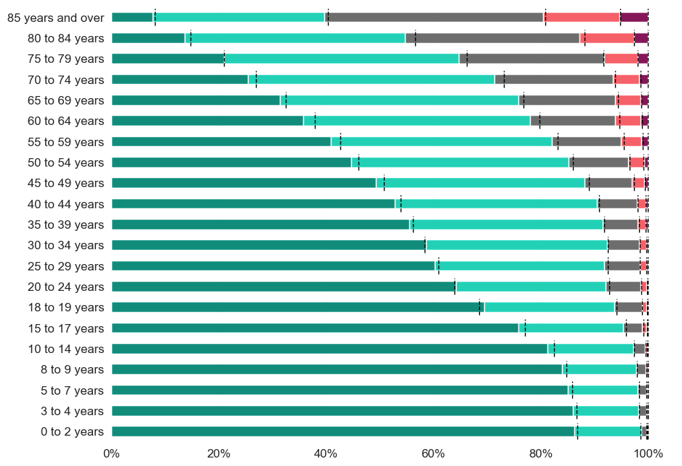
Proportions of people reporting levels of health by age group. As people get older, higher levels of poorer health are reported and lower levels of better health are reported. 0-2 year olds report the highest levels of very good health at around 85%, and 85+ year olds report the lowest level of very good health at around 10%. 85+ year olds also report the highest levels of bad and very bad health, at around 17% combined.

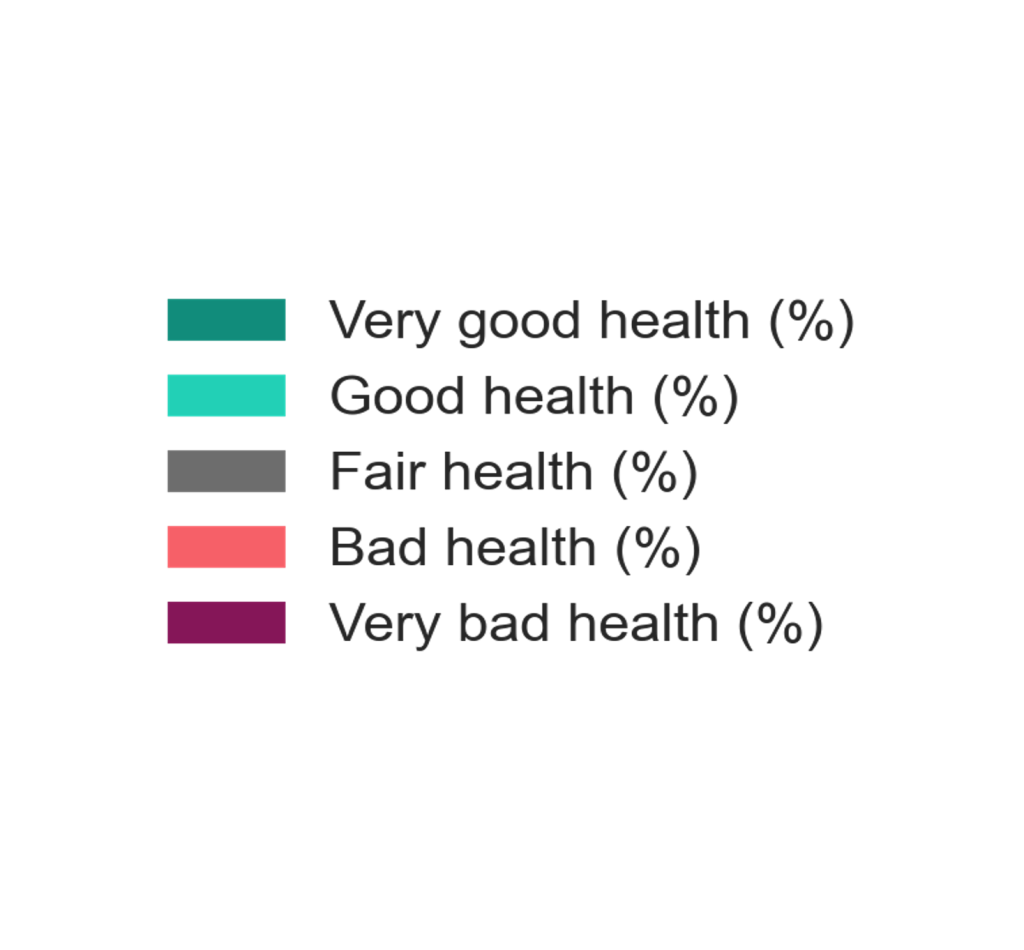
From left to right, the bars are “Very good health”, “Good health”, “Fair health”, “Bad health”, and “Very bad health”.

Data Source: ONS Census 2021

Index of multiple deprivation

East Surrey is the second least populated place in Surrey with an Index of multiple deprivation score of 7.

  • The highest percentage of East Surrey’s registered patients, 26.8% reside in Care collaborative (Redhill) (Decile 7) whilst the smallest percentage, 11.2%, lives in Redhill Phoenix.
  • 84.3% of East Surrey’s registered patients live in Decile 7 PCNs and 15.6% in Decile 8 PCNs.

IMD Decile and Population by Place
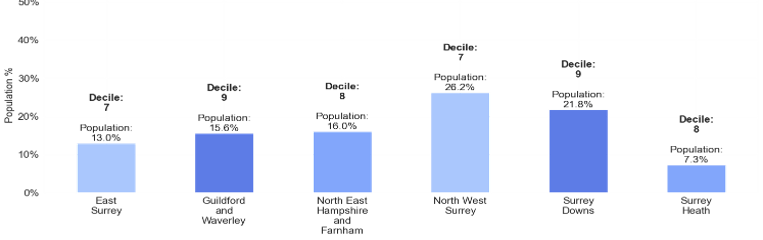
IMD Decile and Population by Place.  East Surrey is in Decile 7 and contains 13.0% of Surrey's population. Guildford and Waverley is in Decile 9 and contains 15.6% of Surrey's population. North East Hampshire and Farnham is in Decile 8 and contains 16.0% of Surrey's population. North West Surrey is in Decile 7 and contains 26.2% of Surrey's population. Surrey Downs is in Decile 9 and contains 21.8% of Surrey's population. Surrey Heath is in Decile 8 and contains 7.3% of Surrey's population.

IMD Decile and Population by PCN in East Surrey
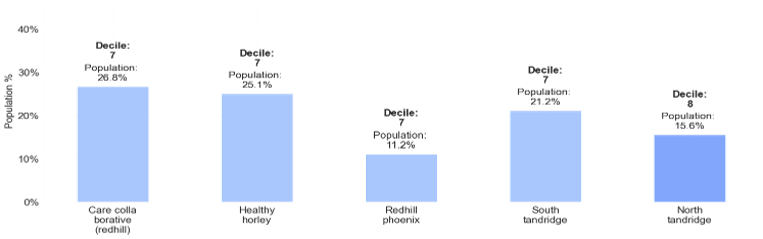
IMD Decile and Population by PCN in East Surrey. Care Collaborative (Redhill) is in Decile 7 and contains 26.8% of East Surrey's population. Healthy Horley is in Decile 7 and contains 25.1% of East Surrey's population. Redhill Phoenix is in Decile 7 and contains 11.2% of East Surrey's population. South Tandridge is in Decile 7 and contains 21.2% of Surrey's population. North Tandridge is in Decile 7 and contains 15.6% of East Surrey's population.

IMD Score by PCN in East Surrey

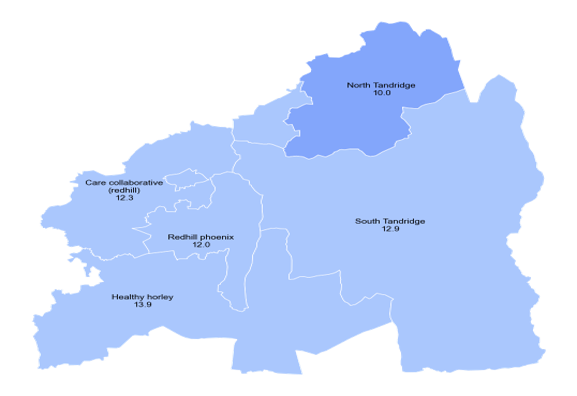
Map of East Surrey showing the IMD score of East Surrey's PCNs. Care Collaborative Redhill, Redhill Phoenix, Healthy Horley, and South Tandridge are all in Decile 7, with scores of 12.3, 12.0, 13.9, and 12.9 respectively. North Tandridge is in Decile 8 with a score of 10.0.
The IMD score ranges. The most deprived decile 1 has scores between 43.86 and 92.73, decile 2 has scores between 33.25 and 43.86, decile 3 has scores between 26.57 and 33.25, decile 4 has scores between 21.55 and 26.57, decile 5 has scores between 17.65 and 21.55, decile 6 has scores between 14.24 and 17.65, decile 7 has scores between 11.30 and 14.24, decile 8 has score between 8.62 and 11,30, decile 9 has scores between 5.91 and 8.62, and the least deprived decile 10 has scores between 0.54 and 5.91.

Based on the English IMDs from 2019. Deciles have been aggregated up to PCN and Place using population weighted scores.

Data Source: ONS

Index of multiple deprivation and health status

In East Surrey, the higher IMD Decile, the more people report ‘very good health’.

IMD deciles and health status for East Surrey
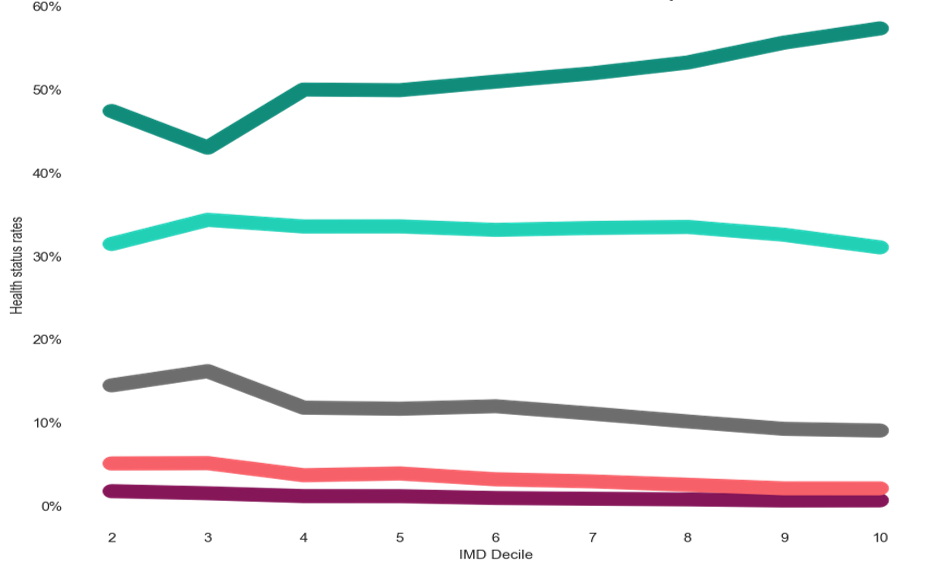
Health status in East Surrey by IMD deciles. The proportion of people reporting very good health increases in higher deciles, with under 50% reporting very good health in decile 2 to 60% reporting very good health in decile 10. An exception to this is decile 3, which has around 42% of people reporting very good health. The amount of people reporting bad and very bad health goes down the higher the decile with around 5% and 2% reporting bad and very bad health respectively at decile 2, and around 3% and 1% reporting bad and very bad health respectively at decile 10.
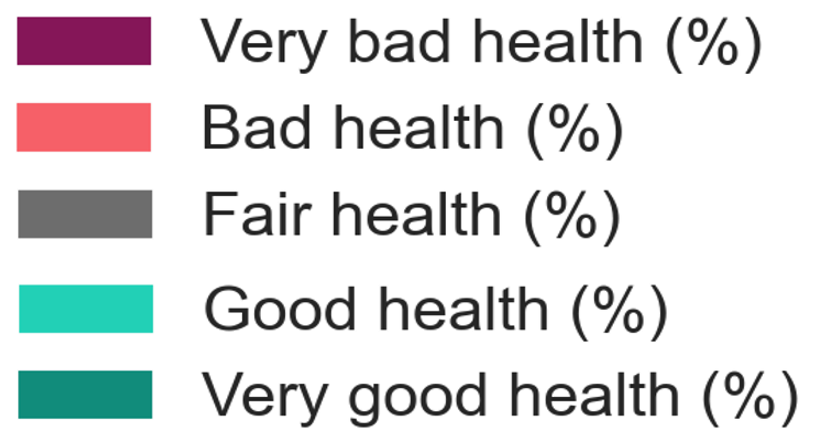
Key for the above graph. Dark green represents very good health, light green represents good health, grey represents fair health, light red represents bad health, and dark red represents very bad health.

From top to bottom, the bars are “Very good health”, “Good health”, “Fair health”, “Bad health”, and “Very bad health”.

Data Source: ONS

Ethnicity

The largest ethnic group in East Surrey was the white grouping at 86.33%.

  • Redhill phoenix has the highest diversity of populations, with 18.40% of non-white ethnicities.

Ethnicity demographics in East Surrey
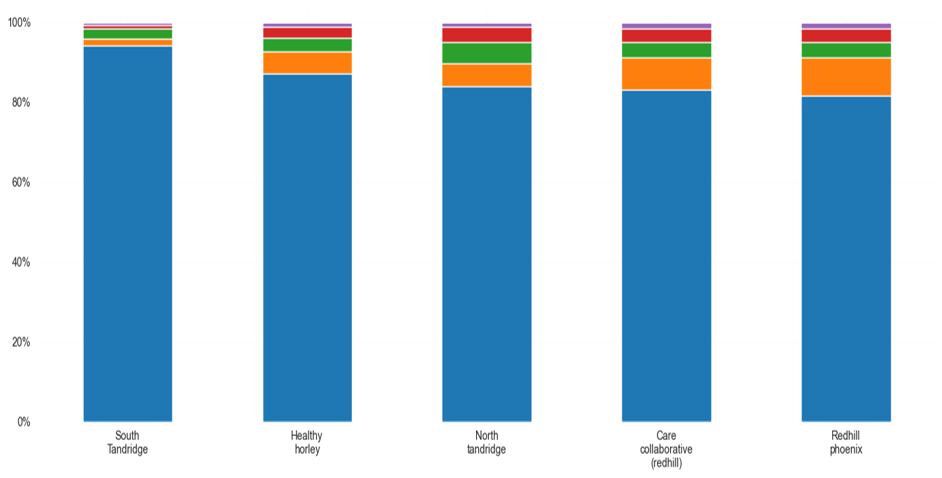
Ethnicity demographics of East Surrey PCNs.  All PCNs have a majority white population, ranging from around 82% in Redhill Phoenix PCN to around 92% in South Tandridge PCN. Redhill Phoenix has the largest proportion of both Asian, Asian British, or Asian Welsh and Black, Black British, Black Welsh, Carribean or African population. North Tandridge has the largest proportion of both Mixed or Multiple ethnic groups, and Other ethnic group populations.
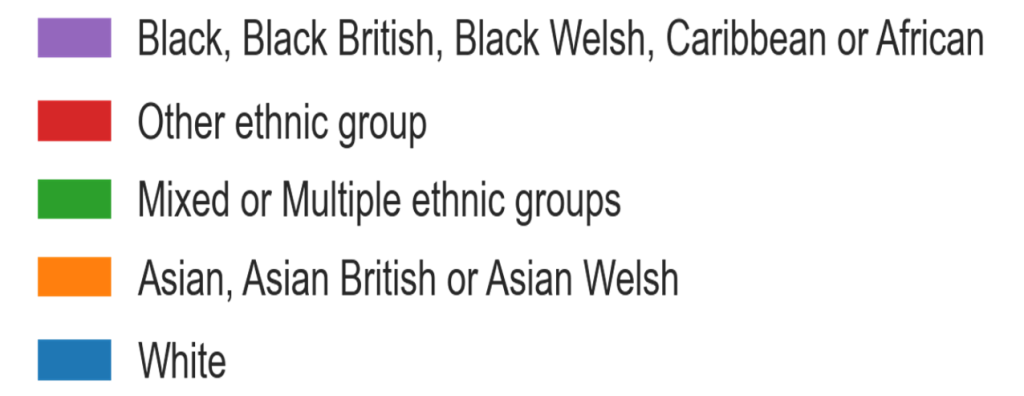
Key to the above graph. White is represented by blue, Asian, Asian British, or Asian Welsh is represented by orange, Mixed or Multiple ethnic groups is represented by green, Other ethnic group is represented by red, and Black, Black British, Black Welsh, Caribbean or African is represented by purple.

From top to bottom, the bars are “Black, Black British, Black Welsh, Caribbean or African”, “Other ethnic group”, “Mixed or Multiple ethnic groups”, “Asian, Asian British or Asian Welsh”, and “White”.

Data Source: ONS Census 2021

Ethnicity and health status

In East Surrey the mixed or multiple ethnic groups ethnicity reported the highest proportion of ‘very good health’ at 67.1%.

  • The white ethnicity reported the highest proportion of ‘very bad health’ at 0.9%

Health status by ethnicity in East Surrey
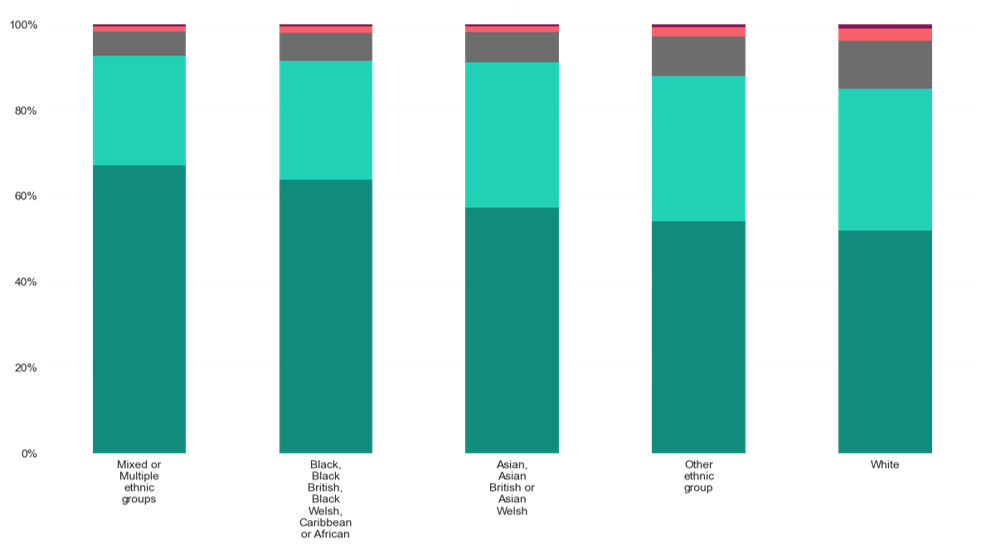
Health Status by Ethnicity in East Surrey. For very good health, the ethnic group that reports the highest is Mixed or multiple ethnic groups (at around 67%), followed by Black, Black British, Black Welsh, Caribbean or African (at around 62%), then Asian, Asian British, or Asian Welsh (at around 58%), then Other ethnic groups (at around 56%) and the ethnic group that reports the least amount of very good health is White (at around 54%). The ethnic group reporting the highest amount of good health is Asian, Asian British, or Asian Welsh. The ethnic group that reports the highest amount of both fair health, bad health and very bad health is White.
Key for the above graph. Dark green represents very good health, light green represents good health, grey represents fair health, light red represents bad health, and dark red represents very bad health.

From top to bottom, the bars are “Very good health”, “Good health”, “Fair health”, “Bad health”, and “Very bad health”.

Data Source: ONS Census 2021

In East Surrey, the ‘White’ (1.9%) group of people reported a higher rate of ‘bad/very bad health’ compared to Surrey (1.8%).

Bad/very bad health status in East Surrey
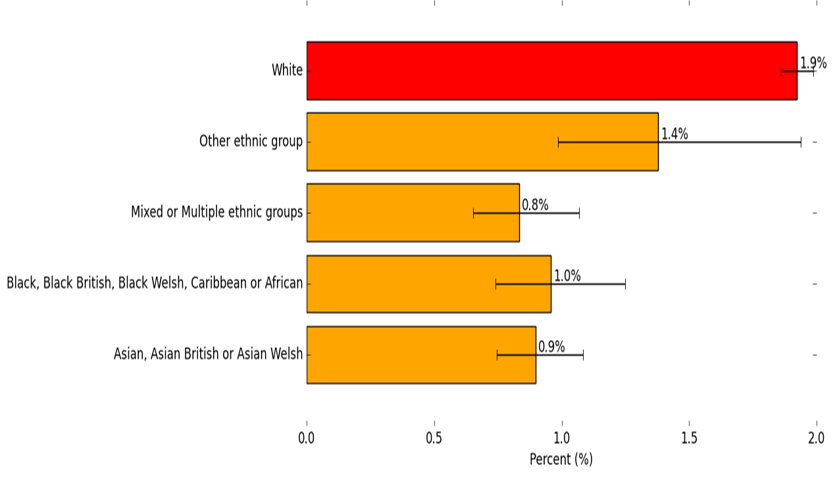
Bad/very bad health status in East Surrey by ethnic group. The ethnic group reporting the highest amount of bad/very bad health is White at 1.9%. This is worse than the Surrey average. Other ethnic group reports 1.4% of bad/very bad health, Mixed or Multiple ethnic groups report 0.8% of bad/very bad health, Black, Black British, Black Welsh, Caribbean or African report 1.0% of bad/very bad health, and Asian, Asian British or Asian Welsh report 0.9% of bad/very bad health. All these groups are similar to the Surrey average.

Key for the above graph. Green indicates that an area is performing better than the Surrey average, yellow indicates that an area is performing similar to the Surrey average, and red indicates that an area is performing worse than the Surrey average.

The ‘White’ group of people performs worse than the Surrey average, but all the rest of the groups perform similar to the Surrey average.

Data Source: ONS Census 2021

Note: These are benchmarked against the Surrey average

Proficiency in English

In East Surrey, 0.60% of people reported ‘limited English proficiency’, which is lower than the Surrey value of 1.04%.

  • No PCNs have reported a ‘limited English proficiency’ value above the Surrey average.

Proficiency in English by Place
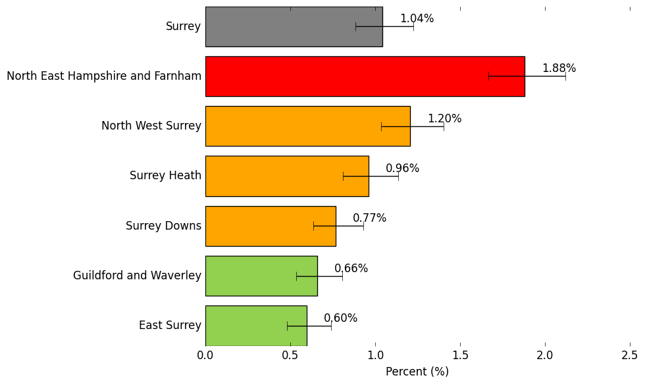
Proficiency in English by Place. Surrey has a reported limited English proficiency of 1.04%. North East Hampshire and Farnham has a reported limited English proficiency of 1.88%, which is worse than the Surrey average. North West Surrey has a reported limited English proficiency of 1.20%, which is similar to the Surrey average. Surrey Heath has a reported limited English proficiency of 0.96%, which is similar to the Surrey average. Surrey Downs has a reported limited English proficiency of 0.7%, which is similar to the Surrey average. Guildford and Waverley has a reported limited English proficiency of 0.66%, which is better than the Surrey average. East Surrey has a reported limited English proficiency of 0.60%, which is better than the Surrey average.

North East Hampshire and Farnham is performing worse than the Surrey average. North West Surrey, Surrey Heath, and Surrey Downs are performing similar to the Surrey average. Guildford and Waverley and East Surrey are performing better than the Surrey average.

Proficiency in English by PCN in East Surrey
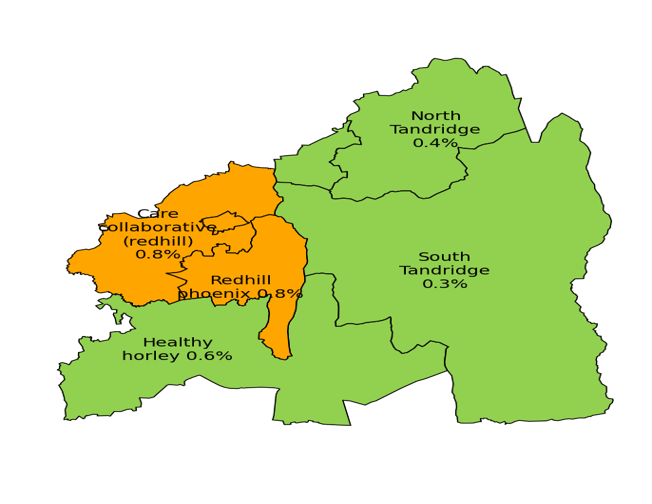
Proficiency in English by PCN in East Surrey. Care Collaborative (Redhill) has a reported limited English proficiency of 0.8%, which is similar to the Surrey average. Redhill Phoenix has a reported limited English proficiency of 0.8%, which is similar to the Surrey average. Healthy Horley has a reported limited English proficiency of 0.6%, which is better than the Surrey average. North Tandridge has a reported limited English proficiency of 0.4%, which is better than the Surrey average. South Tandridge has a reported limited English proficiency of 0.3%, which is similar to the Surrey average.

Care Collaborative (Redhill) and Redhill Phoenix are performing similar to the Surrey average. Healthy Horley, North Tandridge, and South Tandridge are performing better than the Surrey average.

Key for the above graph. Green indicates that an area is performing better than the Surrey average, yellow indicates that an area is performing similar to the Surrey average, and red indicates that an area is performing worse than the Surrey average.

Data Source: ONS Census 2021

Note: These are benchmarked against the Surrey average.

Proficiency in English and health status

In East Surrey people who reported being ‘fluent in English’ also reported the highest proportion of ‘good health’ at 92.9%.

People who reported ‘limited English’ also reported the highest proportion of ‘not good health’ at 7.8%.

Health status by proficiency in English
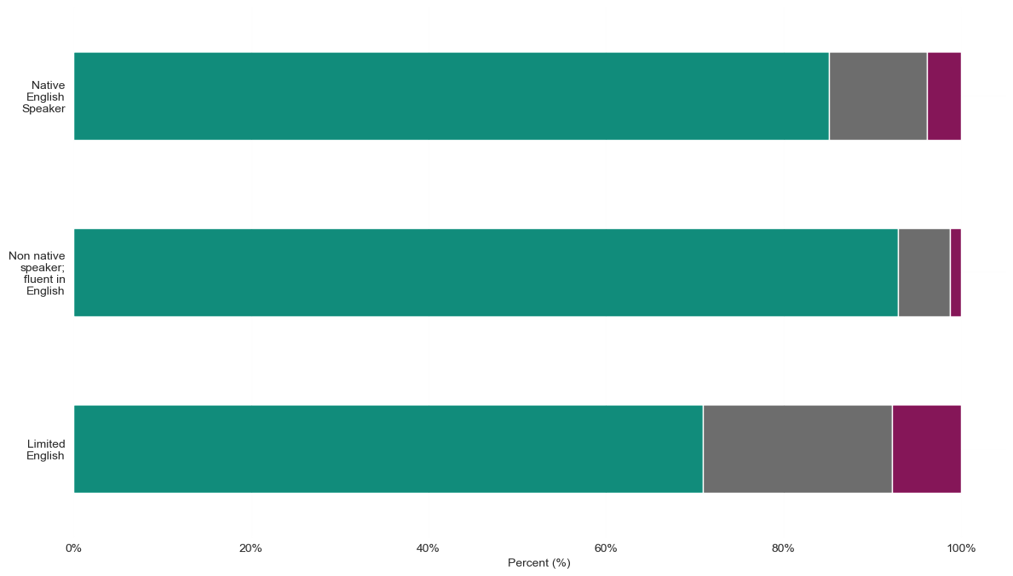
Proficiency in English by health status. The group reporting the highest amount of very good health is Non-native speaker; fluent in English at around 90%. The group reporting the highest amounts of both fair health and not good health is Limited English at around 20% and 8% respectively.
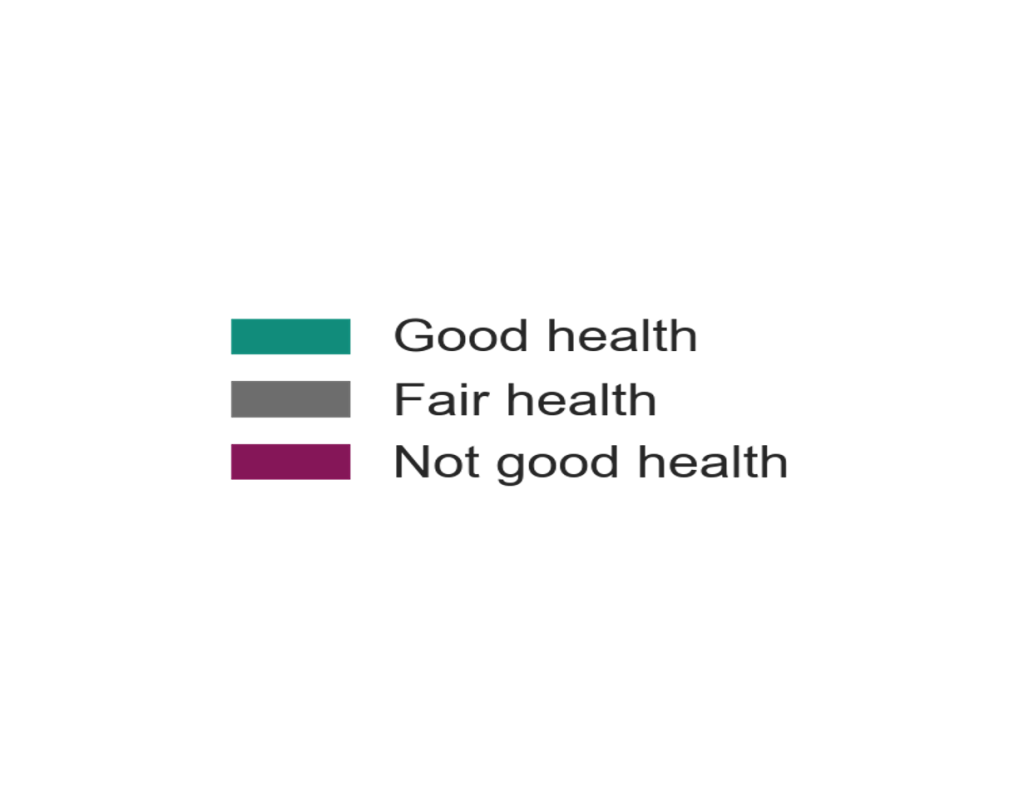
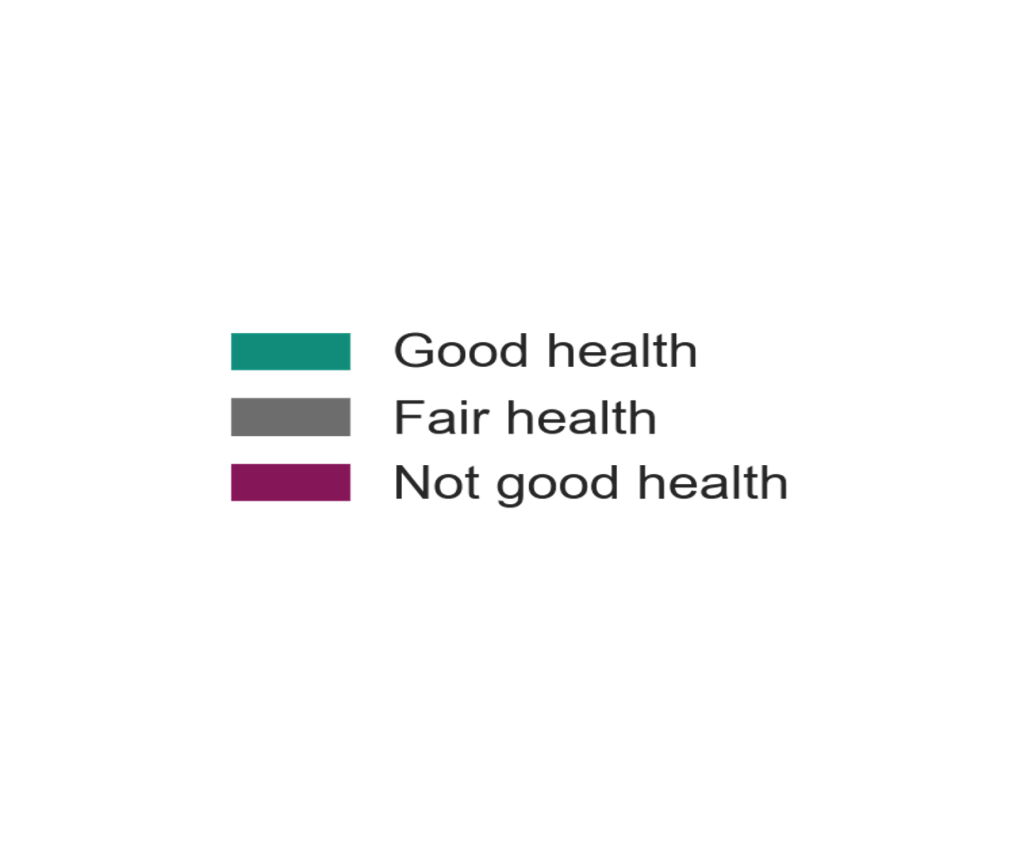
Key to the above graph. Green represents good health, grey represents fair health, and purple represents not good health.

From left to right, the bars are good health, fair health, and not good health.

Data Source: ONS Census 2021

Religion

In East Surrey, 49.12% of the population adheres to Christianity, making it the most prevalent religion.

Religion in East Surrey
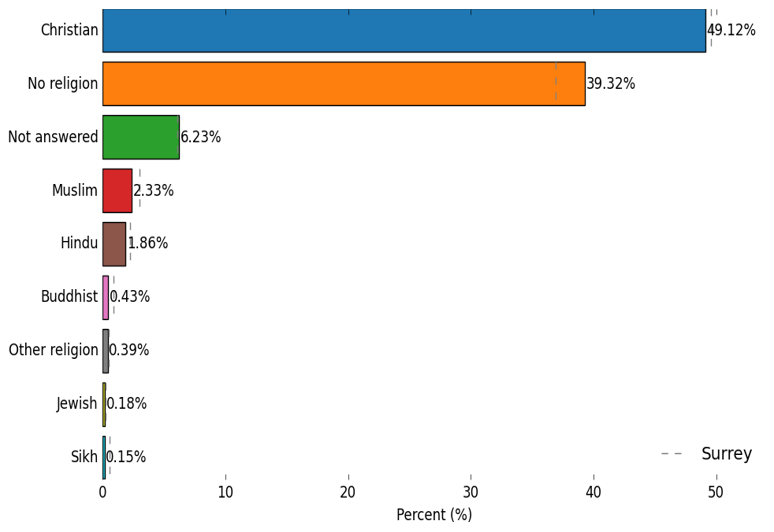
Religion in East Surrey place. The most prevalent religion is Christian at 49.12%. Then in descending order of prevalence is No religion (39.32%), Not answered (6.23%), Muslim (2.33%), Hindu (1.86%), Buddhist (0.43%), Other religion (0.39%), Jewish (0.18%), and Sikh (0.15%).

Data Source: ONS Census 2021

Qualifications

Level of qualification

In East Surrey, 31.5% of the population holds a level 4 qualification or above.

Level of qualification in East Surrey
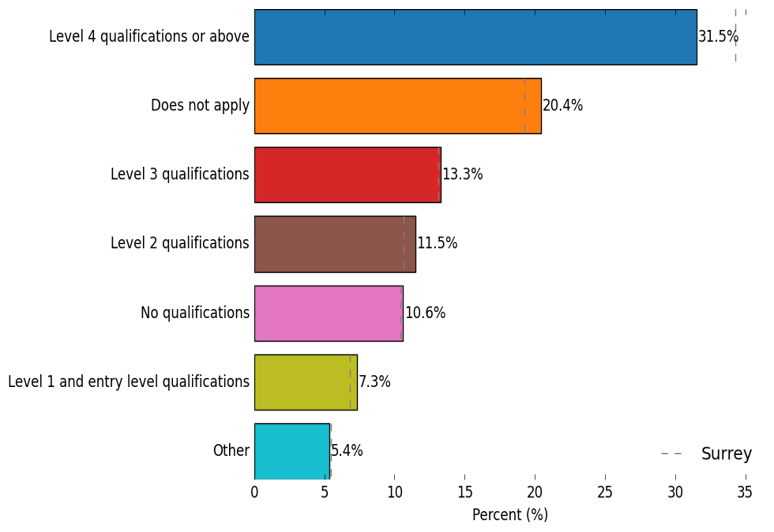
Level of qualification in East Surrey place. 31.5% of residents have Level 4 qualifications or above, 20.4% of residents answered Does not apply, 13.3% of residents have a Level 3 qualification, 11.5% of residents have a Level 2 qualification, 10.6% of residents have No qualifications, 7.3% of residents have Level 1 and entry level qualifications, and 5.4% of residents answered Other.

Data Source: ONS Census 2021

Work

Economically active

  • In East Surrey, 65.69% reported being economically active, which is higher than Surrey’s value of 64.14%.
  • North Tandridge (63.8%) and South Tandridge (61.7%) reported a lower rate than the Surrey average.

Economically active by Place
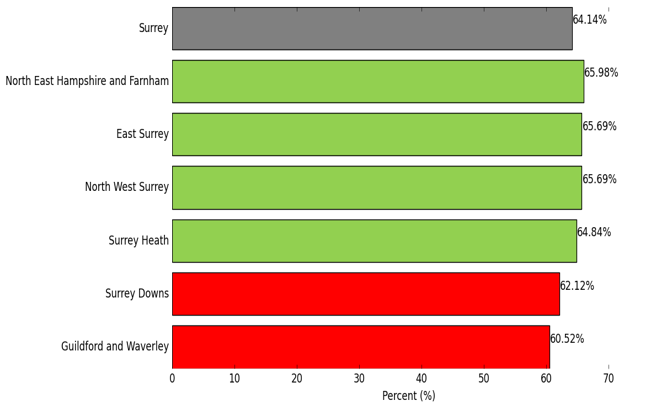
Economically active by Place. 64.14% reported being economically active in Surrey. 65.98% reported being economically active in North East Hampshire and Farnham, which is better than the Surrey average. 65.69% reported being economically active in East Surrey, which is better than the Surrey average. 65.69% reported being economically active in North West Surrey, which is better than the Surrey average. 64.84% reported being economically active in Surrey Heath, which is better than the Surrey average. 62.12% reported being economically active in Surrey Downs, which is worse than the Surrey average. 60.52% reported being economically active in Guildford and Waverley, which is worse than the Surrey average.

North East Hampshire and Farnham, East Surrey, North West Surrey, and Surrey Heath are performing better than the Surrey average. Surrey Downs and Guildford and Waverley are performing worse than the Surrey average.

Economically active by PCN in East Surrey
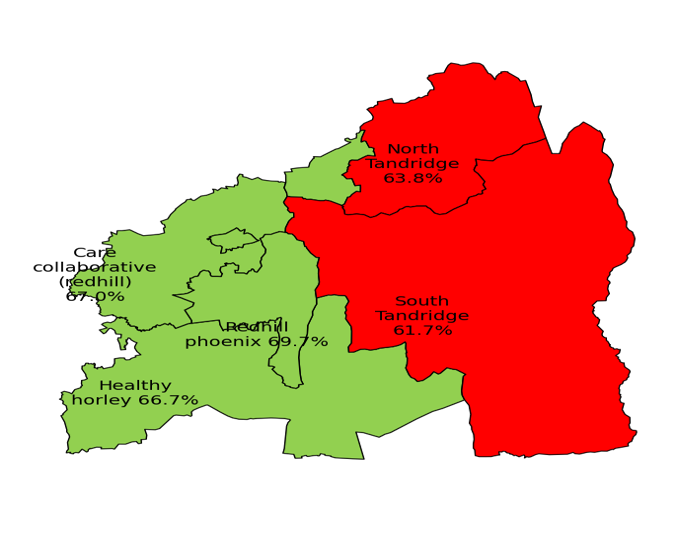
Economically active by PCN in East Surrey. 67.0% reported being economically active in Care Collaborative (Redhill), which is better than the Surrey average. 69.7% reported being economically active in Redhill Phoenix, which is better than the Surrey average. 66.7% reported being economically active in Healthy Horley, which is better than the Surrey average. 63.8% reported being economically active in North Tandridge, which is worse than the Surrey average. 61.7% report being economically active in South Tandridge, which is worse than the Surrey average.

Care Collaborative (Redhill), Redhill Phoenix, and Healthy Horley are performing better than the Surrey average. North Tandridge and South Tandridge are performing worse than the Surrey average.

Key for the above graph. Green indicates that an area is performing better than the Surrey average, yellow indicates that an area is performing similar to the Surrey average, and red indicates that an area is performing worse than the Surrey average.

Data Source: ONS Census 2021

Note: These are benchmarked against the Surrey average.

Occupation

  • In East Surrey, 16.3% of people work in lower professional and higher technical occupations, making it the most prevalent occupation

Occupations in East Surrey
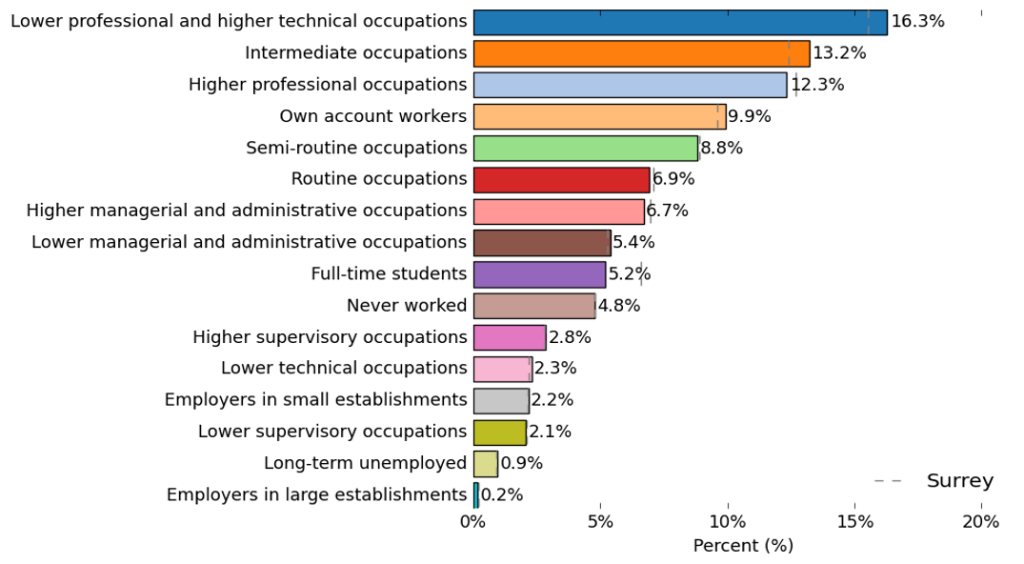
Proportion of people working in various occupations. The highest proportion is in lower professional and higher technical occupations at 16.3%. The rest of the occupations descending proportion amount is Intermediate occupations (at 13.2%), Higher professional occupations (12.3%), Own account workers (9.9%), Semi-routine occupations (8.8%), Routine occupations (6.9%), Higher managerial and administrative occupations (6.7%), Lower managerial and administrative occupations (5.4%), Full-time students (5.2%), Never worked (4.8%), Higher supervisory occupations (2.8%), Lower technical occupations (2.3%), Employers in small establishments (2.2%), Lower supervisory occupations (2.1%), Long-term employed (0.9%), and Employers in large establishments (0.2%).

Data Source: ONS Source 2021

Occupation and health status

  • In East Surrey people who reported being ‘full-time students’ also reported the highest proportion of ‘good health’ at 93.6%.
  • People who reported ‘never worked’ reported the highest proportion of ‘not good health’ at 15.4%.

Health status by occupation
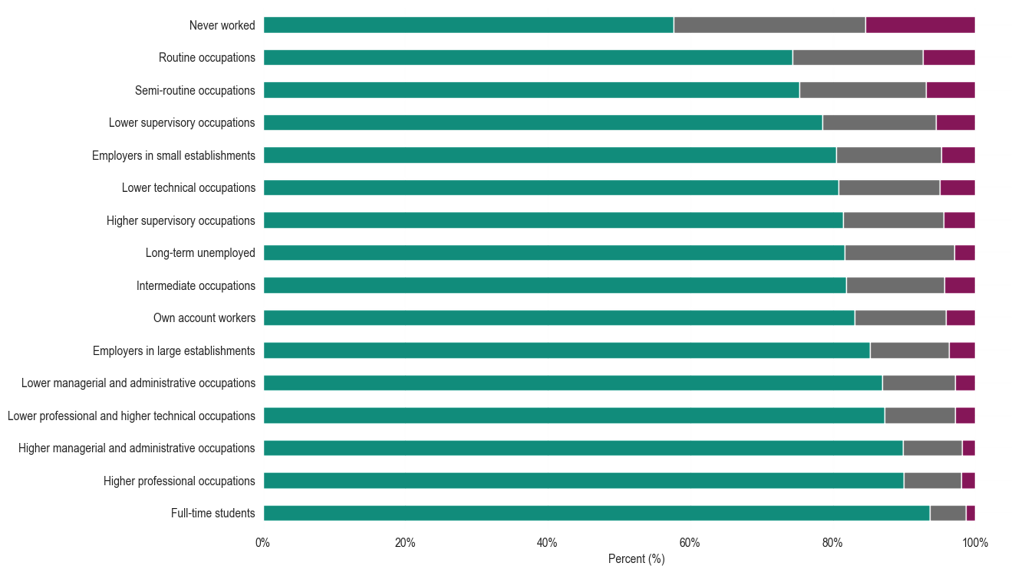
Health status by occupation. The occupation with the highest reported good health is full-time students (at around 93%), followed by Higher professional occupations (at around 89%), and Higher managerial and administrative occupations (at around 89%). The occupation reporting the highest amount of fair health is Never worked (at around 24%). The The occupation reporting the highest amount of poor health is Never worked (at around 17%).
Key to the above graph. Green represents good health, grey represents fair health, and purple represents not good health.

From left to right, the bars are “Good health”, “Fair health”, and “Not good health”.

Data Source: ONS Census 2021

Economic activity and proficiency in English

  • In East Surrey, most of the people who reported being ‘non native speaker; fluent in English’ also reported being economically active and employed at 76.2%.
  • Most of the people who reported ‘limited English’ also reported being economically inactive at 48.9%.

Economic activity by English proficiency
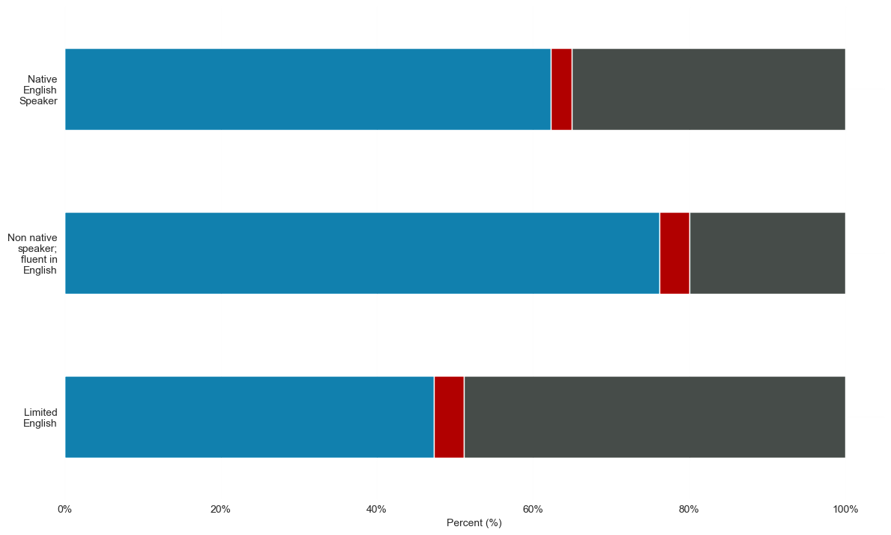
Economic activity by proficiency in English for East Surrey place. The group who reported the highest percentage of economically active: employed is Non-native speaker; fluent in English at around 77%. The groups reporting the highest percentage of economically active: unemployed are both Non-native speaker; fluent in English and Limited English at around 7%. The group reporting the highest percentage of economically inactive is Limited English at around 48%.
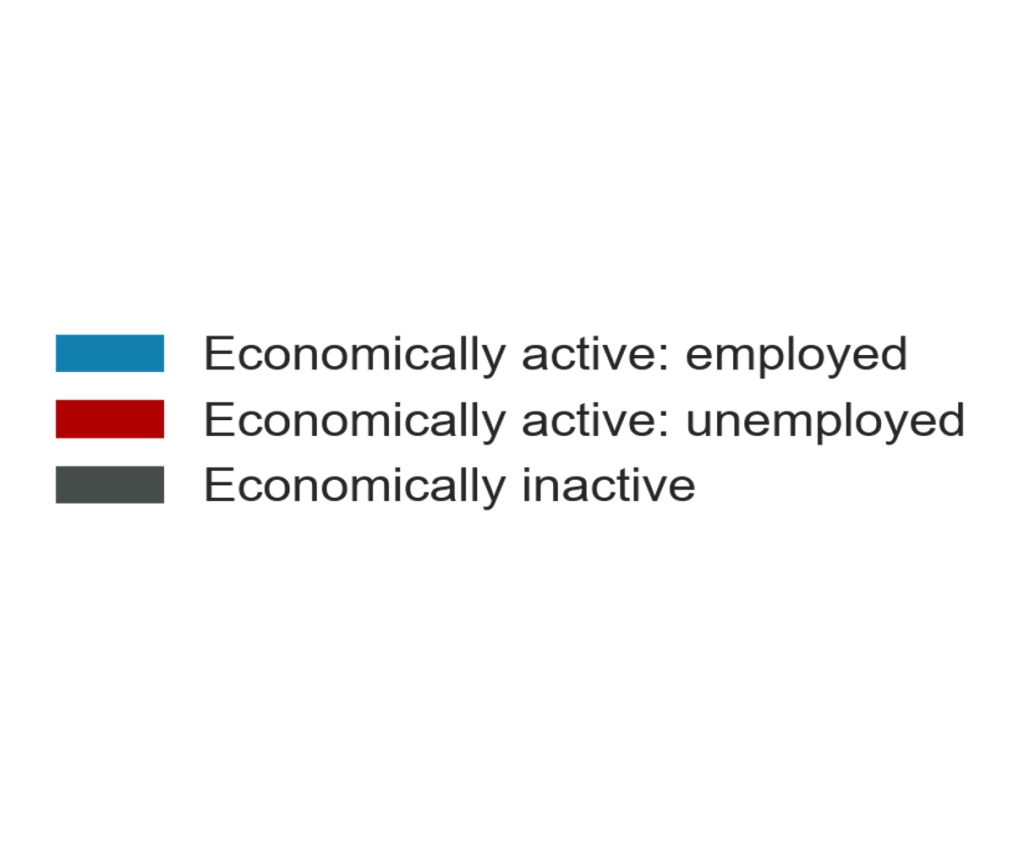
Key to the above graph. Blue represents economically active: employed. Red represents economically active: unemployed. Grey represents economically inactive.

From left to right, the bars are “Economically active: employed”, “Economically active: unemployed”, and “Economically inactive”.

Data Source: ONS Census 2021

Economically inactive and health status

  • In East Surrey, 3.62% of economically inactive people reported ‘not good health’ status, which is similar to the Surrey value of 3.41%.
  • South Tandridge (4.0%) reported a higher rate than the Surrey average.

Economically active reporting a ‘not good health’ status by Place
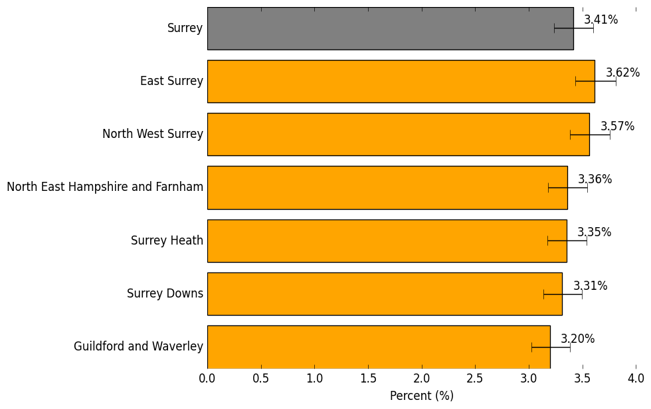
Economically inactive people reporting not good health status. 3.41% of economically inactive people reported not good health status in Surrey. 3.62% of economically inactive people reported not good health status in East Surrey, which is similar to the Surrey average. 3.57% of economically inactive people reported not good health status in North West Surrey, which is similar to the Surrey average. 3.36% of economically inactive people reported not good health status in North East Hampshire and Farnham, which is similar to the Surrey average. 3.35% of economically inactive people reported not good health status in Surrey Heath, which is similar to the Surrey average. 3.31% of economically inactive people reported not good health status in Surrey Downs, which is similar to the Surrey average. 3.20% of economically inactive people reported not good health status in Guildford and Waverley, which is similar to the Surrey average.

All the places are performing similarly to the Surrey average.

Economically active reporting a ‘not good health’ status by PCN
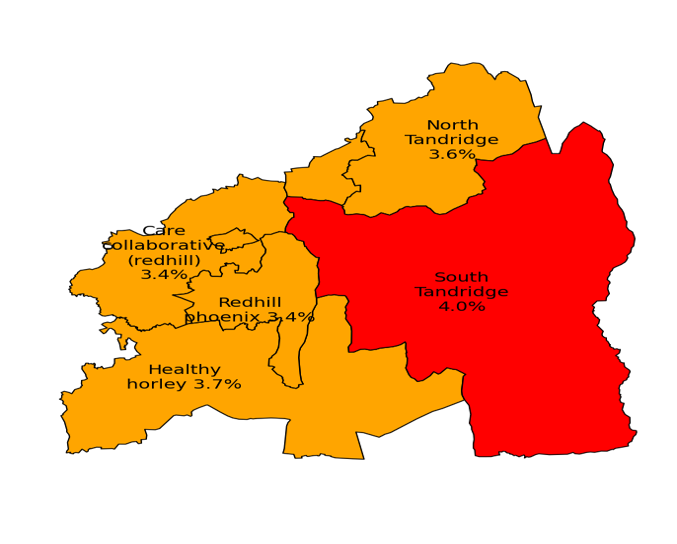
Economically inactive people reporting not good health by PCN in East Surrey. 3.4% of economically inactive people reported not good health status in Care Collaborative (Redhill), which is similar to the Surrey average. 3.4% of economically inactive people reported not good health status in Redhill Phoenix, which is similar to the Surrey average. 3.7% of economically inactive people reported not good health status in Healthy Horley, which is similar to the Surrey average. 3.6% of economically inactive people reported not good health status in North Tandridge, which is similar to the Surrey average. 4.0% of economically inactive people reported not good health status in South Tandridge, which is worse than the Surrey average.

Care Collaborative (Redhill), Redhill Phoenix, Healthy Horley, and North Tandridge are performing similarly to the Surrey average. South Tandridge is performing worse than the Surrey average.

Key for the above graph. Green indicates that an area is performing better than the Surrey average, yellow indicates that an area is performing similar to the Surrey average, and red indicates that an area is performing worse than the Surrey average.

Data Source: ONS Census 2021

Note: these are benchmarked against the Surrey average

Travel to work

In East Surrey, 42.64% of the population doesn’t travel to work.

Travelling to work in East Surrey
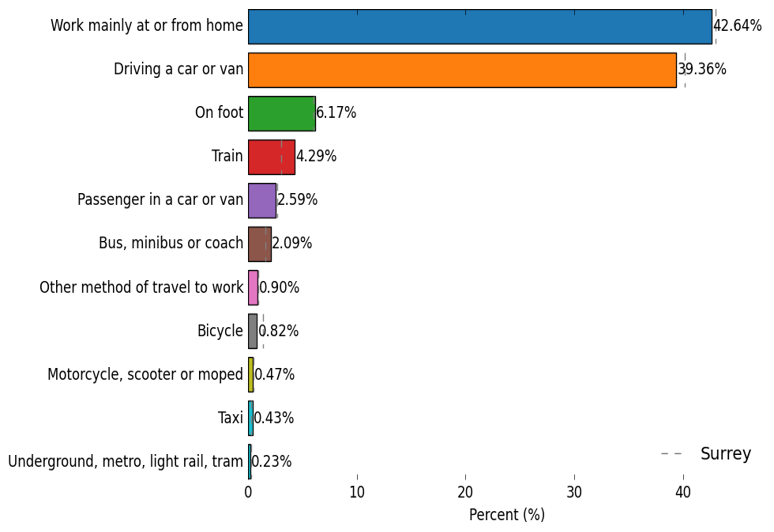
How East Surrey residents travel to work. The largest proportion of people Work mainly at or from home at 42.64%. Then in descending order of prevalence, the methods of transport are Driving a car or van (39.36%), On foot (6.17%), Train (4.29%), Passenger in a car or van (2.59%), Bus, minibus or coach (2.09%), Other method of travel to work (0.90%), Bicycle (0.82%), Motorcycle, scooter or moped (0.47%), Taxi (0.43%), and Underground, metro, light rail, tram (0.23%)

Data Source: ONS Census 2021

Mental Health

Social Emotional and Mental Health Needs – All Pupils

In East Surrey, the proportion of All Pupils with Social Emotional and Mental Health Needs is 3.1%, which is similar to the 3.5% observed in Surrey in 2022-23.

All Pupils with Social Emotional and Mental Health Needs by Place
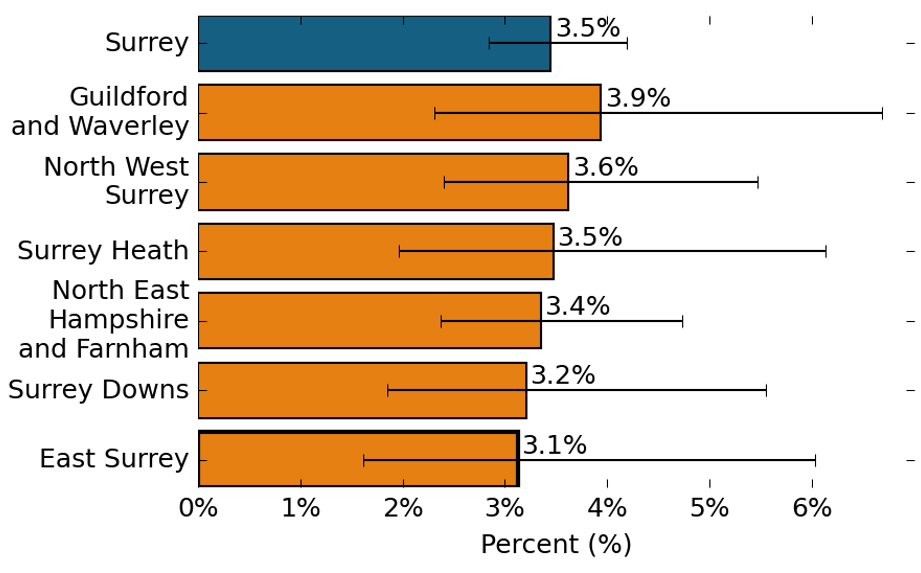
The proportion of all pupils with Social, Emotional and Mental Health needs. 3.5% of pupils in Surrey reported Social, Emotional and Mental Health needs. 3.9% of  pupils in Guildford and Waverley reported Social, Emotional and Mental Health needs, which is similar to the Surrey average. 3.6% of pupils in North West Surrey reported Social, Emotional and Mental Health needs, which is similar to the Surrey average. 3.5% of pupils in Surrey Heath reported Social, Emotional and Mental Health needs, which is similar to the Surrey average. 3.4% of pupils in North East Hampshire and Farnham reported Social, Emotional and Mental Health needs, which is similar to the Surrey average. 3.2% of pupils in Surrey Downs reported Social, Emotional and Mental Health needs, which is similar to the Surrey average. 3.1% of pupils in East Surrey reported Social, Emotional and Mental Health needs, which is similar to the Surrey average.

All Pupils with Social Emotional and Mental Health Needs in East Surrey
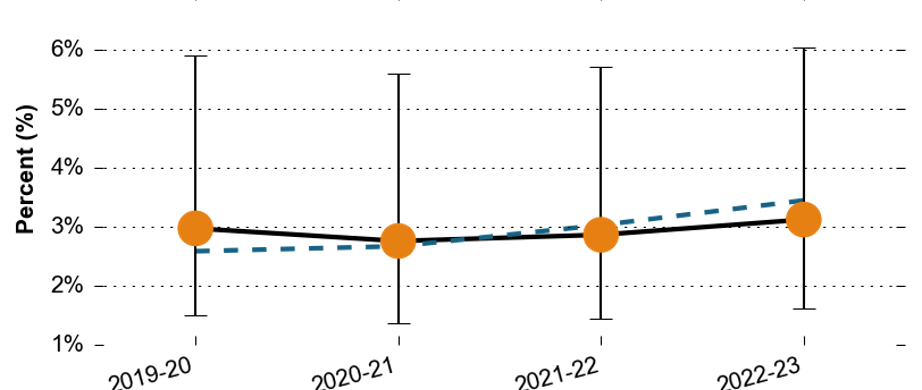
The proportion of all pupils with Social, Emotional and Mental Health needs in East Surrey over time. The proportion has mostly remained consistent over the past 3 years, however there was a slight dip to around 2.8% in 2020-21, and then rising to 3.1% in 2022-23. All the data points are similar to the Surrey average.
Key to the above graphs. Red indicates a value is greater than the Surrey average. Orange indicates a value is similar to the Surrey average. Green indicates a value is less than the Surrey average. Blue indicates the value is Surrey. Grey indicates the value cannot be compared to Surrey.

Data Source: Department of Education

Note: These are benchmarked against the Surrey average

Social Emotional and Mental Health Needs – Primary Pupils

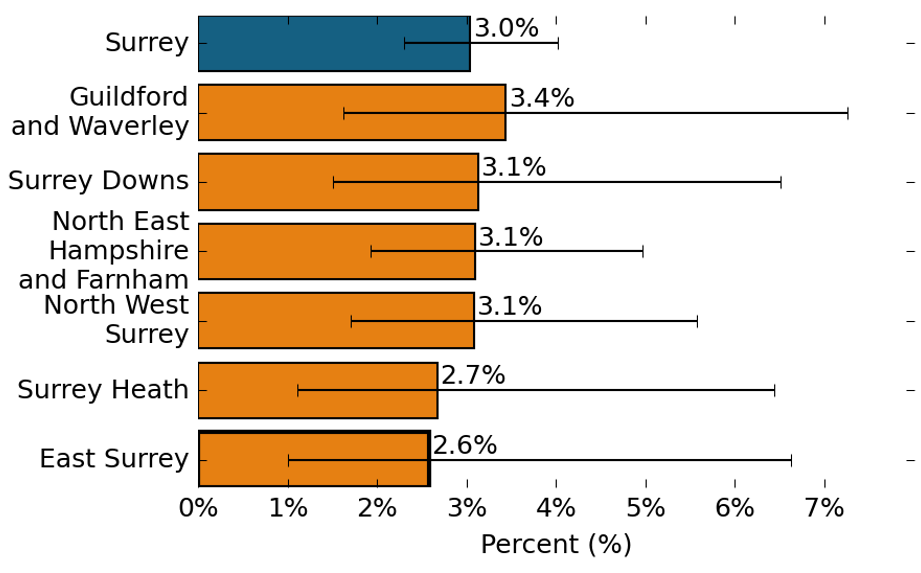
In East Surrey, the proportion of State-funded primary pupils with Social Emotional and Mental Health Needs is 2.6%, which is similar to the 3.0% observed in Surrey in 2022-23.

State-funded primary pupils with Social Emotional and Mental Health Needs by Place

The proportion of primary pupils with Social, Emotional and Mental Health needs. 3.0% of primary pupils in Surrey reported Social, Emotional and Mental Health needs. 3.4% of primary pupils in Guildford and Waverley reported Social, Emotional and Mental Health needs, which is similar to the Surrey average. 3.1% of primary pupils in Surrey Downs reported Social, Emotional and Mental Health needs, which is similar to the Surrey average. 3.1% of primary pupils in North East Hampshire and Farnham reported Social, Emotional and Mental Health needs, which is similar to the Surrey average. 3.1% of primary pupils in North West Surrey reported Social, Emotional and Mental Health needs, which is similar to the Surrey average. 2.7% of pupils in Surrey Heath reported Social, Emotional and Mental Health needs, which is similar to the Surrey average. 2.6% of pupils in East Surrey reported Social, Emotional and Mental Health needs, which is similar to the Surrey average.

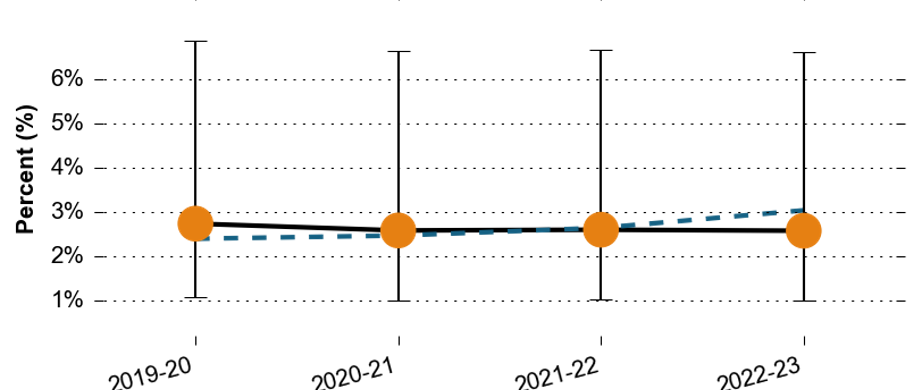
State-funded primary pupils with Social Emotional and Mental Health Needs in East Surrey

The proportion of primary pupils with Social, Emotional and Mental Health needs in East Surrey over time. The proportion has mostly remained consistent over the past 4 years, at around 2.8%. All the data points are similar to the Surrey average.
Key to the above graphs. Red indicates a value is greater than the Surrey average. Orange indicates a value is similar to the Surrey average. Green indicates a value is less than the Surrey average. Blue indicates the value is Surrey. Grey indicates the value cannot be compared to Surrey.

Data Source: Department of Education

Note: These are benchmarked against the Surrey average

Social Emotional or Mental Health Needs – Secondary Pupils

In East Surrey, the proportion of State-funded secondary pupils with Social Emotional or Mental Health Needs is 3.9%, which is similar to the 3.8% observed in Surrey in 2022-23.

State-funded secondary pupils with Social Emotional or Mental Health Needs by Place
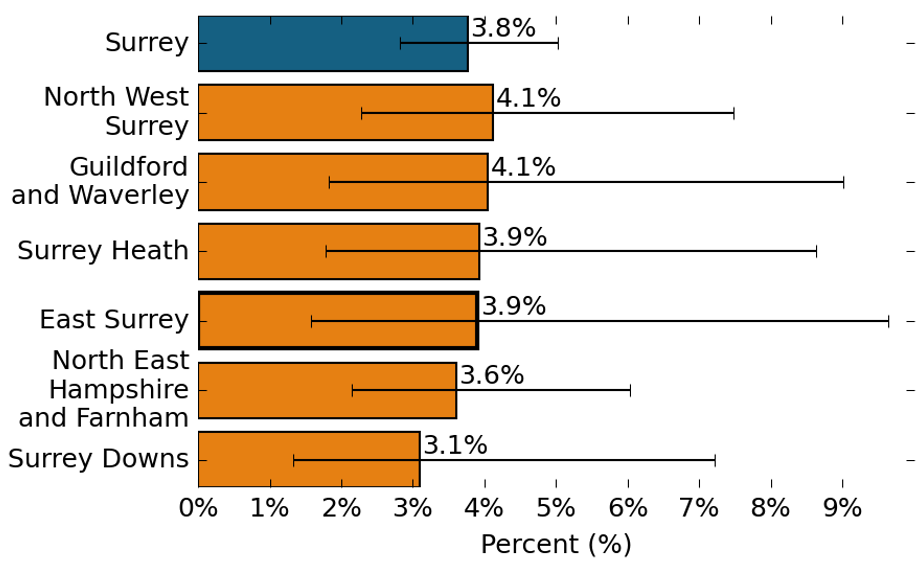
The proportion of secondary pupils with Social, Emotional and Mental Health needs. 3.8% of secondary pupils in Surrey reported Social, Emotional and Mental Health needs. 4.1% of secondary pupils in North West Surrey reported Social, Emotional and Mental Health needs, which is similar to the Surrey average. 4.1% of secondary pupils in Guildford and Waverley reported Social, Emotional and Mental Health needs, which is similar to the Surrey average. 3.9% of secondary pupils in Surrey Heath reported Social, Emotional and Mental Health needs, which is similar to the Surrey average. 3.9% of secondary pupils in East Surrey reported Social, Emotional and Mental Health needs, which is similar to the Surrey average. 3.6% of secondary pupils in North East Hampshire and Farnham reported Social, Emotional and Mental Health needs, which is similar to the Surrey average. 3.1% of secondary pupils in Surrey Downs reported Social, Emotional and Mental Health needs, which is similar to the Surrey average.

State-funded secondary pupils with Social Emotional or Mental Health Needs in East Surrey
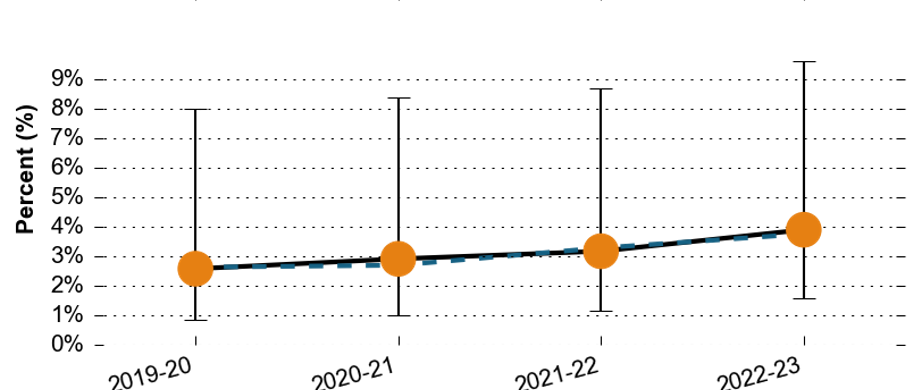
The proportion of secondary pupils with Social, Emotional and Mental Health needs in East Surrey over time. The proportion has been gradually increasing over time, with around 2.5% in 2019-20 to 3.9% in 2022-23. All of the values are similar to the Surrey average.
Key to the above graphs. Red indicates a value is greater than the Surrey average. Orange indicates a value is similar to the Surrey average. Green indicates a value is less than the Surrey average. Blue indicates the value is Surrey. Grey indicates the value cannot be compared to Surrey.

Data Source: Department of Education

Note: These are benchmarked against the Surrey average

Reported a Mental Health Condition

In East Surrey, 11.7% reported a mental health condition, which is similar to the 10.1% observed in Surrey in 2023.

People that Reported A Mental Health Condition by Place
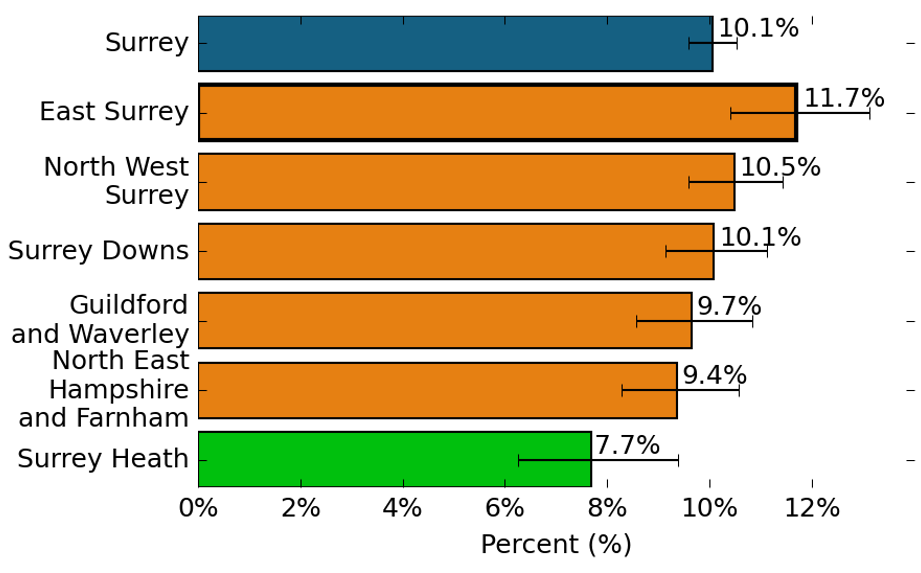
The proportion of people that have reported a mental health condition. In Surrey, the proportion of people reporting a mental health condition is 10.1%. In East Surrey, the proportion of people reporting a mental health condition is 11.7%, which is similar to the Surrey average. In North West Surrey, the proportion of people reporting a mental health condition is 10.5%, which is similar to the Surrey average. In Surrey Downs, the proportion of people reporting a mental health condition is 10.1%, which is similar to the Surrey average. In Guildford and Waverley, the proportion of people reporting a mental health condition is 9.7%, which is similar to the Surrey average. In North East Hampshire and Farnham, the proportion of people reporting a mental health condition is 9.4%, which is similar to the Surrey average. In Surrey Heath, the proportion of people reporting a mental health condition is 7.7%, which is better than the Surrey average.

People that Reported A Mental Health Condition in East Surrey
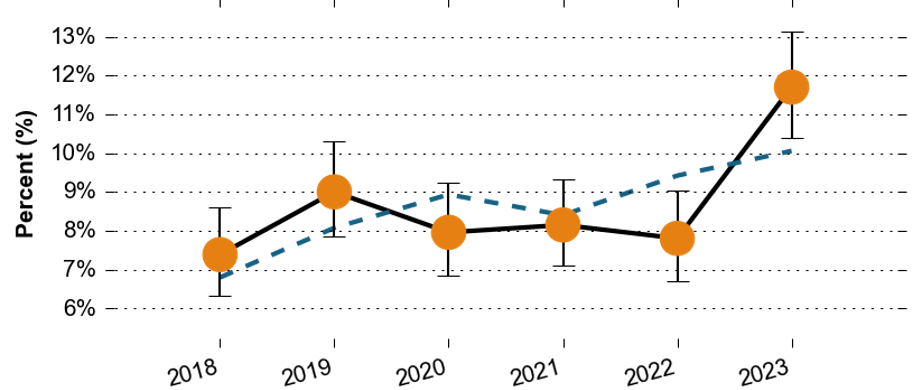
The proportion of people that have reported a mental health condition over time in East Surrey. From about 7.4% in 2018, the proportion rose to around 9.0% in 2019. It then decreased to around 8% until 2023, where it rapidly increased to around 11.6%. All the figures are similar to the Surrey average.

People that Reported A Mental Health Condition by PCN in East Surrey
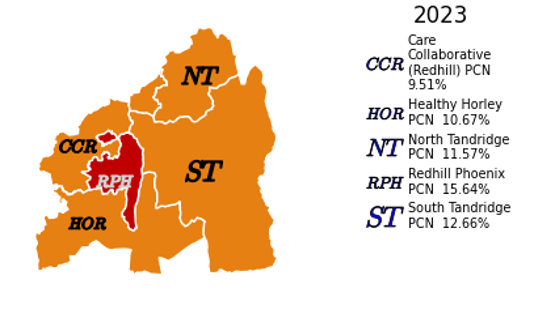
The proportion of people that have reported a mental health condition by PCN in East Surrey. In Care Collaborative (Redhill), the proportion of people reporting a mental health condition is 9.51%, which is similar to the Surrey average. In Redhill Phoenix, the proportion of people reporting a mental health condition is 15.64%, which is greater than the Surrey average. In Healthy Horley, the proportion of people reporting a mental health condition is 10.67%, which is similar to the Surrey average. In North Tandridge, the proportion of people reporting a mental health condition is 11.57%, which is similar to the Surrey average. In South Tandridge, the proportion of people reporting a mental health condition is 12.66%, which is similar to the Surrey average.
Key to the above graphs. Red indicates a value is greater than the Surrey average. Orange indicates a value is similar to the Surrey average. Green indicates a value is less than the Surrey average. Blue indicates the value is Surrey. Grey indicates the value cannot be compared to Surrey.

Data Source: GP Patient Survey

Note: These are benchmarked against the Surrey average

Musculoskeletal

Reported problems with physical mobility

In East Surrey, 9.0% reported problems with physical mobility, which is similar to the 9.8% observed in Surrey in 2023.

People that reported problems with physical mobility by Place
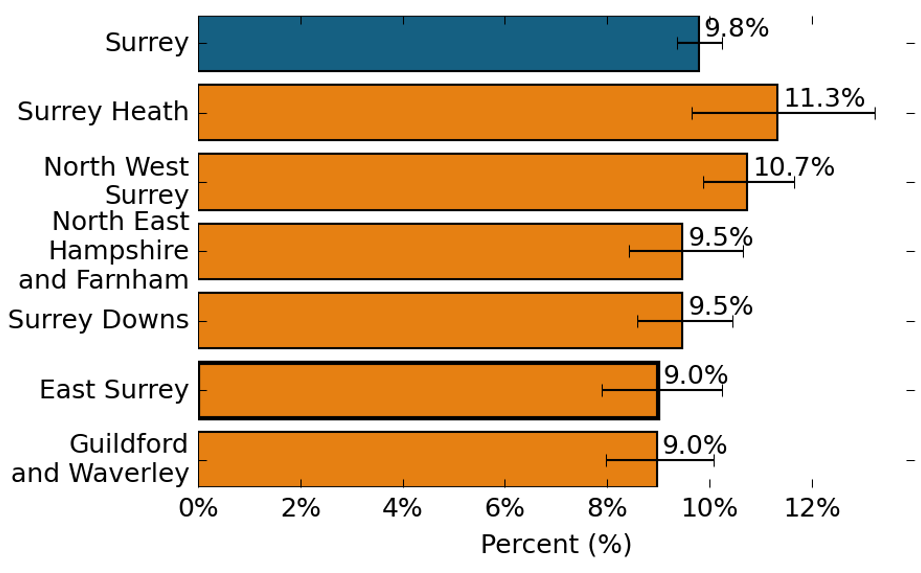
The proportion of people reporting problems in physical mobility. In Surrey, the proportion of people reporting problems in physical mobility is 9.8%. In Surrey Heath, the proportion of people reporting problems in physical mobility is 11.3%, which is similar to the Surrey average. In North West Surrey, the proportion of people reporting problems in physical mobility is 10.7%, which is similar to the Surrey average. In North East Hampshire and Farnham, the proportion of people reporting problems in physical mobility is 9.5%, which is similar to the Surrey average. In Surrey Downs, the proportion of people reporting problems in physical mobility is 9.5%, which is similar to the Surrey average. In East Surrey, the proportion of people reporting problems in physical mobility is 9.0%, which is similar to the Surrey average. In Guildford and Waverley, the proportion of people reporting problems in physical mobility is 9.0%, which is similar to the Surrey average.

People that reported problems with physical mobility in East Surrey
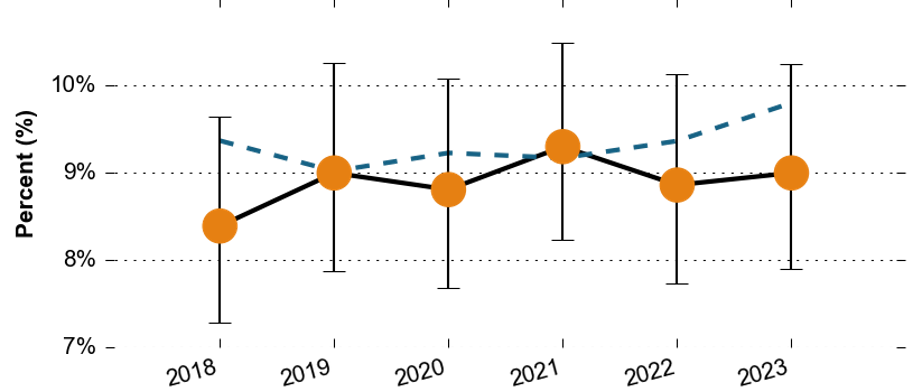
The proportion of people reporting problems in physical mobility over time in East Surrey. In 2018, the proportion was around 8.4%. The value has been fluctuating around the 9% mark since then, with it being the lowest in 2020 at around 8.8%, and the highest in 2021 at around 9.2%. In 2023, the value is around 9.0%. All the value are similar to the Surrey average.

People that reported problems with physical mobility by PCN
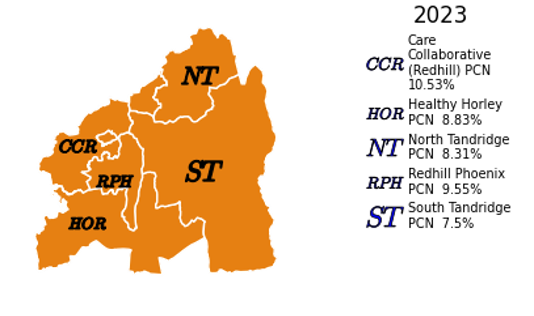
The proportion of people reporting problems in physical mobility by PCN in East Surrey. In Care Collaborative (Redhill), the proportion of people reporting problems in physical mobility is 10.53%, which is similar to the Surrey average. In Redhill Phoenix, the proportion of people reporting problems in physical mobility is 9.55%, which is similar to the Surrey average. In Healthy Horley, the proportion of people reporting problems in physical mobility is 8.83%, which is similar to the Surrey average. In North Tandridge, the proportion of people reporting problems in physical mobility is 8.31%, which is similar to the Surrey average. In South Tandridge, the proportion of people reporting problems in physical mobility is 7.5%, which is similar to the Surrey average.
Key to the above graphs. Red indicates a value is greater than the Surrey average. Orange indicates a value is similar to the Surrey average. Green indicates a value is less than the Surrey average. Blue indicates the value is Surrey. Grey indicates the value cannot be compared to Surrey.

Data Source: GP Patient Survey

Note: These are benchmarked against the Surrey average

Reported two or more falls that have needed medical attention

In East Surrey, 1.2% reported two or more falls that have needed medical attention, which is similar to the 1.8% observed in Surrey in 2023.

People that reported two or more falls that have needed medical attention by Place
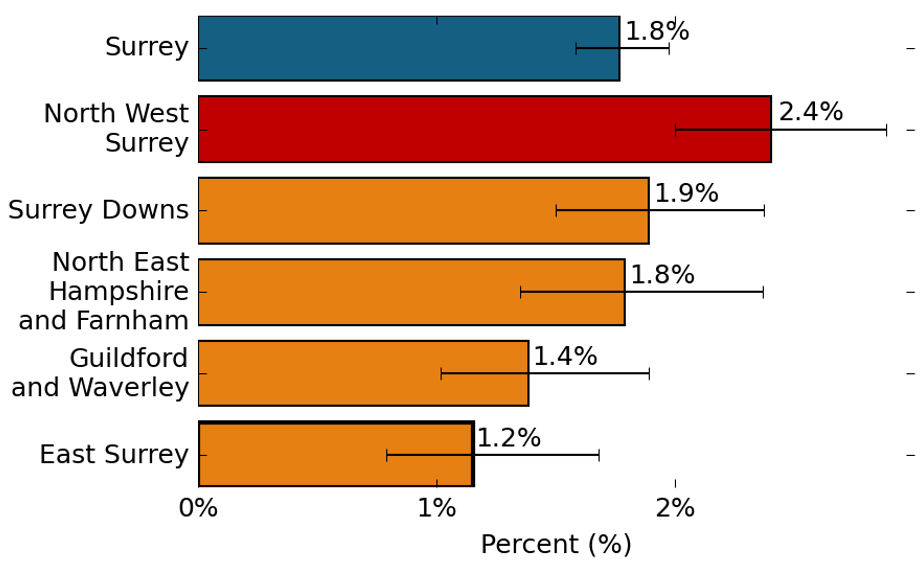
The proportion of people that reported two or more falls that have needed medical attention. In Surrey, the proportion of people that reported two or more falls that have needed medical attention is 1.8%. In North West Surrey, the proportion of people that reported two or more falls that have needed medical attention is 2.4%, which is higher than the Surrey average. In Surrey Downs, the proportion of people that reported two or more falls that have needed medical attention is 1.9%, which is similar to the Surrey average. In North East Hampshire and Farnham, the proportion of people that reported two or more falls that have needed medical attention is 1.8%, which is similar to the Surrey average. In Guildford and Waverley, the proportion of people that reported two or more falls that have needed medical attention is 1.4%, which is similar to the Surrey average. In East Surrey, the proportion of people that reported two or more falls that have needed medical attention is 1.2%, which is similar to the Surrey average.

People that reported two or more falls that have needed medical attention in East Surrey
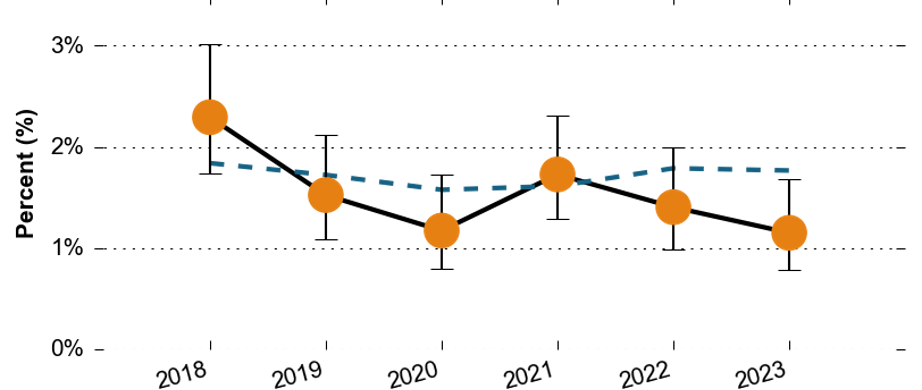
The proportion of people that reported two or more falls that have needed medical attention over time in East Surrey. In 2018, the proportion was around 2.2%. It then dropped to around 1.3% in 2020. It rose slightly in 2021 to around 1.8%, and then decreased again to around 1.2% in 2023. All these values are similar to the Surrey average.

People that reported two or more falls that have needed medical attention by PCN
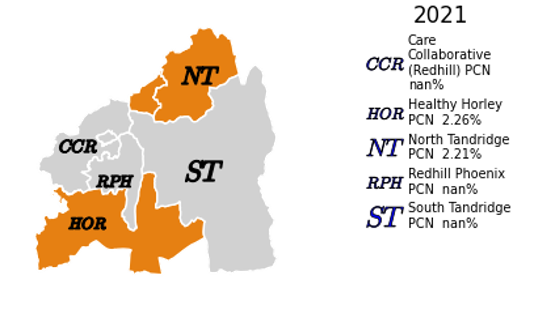
The proportion of people that reported two or more falls that have needed medical attention by PCN in East Surrey. In Healthy Horley, the proportion of people that reported two or more falls that have needed medical attention is 2.26%, which is similar to the Surrey average. In North Tandridge, the proportion of people that reported two or more falls that have needed medical attention is 2.21%, which is similar to the Surrey average. Care Collaborative (Redhill), Redhill Phoenix, and South Tandridge all have no data, and cannot be compared to the Surrey average.

Key to the above graphs. Red indicates a value is greater than the Surrey average. Orange indicates a value is similar to the Surrey average. Green indicates a value is less than the Surrey average. Blue indicates the value is Surrey. Grey indicates the value cannot be compared to Surrey.

Data Source: GP Patient Survey

Note: These are benchmarked against the Surrey average

Loneliness

Reported feeling isolated from others

In East Surrey, 5.8% reported feeling isolated from others, which is similar to the 6.2% observed in Surrey in 2023.

People that reported feeling isolated from others by Place
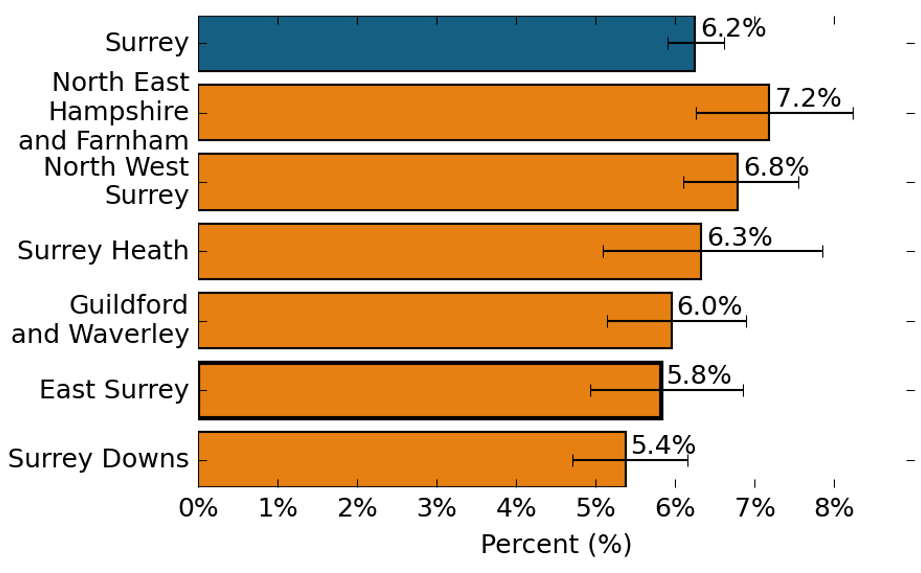
The proportion of people that reported feeling isolated from others. In Surrey, the proportion of GP Patients that reported feeling isolated from others is 6.2%. In North East Hampshire and Farnham, the proportion of people that reported feeling isolated from others is 7.2%, which is similar to the Surrey average. In North West Surrey, the proportion of people that reported feeling isolated from others is 6.8%, which is similar to the Surrey average. In Surrey Heath, the proportion of people that reported feeling isolated from others is 6.3%, which is similar to the Surrey average. In Guildford and Waverley, the proportion of people that reported feeling isolated from others is 6.0%, which is similar to the Surrey average. In East Surrey, the proportion of people that reported feeling isolated from others is 5.8%, which is similar to the Surrey average. In Surrey Downs, the proportion of people that reported feeling isolated from others is 5.4%, which is similar to the Surrey average.

People that reported feeling isolated from others in East Surrey
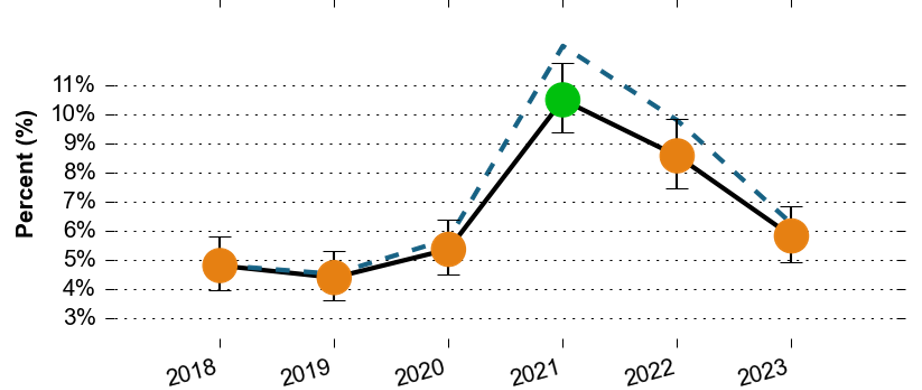
The proportion of people that reported feeling isolated from others over time in East Surrey. In 2018, the proportion was around 4.9%. It dipped slightly in 2019 to around 4.6%, and rose slightly again to around 5.3% in 2020. 2021 saw a massive increase to around 10.6%. It then started to decrease, 8.6% in 2022 and 5.9% in 2023. The value for 2021 is better than the Surrey average, but the rest of the values are similar to the Surrey average.

People that reported feeling isolated from others by PCN
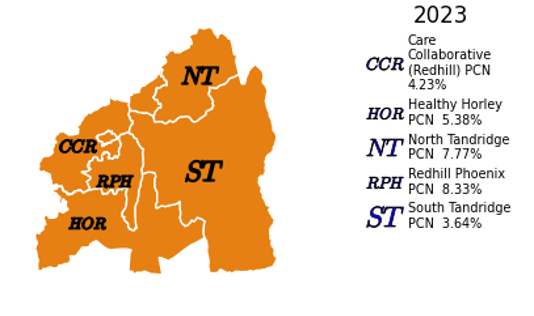
The proportion of people that reported feeling isolated from others by PCN in East Surrey. In Care Collaborative (Redhill), the proportion of people that reported feeling isolated from others is 4.23%, which is similar to the Surrey average. In Redhill Phoenix, the proportion of people that reported feeling isolated from others is 8.33%, which is similar to the Surrey average. In Healthy Horley, the proportion of people that reported feeling isolated from others is 5.38%, which is similar to the Surrey average. In North Tandridge, the proportion of people that reported feeling isolated from others is 7.77%, which is similar to the Surrey average. In South Tandridge, the proportion of people that reported feeling isolated from others is 3.64%, which is similar to the Surrey average.

Key to the above graphs. Red indicates a value is greater than the Surrey average. Orange indicates a value is similar to the Surrey average. Green indicates a value is less than the Surrey average. Blue indicates the value is Surrey. Grey indicates the value cannot be compared to Surrey.

Data Source: GP Patient Survey

Note: These are benchmarked against the Surrey average

Smoking

Described themselves as a current Smoker

In East Surrey, 11.5% described themselves as a current Smoker, which is similar to the 10.3% observed in Surrey in 2023.

People that Described themselves as a current Smoker by Place
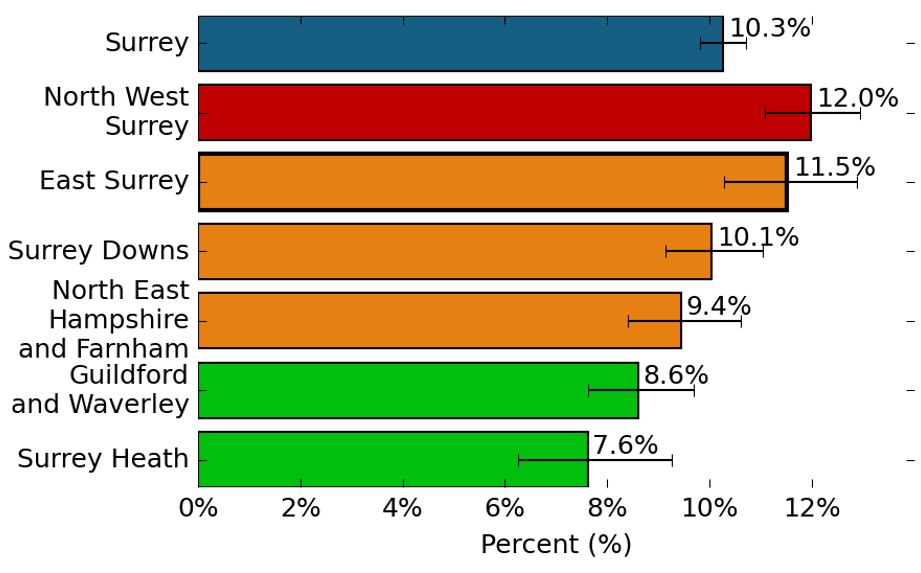
The proportion of people that described themselves as a current smoker. In Surrey, the proportion of people that described themselves as a current smoker is 10.3%. In North West Surrey, the proportion of people that described themselves as a current smoker is 12.0%, which is higher than the Surrey average. In East Surrey, the proportion of people that described themselves as a current smoker is 11.5%, which is similar to the Surrey average. In Surrey Downs, the proportion of people that described themselves as a current smoker is 10.1%, which is similar to the Surrey average. In North East Hampshire and Farnham, the proportion of people that described themselves as a current smoker is 9.4%, which is similar to the Surrey average. In Guildford and Waverley, the proportion of people that described themselves as a current smoker is 8.6%, which is better than the Surrey average. In Surrey Heath, the proportion of people that described themselves as a current smoker is 7.6%, which is better than the Surrey average.

People that Described themselves as a current Smoker in East Surrey

The proportion of people that described themselves as a current smoker over time in East Surrey. In 2018 the value was around 11.8%. It then decreased to around 10.8% in 2019, and rose again in 2020 to around 12.2%. It then decreased in 2021 to around 10.6%, and then rose again to around 11.0% in 2022 and 11.5% in 2023. All these values are similar to the Surrey average.

People that Described themselves as a current Smoker by PCN
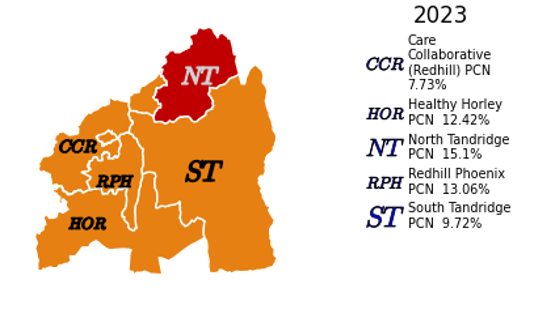
The proportion of people that described themselves as a current smoker by PCN in East Surrey. In Care Collaborative (Redhill), the proportion of people that described themselves as a current smoker is 7.73%, which is similar to the Surrey average. In Redhill Phoenix, the proportion of people that described themselves as a current smoker is 13.06%, which is similar to the Surrey average. In Healthy Horley, the proportion of people that described themselves as a current smoker is 12.42%, which is similar to the Surrey average. In North Tandridge, the proportion of people that described themselves as a current smoker is 15.1%, which is higher than the Surrey average. In South Tandridge, the proportion of people that described themselves as a current smoker is 9.72%, which is similar to the Surrey average.
Key to the above graphs. Red indicates a value is greater than the Surrey average. Orange indicates a value is similar to the Surrey average. Green indicates a value is less than the Surrey average. Blue indicates the value is Surrey. Grey indicates the value cannot be compared to Surrey.

Data Source: GP Patient Survey

Note: These are benchmarked against the Surrey average