
Community Safety
Community Safety
Publication Date
This chapter was published in February 2025.
Contents
- Community Safety Dashboard
- Introduction
- Protecting our most vulnerable
- Protecting our communities from harm
- Recommendations
- References
Community Safety Dashboard
The data underpinning this JSNA Chapter can be explored further in the Community Safety JSNA Dashboard.

Introduction
Surrey is one of the safest places in England and Wales, currently ranked 4th safest place to live in the UK. This uses numbers of police recorded crime and considers severity and violence. [1] Despite this crime and the fear of crime still exists. Some want to do harm within our communities and to our most vulnerable residents.
Community safety is an area of work concerned with protecting people, individually and collectively, and their quality of life, from hazards or threats that result from the criminal or anti-social behaviour of others [2]. As such the range of behaviours and interventions that can be defined as falling within Community Safety are hugely varied and are too complex for one single agency to tackle. A collaborative approach across Police, Fire and Rescue services and local authorities is required.
Community Safety Partnerships (CSPs) were introduced in the Crime and Disorder Act 1998 (Section 6, Crime and Disorder Act 1998) and placed a statutory duty on responsible authorities to formulate and implement strategies to tackle crime, disorder and antisocial behaviour in their communities based on the principle that effective partnership working is vital to ensuring safer communities. The responsible authorities of CSPs are:
- Police
- Fire and Rescue Authorities
- Local Authorities
- Health Partners
- Probation Service
There are 11 CSP’s across Surrey, one for each borough and district council. Each are required to provide a partnership plan evidencing how the partnership intends to tackle crime and anti-social behaviour in their area and that sets clear and robust priorities.
As a two-tier authority, Surrey is required under section 17 of the Crime and Disorder Act 1998 to have a County Community Safety Agreement (CSA). This document aims to assist CSPs in sharing capabilities and resources to better respond to individuals with complex needs. It focuses on improving the identification and support of vulnerable people, prioritising key areas across the county and enhancing support for victims of crime and anti-social behaviour. Additionally, it promotes a whole place approach to commissioning and delivering preventative services. It is anticipated that this JSNA chapter will support the formulation of a future CSA.
Surrey’s Police and Crime Commissioner (PCC) has a statutory duty to set police and crime objectives across the county through a Police and Crime Plan and through this has a responsibility to bring together community safety and criminal justice partners and make sure local priorities are joined up. The PCC consults widely with both community safety partners as well as the public to develop the Police and Crime Plan priorities. The 2011 Police Reform and Social Responsibility Act established that PCCs and CSPs must act in cooperation with each other, both giving due regard to each other’s priorities. The Crime and Disorder Act 2007 gives PCCs in England the power to require representatives of responsible authorities within a police force area to attend a meeting to assist in the formulisation and implementation of strategies. Further reviews into the responsibilities of PCCs are currently being undertaken but it is understood new legislation will strengthen these responsibilities.
The Community Safety Vision for Surrey 21- 25 as articulated in the CSA is to ensure that we:
- Protect our most vulnerable
- Protect our communities from harm
- Empower our communities to feel safe
The priorities set within the Surrey CSA as well as government priorities have informed the development of this JSNA chapter and it focusses on the following issues and areas of need:
Protecting our most vulnerable:
- Serious Violence
- Domestic Abuse
- Preventing Extremism
- Serious and Organised Crime which includes Child Exploitation, Fraud and Modern Slavery
- Violence Against Women and Girls
- Hate Crime and Community Cohesion
Protecting our Communities from Harm:
- Anti-Social Behaviour
- Fire Safety
- Road Safety
Drugs which is a feature of the CSA under Protecting Communities from Harm is covered in the Substance Misuse JSNA chapter.
The community safety vision of empowering our communities to feel safe, relates to the building of community safety resilience and awareness raising and work to improve these forms a part of each of the two preceding sections.
As in any comprehensive document of this kind there will be information and data gaps which prevent us from fully understanding all the issues. This chapter intends to identify those gaps as part of unmet need so that decisions can be taken about how improvements can be made.
The recommendations in this chapter should be considered by CSP’s to inform local work and will be progressed within countrywide strategic oversight groups which have a remit for the specific issues contained within the chapter.
Protecting our most vulnerable
Serious violence
The National Context
In 2018 the Government published its Serious Violence Strategy setting out its analysis of drivers and trends of serious violence and its plans for reducing and preventing violence in our communities. Over the subsequent years the Government have established; violence reduction units in the areas with the highest levels of homicide, knife crime and A&E admissions, established the Youth Endowment Fund to support projects and action, developed a research platform to inform commissioners of what works and finally in 2022 the Home Office brought forward legislation to introduce the Serious Violence Duty (SVD).
The purpose of the SVD is to ensure that relevant services work together to share data, intelligence, and knowledge to understand and address the root causes of serious violence. It also allows the specified authorities to develop and target their interventions to prevent and stop violence altogether.
The SVD aims to ensure that agencies focus their activity on reducing serious violence whilst also providing sufficient flexibility so that the relevant organisations can engage and work together in the most effective local partnership for any given area. It strongly encouraged local areas to adopt a public health approach to reducing violence. It is SVD that has provided Surrey with the mechanisms and means to build a partnership response to serious violence in Surrey.
The Duty requires the following specified authorities within a local government area to collaborate and plan to prevent and reduce serious violence:
- Police
- Probation Services or Youth Offending Teams
- Fire and Rescue
- Integrated Care Boards
- District and Borough Councils
- County Councils
- Schools and the Education Authority must collaborate
- Prison Services must collaborate as requested
The full Serious Violence Duty guidance can be found here.
Our approach
In Surrey we follow a public health approach and the recommendations from the 2019 across government publication – ‘A whole systems multi agency approach to serious violence prevention’. This approach considers that serious violence is not inevitable and is preventable but cannot be tackled in isolation. It must be addressed through prevention strategies that consider the multiple risk factors that cause and perpetuate violence such as deprivation, early life trauma and emotional and physical health, and promote the protective factors that mitigate against the growth and victimisation of violence.
This approach means violence reduction interventions are not constrained by our organisational or professional boundaries and remain focused on generating long term reductions as well as short term solutions. At the core of the approach, data and intelligence is used to identify the burden on the population, including any inequalities, meaning actions responding to the problem are rooted in evidence of effectiveness.
In understanding the causes and contributing factors of violence, we can deliver across four different levels of prevention aimed at addressing the risk factors, reducing prevalence and threat of violence:
- Contextual prevention, meaning we support the creation of the conditions that prevent violence. These include economic growth, social-cultural change, environmental and legislative change.
- Primary prevention, meaning preventing violence before it happens by understanding the root causes and working to strengthen the protective factors at the earliest stage.
- Secondary prevention, being an immediate response to early instances of violence and ensuring the provision of timely, tailored and effective interventions.
- Tertiary prevention, focusing on those engaged in violence by providing effective support to work towards rehabilitation.
We have adopted the five key principles of the public health approach.
Local Response
Surrey Serious Violence Needs Assessment
The headlines from the partnership’s Surrey Serious Violence Needs Assessment and Surrey Police’s Strategic Assessment tells us that violence in all police recorded crime categories has increased with Violence Against Women and Girls (VAWG) offences increasing the most. It is believed this is in part due to an increase in confidence to report.
The night-time economy and alcohol are key drivers of serious violence. Offending continues to peak during evenings, particularly at the weekends, and in the summer and early autumn. Serious violence involving those under the age of 18 increases after the end of the school day. Public place violence predominately occurs in city and town centre locations. Hotspots typically coincide with areas of greater deprivation, and around hospitals, courts, police stations or prisons.
Surrey has clear hot spot areas across the county for both violence with and without injury and knife crime. These hot spots are clearly linked to our town centres and more urban areas. (A list of Surrey Hotspot areas are listed below).
White males between 25 and 34 years old are most vulnerable to serious violence, however there are areas, such as domestic serious violence, that disproportionately affect females.
The role of victim and offender can be interchangeable, and they are most commonly strangers, followed by rivals or feuding. Deprivation, other poverty related issues and substance misuse are common amongst those involved.
Drug use, supply and exploitation are likely to be amongst the key drivers of Surrey’s serious violence. The true scale of drug related violence remains unknown and is almost certainly underreported due to fear of reprisals. Those in the lower tiers of drugs supply networks pose, and are at, the most risk of violence. It is a realistic possibility that local drug dealing lines will see an increase in violence due to a greater presence of those with previous affiliations running them.
Those involved in the most serious offences often have complex needs, with childhood trauma, mental ill health or neurodiversity disproportionately present in the offender and victims’ cohorts. Offending can continue into adulthood; poverty related issues, school exclusions and persistent absences are indicators for lifelong involvement in serious violence.
There has been an increase in admissions to A&E with an assault with a bladed article with numbers tending to peak in October and November with males being the predominant gender although there is a need to capture this data better.
Social media alters perceptions of violence and increases fear, resulting in a change of behaviour by those who perceive themselves at risk, and provides an environment to escalate rivalries and grudges.
Data for Children and Young People shows us that violence is also rising, especially amongst the young female cohort.
The needs assessment also identified gaps and limitations in our data and the partnership committed to focusing on improved accuracy of data collection, understanding the community impact and developing a better understanding of our offending and victim cohorts.
Surrey Serious Violence Reduction Strategy
In response to the Serious Violence Needs Assessment the partnership developed a strategy, focusing on reducing and preventing violence.
The vision of the strategy is: The Surrey Serious Violence Reduction Partnership will work together to prevent harm, reduce the occurrence of violence, develop a counter-narrative around violence and increase confidence in neighbourhoods. With insight and data, we can co-design interventions and support, which will not only reduce the violence but work to prevent the causal factors that allow violence to grow.
The partnerships priorities have been developed to meet this vision.
Table 1: priorities and aims of the Surrey Serious Violence Reduction Partnership
| Priority: | Main Aim: |
| Leadership | To create system change through investing in a dynamic governance structure that enables the cultural change necessary to bring about long-term reduction in the drivers of violence. |
| Evidence | To maximise our impact with smarter use of data and intelligence to create targeted solutions. |
| Connections | To develop a placed based, community led response to serious violence. |
| Focus | To prevent and deter serious violence by developing responses that address the causes, reducing the risk factors and increasing the protective factors. |
Governance
In 2024 the Surrey Serious Violence Reduction Partnership (SSVRP) was established. The SSVRP has provided a forum for system leadership that coordinates a collaborative approach and fosters greater consistency across the work programmes that tackle serious violence. This approach has assisted all the relevant Executives and Boards in understanding the driving factors of violence and their role in preventing violence from escalating.
Members of the SSVRP will –
- Agree and oversee the Serious Violence Reduction Strategy and delivery plans for Surrey.
- Provide strategic support and updates from their respective areas of expertise.
- Provide leadership and remove strategic challenges and barriers.
- Work as a partnership and make joint decisions to deliver the Serious Violence Duty.
- Support OPCC in meeting the requirement of the Serious Violence Home Office grant and oversee the funding allocation for Surrey.
The establishment of the SSVRP does not take away the ownership of the respective workstreams but provides the opportunity to work across the strands, sharing and linking into their respective networks and resources. The SSVRP will report into the Health and Wellbeing Board and support the priority 3 and that People are safe and feel safe. The SSVRP will also report into the Community safety Partnerships, recognising their role in supporting the delivery of the Surrey Serious Violence Reduction Strategy.
Domestic abuse
Domestic abuse (DA) is defined by the UK government as ‘Behaviour of a person (“A”) towards another person (“B”) is “domestic abuse” if A & B are each aged 16 or over and are personally connected to each other, and the behaviour is abusive.
Behaviour is “abusive” if it consists of any of the following: physical or sexual abuse; violent or threatening behaviour; controlling or coercive behaviour; economic abuse; psychological, emotional, or other abuse’.
The Domestic Abuse Act 2021 sets out how people can be ‘personally connected’ including if they are or have been in an intimate relationship, married, civil partners, agree or have agreed to marry each other, have had, or have a parental relationship to a child or are relatives. There is no requirement for the victim and the perpetrator to cohabit although many will have.
National Context
- The police recorded 889,918 domestic abuse-related crimes across all police forces in England and Wales (excluding Devon and Cornwall) in the year ending March 2023.
- In the year ending March 2023, domestic abuse-related crimes represented 16.2% of all offences recorded by the police. Violence against the person had the highest proportion of offences identified as domestic abuse-related (34.0%).
- The National Domestic Abuse Helpline was contacted 171,490 times in the year ending March 2023; a decrease of 10.7% compared with the year ending March 2022.
- Data from Respect Men’s Advice Line for the year ending March 2023 show they were contacted 39,417 times, while the Respect Phoneline for perpetrators of domestic abuse were contacted 8,955 times.
- There were 370 domestic homicides recorded by the police in the period between year ending March 2020 and year ending March 2022. This represents approximately one in five of all homicides where the victim was aged 16 years and over. 67.3% of the victims of domestic homicide were female, compared to non-domestic homicides where many victims were male (87.8%).
- The Crime Survey for England and Wales estimated that 2.1 million people aged 16 years and over (1.4 million women and 751,000 men) experienced domestic abuse in the year ending March 2023. Less than 1 in 5 (18.9%) of those experiencing partner abuse told the police.
- 20% of children have lived with an adult perpetrating domestic abuse and 62% of children living with domestic abuse are directly harmed by the perpetrator of the abuse, in addition to the harm caused by witnessing the abuse of others.
- The social and economic costs of DA are estimated at £66 billion in England and Wales in the year 2016-17. £14 billion of this is the cost to the economy arising from lost output due to time off work.
- The Crime Survey for England and Wales showed that 57% of women who had experienced abuse before the age of 16 years, also experienced domestic abuse later in life. In comparison, 17% of women who did not experience abuse before the age of 16 years experienced domestic abuse later in life.
- The 2019 to 2020 Statutory Homelessness Annual Report showed that around 1 in 11 households in England (8.7%) who were homeless or threatened with homelessness recorded domestic abuse as the main reason. And the charity St Mungo’s reported that 35% of women they worked with who had slept rough left home to escape violence.
In February 2024 following a public consultation, the Government announced that they were renaming Domestic Homicide Reviews to Domestic Abuse Related Death Reviews, to better reflect all deaths which fall within their scope. The new changes were made after concerns were raised by charities and bereaved families that the previous definition did not fully reflect the range of domestic abuse related deaths (specifically suicide related deaths). The changes will be brought into law via an amendment to the Victims and Prisoners Bill.
Local context
Tackling Domestic Abuse requires a multiagency response which in Surrey is co-ordinated through the Domestic Abuse Executive Group. This includes partners from Health, Surrey Police, the Office of the Police and Crime Commissioner (OPCC), Housing, Specialist Domestic Abuse Services, Adult Social Care, and Children’s Social Care. The Executive oversees five working groups which are responsible for the continuous improvement of domestic abuse services and the response to domestic abuse of all partners.
Domestic Abuse services in Surrey are commissioned by Surrey County Council, Surrey Police, and the Office of the Police and Crime Commissioner (OPCC). In some cases, this is joint commissioning.
Due to the nature of the offence, how a victim might seek help and the different methods of recording by agencies across Surrey, lead to challenges with understanding an accurate record of need. Below provides some of the data picture for the county.
Surrey Police Data
The total number of DA related incidents recorded by Surrey Police in 2023-4 fell by 3% compared to the previous year, although there was a lot of variation across the year, from a peak of 703 in December to a low of 530 in January. This reduction is in line with data from other forces. DA incidents are those where no criminal offence has been disclosed.
The total number of DA related crimes was very similar to 2022-3 and 2% lower than 2021-2. The monthly figures ranged from 639 in January to 726 in February.
Figure 1: Domestic abuse related incidents in Surrey
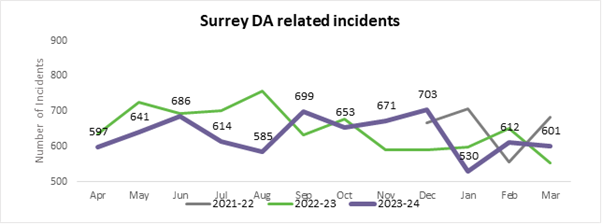
Figure 2: Domestic abuse related crimes in Surrey
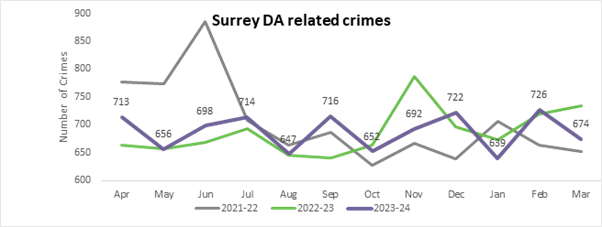
Figure 3: Domestic Abuse Outreach Data
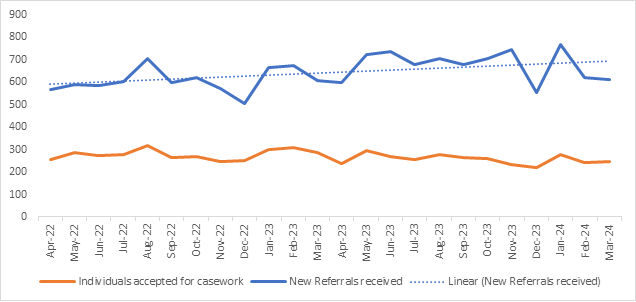
8124 referrals relating to 5205 individuals were received by outreach services in 2023-4 under the previous contract, with 46% of referrals coming from police.
3081 people were accepted for case work, 95% of whom were female, and the largest age groups were 25-34 and 35-44, which made up 56%.
138 children and young people were supported via group work and 1:1 work.
In 71% of cases the perpetrator was ex or current intimate partner, with spouse making up a further 13%.
Emotional abuse was the most reported type of abuse, being present in 72% of cases. Jealous / controlling behaviour was reported in 40% of cases, and physical abuse in a third.
Surrey Domestic Abuse Helpline Data
The Surrey Domestic Abuse helpline is provided by Your Sanctuary and provides emotional and practical support Monday to Friday 09:00 to 16:00.
Figure 4: Contacts to Surrey domestic abuse helpline
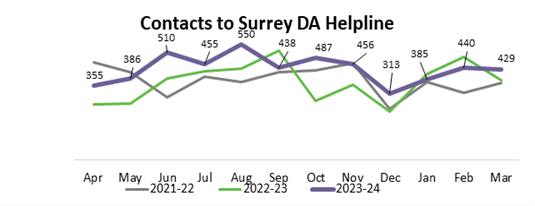
There was a total of 5,204 contacts to the Surrey DA helpline between April 2023 and March 2024, an increase of 17% compared to the previous year.
December saw the lowest number of contacts, which appears to be a seasonal trend.
Contacts peaked in August 2023 at 550, the highest number of monthly contacts in over 5 years.
Health Independent Domestic Violence Advisor (HIDVA)
HIDVAs received 542 referrals in 2023-4, of which 40% were from the Emergency Department / A&E and nearly a quarter from maternity.
241 of the people referred engaged with HIDVA, of these 88% were patients, 10% staff and 2% patient friend or family.
For nearly a half of those who engaged, the level of risk was high.
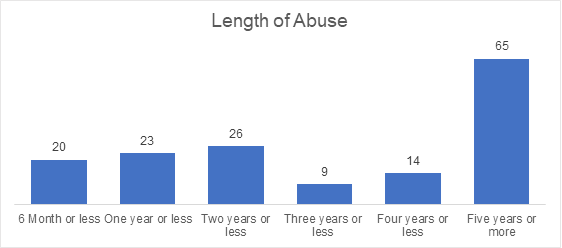
More than a quarter of those who engaged reported being subject to abuse for five or more years.
Figure 5: length of domestic abuse for those engaged with HIDVA in 2023-24
Safe accommodation
The Domestic Abuse Act 2021 placed a new duty on Tier One Local Authorities to assess the need for victims of domestic abuse and their children in safe accommodation services and to commission appropriate support in their areas. The Government announced £98 million of additional funding through the Department of Levelling Up Housing and Communities (DLUHC) to enable us to deliver the new duty. Surrey received £1.93million of this money for 21-22 and 22-23, and the same amount is committed in 23-24 for the delivery of safe accommodation services in Surrey.
Across Surrey Refuge is provided by 3 providers, Your Sanctuary, I Choose Freedom and Salvation Army. There is a total of 80 refuge spaces, up 23% from November 2021.
However, this still falls short of the Council of Europe recommendation of one refuge unit per 10,000? head of population, which would require 121 units based on the mid-2022 population estimate for Surrey.
Table 2: number of refuge spaces for each type of refuge
| Type of refuge | Spaces |
| Shared | 71 |
| Dispersed | 8 |
| Move-on | 1 |
| Total | 80 |
Shared spaces are provided in refuges while dispersed and move-on spaces are provided by Refuge for All.
- In 2023- 24 Demand outstripped capacity, with 45% of people referred being unable to be supported due to capacity constraints.
- In 2023-24 The number of unable to be supported due to services being unable to meet their needs has fallen by 50% since 2022-3.
Multi Agency Risk Assessment Conference (MARAC)
Multi Agency Risk Assessment Conferences (MARACs) are where statutory and voluntary agency representatives, including Childrens Services, Health, Police, Probation, housing, and IDVA’s (Independent Domestic Violence Advisors), share information about high-risk victims of domestic abuse to produce a coordinated action plan to increase victim safety. It is assumed that no professional or agency is solely responsible for the survivor’s safety.
Surrey currently has six MARAC meetings. Between them they cover the geographical area of Surrey, each meeting fortnightly. These areas are:
- Surrey Heath and Woking
- Guildford and Waverley
- Tandridge, Mole Valley and Epsom
- Reigate and Banstead, and Ewell
- Runnymede and Elmbridge
- Spelthorne
Table 3: MARAC cases in Surrey, 2023/24
| MARAC | West Surrey (G&W) | North Surrey | East Surrey | West Surrey (W&SH) | Surrey 2023-4 | Surrey 2022-3 |
| Number of Cases discussed | 290 | 461 | 641 | 222 | 1614 | 1593 |
| Number of cases per 10,000 adult females | 26 | 34 | 38 | 28 | 33 | 34 |
| % repeat cases | 24% | 26% | 27% | 18% | 25% | 28% |
| % male victims | 4.8% | 5.6% | 6.1% | 3.6% | 5.4% | 7.5% |
| % BAME | 18% | 13% | 14% | 23% | 16% | 19% |
| % of cases where the victim had care & support needs | 2.1% | 3.5% | 4.7% | 1.8% | 3.5% | NK |
| % of cases where the victim had mental health issues | 44.1% | 34.9% | 37.4% | 48.2% | 39.4% | NK |
| % LGBT | 2.4% | 1.1% | 0.8% | 1.4% | 1.2% | 1.5% |
| Number of children in household | 412 | 613 | 888 | 303 | 2216 | 2281 |
| Average children per case | 1.42 | 1.33 | 1.39 | 1.36 | 1.37 | 1.43 |
Domestic Abuse Related Death Review (DARDR) & Data
A “Domestic Abuse Related Death Review” (previously known as a Domestic Homicide Review or DHR) means a review of the circumstances in which the death of a person aged 16 or over has, or appears to have, resulted from violence, abuse or neglect by:
- a person to whom she/he was related or with whom she/he was or had been in an intimate personal relationship, or
- a member of the same household as herself/himself, held with a view to identifying the lessons to be learnt from the death.
Where a victim took their own life (suicide) and the circumstances give rise to concern, for example it emerges that there was coercive controlling behaviour in the relationship, a review should be undertaken, even if a suspect is not charged with an offence or they are tried and acquitted. Reviews are not about who is culpable.
Table 4: Current number of DARDRs and joint DARDR/SARs per borough (November 2024):
| Borough | Current Number of DARDRs and Joint DARDR/SARs |
| Runnymede | 3 |
| Reigate and Banstead | 3 |
| Epsom and Ewell | 2 |
| Surrey Heath | 2 |
| Spelthorne | 2 |
| Woking | 2 |
| Guildford | 1 |
| Elmbridge | 1 |
| Mole Valley | 1 |
| Tandridge | 1 |
Youth Using Violence and Abuse (YUVA) – funded by Surrey County Council
Interventions for 11–18-year-olds (up to 25 where there are additional needs) who use abusive behaviours in their relationships with a family member or an intimate relationship.
170 individuals from 116 families were seen by YUVA in 2023-4.
Young people attend a total of 266 hours of direct work with YUVA, while parents / carers attended a total of 655 hours in 2023-4.
Demand has outstripped capacity and 166 individuals from 71 families were awaiting service at the end of 2023-4.
YUVA provided a total of 107 consultations to other professionals 26% of which were to Targeted Youth Support Practitioners and 20% to Children’s Social Care.
Domestic Abuse Services in Surrey
D.A. SEEN, the Domestic Abuse Surrey Expert by Experience Network
The Survivors Steering Group is a group of 11 survivors from across the Surrey DA Partnership who have all directly experienced domestic abuse. Together the women have 13 children. Their children have directly or indirectly experienced domestic abuse, and we have cases of child on parent abuse from domestic abuse related trauma. Women for whom trauma is a lasting, daily effect from their experience. Women who have faced additional barriers due to racism, homophobia, culture, faith, mental health, disability, financial hardship. Women who are passionate and committed to using their experience to inform services, educate statutory agencies and staff, and help other women.
Established in 2020 the SSG has gone from strength to strength and are now at the point of preparing to relaunch themselves with a new name, celebrating their achievements individually and collectively as well as continuing to strive for system change within policing, children’s social care, family courts and beyond.
Domestic Abuse Outreach
Domestic abuse outreach services have been commissioned by Surrey County Council, Surrey Police and the Office of the Police and Crime Commissioner for several years under a variety of different grants and service level agreements.
In 2024 a commissioning process was undertaken that brought together funding from Surrey County Council, Surrey Police and the Office of the Police and Crime Commissioner. The Outreach service focuses on specialist DA services which include any intervention or service that supports survivors of domestic abuse (children and adults) at the earliest point and at point of crisis – this includes Community Independent Domestic Violence Advisors / advocacy; 1:1 work with children and adults; out of core hours support through various channels.
The Surrey Domestic Abuse Partnership (SDAP) is a group of independent charities who work together across the whole of Surrey to ensure that survivors of domestic abuse, aged 16 and over, are safe and can build a future where domestic abuse is not tolerated.
SDAP outreach services offer an independent, confidential, listening service to anyone affected by domestic abuse. They are free impartial services giving practical help and emotional support, as well as providing information on a wide range of issues including housing, benefits, safety planning and the needs of children affected by domestic abuse. SDAP’s outreach services provide support to any victim of domestic abuse regardless of age, gender, sexuality or race. The partnership has provided:
- An IDVA to provide specialist support for victims of abuse who identify as LBGT+
- An IDVA to provide specialist support for Black, Asian, Minority Ethnic and Refugee victims of domestic abuse
- An IDVA to provide specialist support for victims of abuse who are children or young people
- An IDVA to provide specialist support for victims of abuse who have a disability
- Funding to support the SDAP helpline managed by Your Sanctuary
- Funding for survivors with complex needs
- Additional funding for the core IDVA provision and Service Managers
- An Intimate-Stalking Advocate
- An IDVA dedicated to support the rural community
- Police Advocates embedded in each of the divisional police stations
East Surrey Domestic Abuse Service (ESDAS) is the lead partner in SDAP service for Surrey and primarily work in Mole Valley, Reigate & Banstead and Tandridge.
North Surrey Domestic Abuse Service (NSDAS) is provided by Citizens Advice Bureau and covers the boroughs of Epsom & Ewell, Elmbridge, and Spelthorne.
South-West Surrey Domestic Abuse Services (SWSDAS) is a partner in the SDAP and the service covers the boroughs of Guildford and Waverley.
Your Sanctuary are a partner in SDAP commissioned domestic abuse service for Surrey. The service covers the boroughs of Runnymede, Surrey Heath, and Woking. In addition to provision offered by other partner agencies Your Sanctuary provides a Community Outreach Service for men experiencing domestic abuse who live in Surrey.
Your Sanctuary also run a volunteer programme with approximately 75 volunteers who assist in delivery of outreach services, the helpline, refuge services and other administrative functions.
Advocacy After Fatal Domestic Abuse (AAFDA)
AAFDA Provide specialist and expert one to one advocacy and peer support to individuals bereaved by suicide or unexplained death following domestic abuse in Surrey.
Hourglass
Hourglass is the UK’s only charity focused on the abuse and neglect of older people. Their mission is to end the harm, abuse, and exploitation of older people in the UK. The OPCC has commissioned this service to provide tailored support to older victims of domestic abuse and sexual violence.
Surrey Minority Ethnic Forum (SMEF)
SMEF supports and represents the needs and aspirations of a growing ethnic minority population in Surrey. The OPCC have commissioned ‘The Trust Project’ which is an outreach support service for black and minority ethnic women at risk of domestic abuse.
Safe Accommodation
Refuge services are an established, essential element in delivering support to the most vulnerable victims of domestic abuse who are no longer safe at home. A refuge service provides holistic, specialist support to meet the needs of victims and their children in a supportive, safe, and secure environment. There is no ‘typical victim’ supported in a refuge – victims and children will have a range of support needs, including those related to safety, criminal and family justice, disability, physical and mental health, immigration status, children’s welfare and education, financial needs including debt, and social needs.
Across Surrey, Refuge is provided by 3 providers, Your Sanctuary, I Choose Freedom and Salvation Army. There is a total of 80 refuge spaces, up 23% from November 2021.
Perpetrator Interventions
Hope for Change – Intensive Housing Management for Perpetrators
Hope for Change is a service that offers temporary housing solutions for those individuals causing harm through domestic abuse – 6 residents currently with a further 24 on the waiting list from Probation alone. 6 referrals were not accepted due to no spaces available, and there were 2 female perpetrators amongst enquiries for support. In 1 week – 16th March – there were 7 perpetrators who needed hope for change accommodation.
Steps to Change Hub
Steps to Change brings together independent and expert services in this field to work alongside each other which are: Interventions Alliance (interventions for perpetrators), Surrey Domestic Abuse Partnership and Victim and Witness Care Unit (integrated support for survivors) and Waythrough (formally Richmond Fellowship) who provide services for children and adolescents who use abuse/violence in their relationships – YUVA. The Steps to Change hub acts as a gateway to interventions for anyone demonstrating abusive behaviours which are of concern. This will include adults perpetrating domestic abuse/stalking who are arrested by police but not charged, those subject to a police investigation, or those who may have committed an offence which is appropriate for a formal out of court disposal. After a referral into the Steps to Change team, there will be engagement work undertaken to motivate those offending to address their behaviour and make a change.
Youth Using Violence and Abuse (YUVA) – funded by Surrey County Council and OPCC
The project is delivered by Waythrough (formally known as Richmond Fellowship) and provides interventions for 11–18-year-olds (up to 25 where there are additional needs) who use abusive behaviours in their relationships with a family member or an intimate relationship, and parents/carers, siblings, or intimate partners affected by young people’s violence/abuse.
YUVA service incorporates a whole family model to address young people who use abuse or aggression toward family members or intimate partners. The primary aim is to increase the safety of families and support young people to maintain positive relationships. The service consists of two separate but integrated services:
- The young person programme, which works directly with young people who are using violence/abuse toward their family or intimate partner
- A support service consisting of a combination of 1:1 session for siblings and/or intimate partners, and a structured parent’s group
Referrals will be accepted from all professionals and families. Following referral, a suitability assessment will be completed with the young person to assess their motivation to engage with the programme, as well as assess any family members or partners involved. After that, a total of 10 face-to-face sessions is offered. A consent form needs to be signed by the parent/carer before work can start with young people.
Compulsive and Obsessive Behaviour Intervention (COBI) – by Interventions Alliance
COBI is a treatment for people whose thoughts and behaviours could be described as obsessive. It is a challenging and intensive talking therapy which uses a treatment model called Dialectical Behaviour Therapy (DBT). The aim of the therapy is to help people to acknowledge, accept and recognise their difficult emotions and thoughts that trigger harmful behaviour towards others. The programme helps people to learn new ways to manage these feelings without this causing harm to others.
Healthy Relationships – by Interventions Alliance
This programme helps people using abusive behaviours to understand the choices needed to make a change. Working with a professional, they are supported to understand their thoughts, feelings and behaviours, so they can develop skills to manage these better in the future. By attending sessions in a non-judgemental, supportive and safe space, they benefit from:
- Learning what a healthy relationship looks like and how best to work to achieve that;
- Knowing how to communicate effectively whilst respecting another’s emotional and physical boundaries;
- Responding to emotional responses with awareness, to create positive behavioural change and without causing harm or distress to others; and
- Understanding the impact of harmful relationships on children.
Other Services for Domestic Abuse victims in Surrey
DA advocates embedded within Surrey Police Domestic Abuse teams to provide fast-time support at point of report, specialist professional advice on case.
Victim and Witness Care Unit (this is the unit operated by Surrey Police which supports many domestic abuse victims in addition to referrals being made to SDAP).
Family Lives:
Family Lives is a charity whose aim is to help support parents and carers to deal with all aspects of family life. It provides this through a 24hour helpline, extensive advice on its website, live chat services, befriending services, and parenting/relationship support groups.
Family Centres:
Surrey’s 11 Family Centres based in each District and Borough use a whole family approach to support children aged 0-18 years (up to 25 years for those with additional needs and disabilities) at the earliest opportunity to find solutions to the parenting and relationship challenges they face, and to grow in confidence to manage future difficulties. The Family Centres aim is to help families build their own resilience and self-reliance. The Family Centres provide one-to-one family support where the family situation is having a significant impact on the health, development, or wellbeing of the child/children. The centres work in partnership with health, schools, community groups, and other commissioned services to ensure families receive joined up support from key agencies.
MySpace:
MySpace is a 12week community-based treatment programme run by Welcare for children from homes where domestic abuse and violence has occurred. The group environment helps children to realise they are not alone and provides a supportive and safe space for them to process their experiences.
Guildford Action for Families (the GAF):
The GAF (Guildford Action for Families) service supports isolated families with issues including debt, housing, mental health challenges, isolation, relationship breakdown, domestic abuse, parenting skills, employment, and substance misuse.
Vaughan House:
Based in Guildford, Vaughan House offers supported housing to those who are single, homeless or at risk of homelessness. Residents may have complex support needs, such as substance abuse, mental health issues or offending behaviour. They work to create greater independence and success in employment, education, or training.
The Women’s Support Centre:
The Women’s Support Centre (WSC) works with women whose lives are affected by the Criminal Justice system—both those who have served a sentence and those that are in contact with, or at risk of being in contact with, the Criminal Justice system. The WSC is based in Woking. The project workers at the Centre support their clients to recognise and address their needs with the aim of reintegrating back into the community and leading a more stable life. The WSC works closely with several organisations including all the Surrey local authorities, the police, and NHS Surrey.
Identified Gaps in Services
Children as victims
The Domestic Abuse Act 2021 made it so that children who witness domestic abuse are considered victims. As with any victim of domestic abuse it is important there are specialist services available to them and an acknowledgement of the impact the abuse will have had on them.
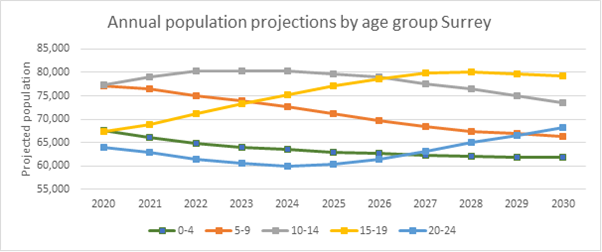
The 2021 census results align closely with Surrey’s population projections from 2016 – 2030. The graph below shows the projected population changes from this data and indicates:
- The number of 0–4-year-olds is anticipated to continue to decrease down to 61,797 in 2030.
- The 5-9 age group is projected to decrease by an even larger amount falling to 66,359 in 2030.
- The number of 10–14-year-olds is predicted to increase to 80,000 in 2023 at which point it will plateau and then begin to decline by 2025.
- In percentage terms this means by 2030 the population of 0–4-year-olds would have fallen by 9.1% compared to 2020, the population of 5–9-year-olds by 14.3% and 10–14-year-olds would have fallen by 4.6%. While the 15–19-year-old age group will have risen by 15.1% by 2030.
Figure 6: Annual population projections by age group in Surrey
Between April 2023 and March 2024, 138 children were supported by DA Outreach service via group work or 1:1 work.
Surrey currently has no specialist provision that is exclusively for children or young people, including for those who are experiencing abuse in their early intimate relationships. Early intimate relationships often begin in adolescence which is an age group which is due to increase as a percentage of the overall Surrey population.
Preventing extremism
Counter Terrorism (Prevent)
The UK Government defines extremism as “the promotion or advancement of an ideology based on violence, hatred or intolerance that aims to:
- Negate or destroy the fundamental rights and freedoms of others; or
- Undermine, overturn or replace the UKs system of liberal parliamentary democracy and democratic rights; or
- Intentionally create a permissive environment for others to achieve the results in (1) or (2)
(Gov UK New Definition of Extremism 2024)
CONTEST is the UKs counter terrorism strategy. The aim is to reduce the risk from terrorism to the UK, its citizens and interests overseas, so that people can go about their lives freely and with confidence. (CONTEST: The United Kingdom’s Strategy for Countering Terrorism 2023)
Prevent remains one of the key pillars of CONTEST, alongside the other three ‘P’ work strands:
- Prevent: to stop people becoming terrorists or supporting terrorism
- Pursue: to stop terrorist attacks
- Protect: to strengthen our protection against a terrorist attack
- Prepare: to mitigate the impact of a terrorist attack
The Counter-Terrorism and Security Act 2015 (CTSA) provides an important statutory framework to support this strategy and places a specific duty on ‘specified organisations’ to have “due regard to the need to prevent people from being drawn into terrorism”
The Prevent Duty
The aim of Prevent is to stop people from becoming terrorists or supporting terrorism. Prevent also extends to supporting the rehabilitation and disengagement of those already involved in terrorism. It sits alongside long-established safeguarding duties on professionals to protect people from a range of other harms, such as substance abuse, involvement in gangs, and physical and sexual exploitation. The duty helps to ensure that people who are susceptible to radicalisation are supported as they would be under safeguarding processes.
Prevents objectives:
- tackle the ideological causes of terrorism
- intervene early to support people susceptible to radicalisation
- enable people who have already engaged in terrorism to disengage and rehabilitate
Prevent duty guidance: for England and Wales (accessible) – GOV.UK (www.gov.uk)
Channel
The CTSA 2015 sets out the duty placed on each local authority and specified organisations to establish ‘Channel panels’ to provide support for people (children and adults) vulnerable to being drawn into terrorism.
Referrals to the multi-agency and Local Authority led Channel Panel can come from a wide range of people and organisations. Referrals are first assessed by specialist Counter Terrorism Police to establish the nature and extent of an individual’s vulnerability and whether the criteria set out in s36 of the CTSA 2015 are met. If a case is adopted, Channel panel members will discuss and agree a bespoke support plan tailored to the needs of the individual case. Panel members should bring individual expertise in relation to their respective professions and the services and support available locally to develop an appropriate support plan.
An effective Channel panel is established in Surrey chaired by Surrey County Council. This provides tailored support plans for the purpose of reducing an individual’s susceptibility to being drawn into terrorism.
The Surrey Prevent Executive Group
Specified authorities under the Prevent Duty in Surrey attend a multi-agency group called the Surrey Prevent Executive Group. The role of this meeting includes:
- Assessing local risk
- Developing a Prevent Action Plan to collate partnership activity
- Demonstrating effective compliance with the Prevent Duty
- Overseeing the activity of the Channel Panel
Understanding and Recognising Risk
Prevent’s first objective is to tackle the ideological causes of terrorism. The ideological component of terrorism is what sets it apart from other acts of serious violence. Prevent deals with ideologies including Islamist extremism, extreme right-wing ideology and other ideologies and concerns that may pose a terrorist threat. Established terrorist narratives exhibit common themes such as antisemitism, misogyny, anti-establishment, anti-LGBT grievances and religious or ethnic superiority.
People can become susceptible to being drawn into terrorism for a wide range of reasons and while the information set out below is intended to promote understanding it will be important for professionals to supplement this reading with more specific detailed literature or seek specialist advice from local Prevent contacts.
People can become susceptible to what has been described as ‘radicalisation’ through their exposure to, or involvement with, groups or individuals who advocate terrorism/extremism to promulgate their social, religious or political ideologies. This can occur due to the influence of family members or friends and/or direct contact with extremist groups and organisations or, increasingly, through individual online activities such as on social media and gaming platforms which is now seen as a major threat. This can result in some individuals becoming at risk of being drawn into extremist thought and action which could lead to criminal activity and has the potential to cause them and others harm. An increasing threat is from self-initiated terrorists who act alone to carry out low sophistication attacks which require little planning, such as those involving knifes or vehicles.
Most individuals, even those who hold radical views, do not become involved in extremism. Numerous factors can contribute to and influence the range of behaviours that can be associated with forms of extremism. It is important to carefully consider these factors to develop an objective understanding of the issue. It is also necessary to understand those factors that build resilience and protect individuals from engaging in extremist activity.
It is important that all professionals who have contact with vulnerable individuals are able to recognise these factors. Where further advice is necessary this can be sought from designated safeguarding leads, or the local authority lead for Prevent and then shared with the Counter Terrorism Police via the referral form. Counter Terrorism police can also be contacted for advice.
Vulnerability factors
There are many factors that can make someone susceptible to radicalisation. They can apply to any age, social class, religion, ethnic or educational background. There is no single route to radicalisation however research shows that indicators of an individual’s potential vulnerability can include:
- Need for Identity Meaning and Belonging – can present as a distancing from family and friends and their community or in some cases, their cultural / religious heritage and feeling uncomfortable with their place in the society surrounding them
- Personal Crisis – may include a significant trauma such as a major transition in life, family tensions; sense of isolation; experiences of bullying; the triggering of earlier traumas; low self-esteem; disassociating from existing friendship group and becoming involved with a new and different group of friends; searching for answers to questions about identity, faith and belonging
- Grievance which may be due to personal events leading to a sense of injustice
- Unmet Aspirations – in the context of perceived injustices; feeling of failure or inadequacy; rejection of civic life.
- Mental Health Issues – most people suffering from depression, anxiety or other mental health issues are not drawn into extremism. However, for some people it can increase their vulnerability to being influenced by extremists.
- Criminality – that may include experiences of imprisonment; poor resettlement / reintegration; previous involvement with criminal groups
The above list is not exhaustive, nor does it mean that everyone experiencing the above are at risk of exploitation for the purposes of extremism – individuals may show some, all or none of the vulnerabilities and the process of radicalisation is different for every individual and can take place over an extended period or within a very short time frame. As a result, it is important that awareness, sensitivity and expertise are developed within all contexts to recognise signs and indications of radicalisation.
As the risk of radicalisation is the product of several factors, identifying this risk requires that staff exercise their professional judgement, seeking further advice as necessary. It may be combined with other vulnerabilities or may be the only risk identified. This can place people at risk of being drawn into extremism and ultimately criminal activity and has the potential to cause harm. The Prevent and Channel Process is aimed at stopping people being drawn into terrorism at an early stage, safeguarding them through recognising the signs and intervening early to divert them away from this dangerous path.
Potential indicators of radicalisation may include:
- Use of inappropriate language;
- Possession or accessing violent extremist literature;
- Behavioural changes such as becoming secretive;
- The expression of extremist views;
- Advocating violent actions and means;
- Association with known extremists;
- Articulating support for violent extremist causes or leaders;
- Using extremist views to explain personal disadvantage;
- Joining or seeking to join extremist organisations;
- Seeking to recruit others to an extremist ideology.
Identification and referrals
If a member of the public has a concern about a person, they know who may be susceptible to radicalisation they can raise these via: https://actearly.uk/, by calling 101, or with their Local Authority safeguarding team.
Staff working in public-facing organisations receive training to help identify people who may be susceptible to radicalisation, and what to do about it. Local Authorities, schools, colleges, universities, health bodies, prisons, probation organisations and the police are subject to a statutory duty through the Counterterrorism and Security Act 2015 to include in their day-to-day work consideration of the need to safeguard people from being drawn into terrorism.
Professionals working with clients who live in Surrey can make a referral to Prevent using: Referral process | Healthy Surrey
What we know
In the year ending 31 March 2023, there were 6,817 referrals to Prevent in England and Wales. This is an increase of 6.4% compared to the previous year (6,406), and the third highest number of referrals since the first period reported on (2015/16). The increase is predominately driven by an increase in referrals from the Education, Community and Police sectors which saw increases of 16%, 16% and 7% respectively.
Like last year, the Education sector made the highest number of referrals (2,684; 39%), followed by the Police (1,943; 29%). The year ending 31 March 2023 saw referrals from the Education sector account for an increased proportion of all referrals (2,684 of 6,817; 39%) compared to 2024 (36%). Since data recording began in 2015/16, Education referrals have accounted for 33% of all referrals.
As in previous years, where gender was specified (6,801), most referrals were for males (6,125; 90%).
Of the referrals where age of the individual was known (6,796), those aged 15 to 20 again accounted for the largest proportion (2,203; 32%). Those aged 14 years and under account for the second largest proportion (2,119; 31%) of referrals. This year, Home Office analysts have included statistics broken down by a supplementary set of age groups to provide additional detail on the makeup of Prevent referrals. Those aged between 11 and 15 account for 2,628 (39%) of referrals where age is specified. Nearly half (46%) of referrals that became adopted cases are for individuals aged between 11 and 15.
Of those in custody for terrorism connected offences in Great Britain as of 30 June 2023, 65% were categorised as holding Islamist-extremist views, 27% were categorised as holding Extreme Right-Wing ideologies, and the remaining 8% were categorised as holding beliefs related to other ideologies. These figures include both those that had been convicted and those being held on remand (that is, held in custody until a later date when a trial or sentencing hearing will take place).
The threat from Islamist terrorism remains the foremost and most significant, accounting for 67% of attacks since 2018 and about three quarters of the MI5 caseload. Through the implementation of the Independent Review of Prevent, greater emphasis will be placed on ensuring that Prevent is delivered in a proportionate manner that focuses on the most prolific threats.
Serious and organised crime
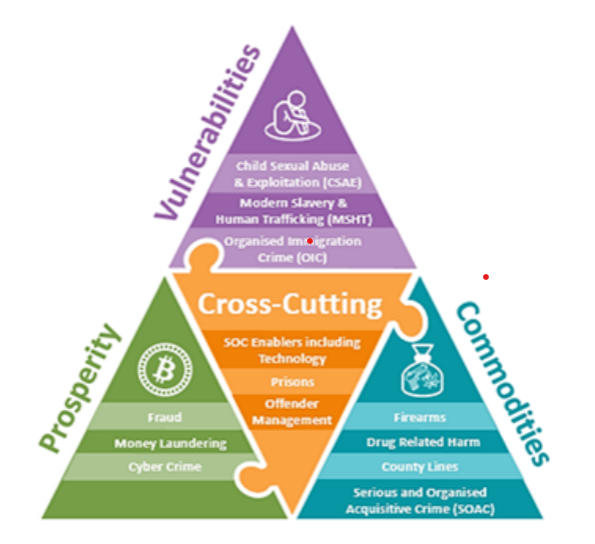
Serious and organised crime is defined as individuals planning, coordinating and committing serious offences, whether individually, in groups and or as part of transactional networks. The main categories of offences covered are child sexual exploitation and abuse, illegal drugs and associated harm, modern slavery and human trafficking and economic crime in all its forms including the threat caused by Cyber Crime. (Surrey Serious and Organised Crime Partnership Strategy 2023/25).
National Context
The Home Office published the Serious and Organised Crime 2023/28- No Place to Hide, in December 2023. This builds on the previous strategy released in 2018 by allowing no safe space for serious and organise criminals to operate. The strategy continues to recognise the importance of the 4 Ps delivery framework (Pursue, Prepare, Protect and Prevent)
Using a whole system approach to tackle serious and organised crime it focuses on 5 lines of action:
- In Country- Disrupting and dismantling organised crime groups in this country
- UK Border- Strengthening the UK border.
- International- Improving international information and intelligence sharing and reduce global drivers of serious and organised crime.
- Technology and Capabilities- ensuring the best intelligence and data collection, analysis and investigative capabilities are in place to identify and disrupt organised criminals.
- Multi Agency Response- ensuring all public and private sector partners are working collaboratively with the right capacity, skills, structures and tasking processes to ensure a better aligned, more effective, value for money, better delivered response.
National Key Facts and Figures
- 680,000- 830,000 is the estimated number of UK based individuals posing varying degrees of risk to children (National Crime Agency)
- 1 in 6 girls are estimated to have experienced child sexual abuse before the age of 16 (the independent inquiry into child sexual abuse)
- 43% of the 29,845 computer misuses reports to Action Fraud between April 2021 and March 2022 involved hacking of social media and email accounts. (Action Fraud)
- 4.5% of firearm offences from April 2012- April 22 involved fatality or serious injury (Office for National Statistics)
- 52% of potential victims in the UK during 2022 were children. 78% of these reported criminal exploitation (UK data service- NRM statistics)
Local Context
The Surrey Serious & Organised Partnership Board has been set up with partners to align efforts through a partnership action plan, to tackle serious and organised criminals as one cohesive system. Partners include Police, Trading Standards, His Majesty’s Revenue and Customs, Department of Work and Pensions and Immigration Enforcement amongst others.
The group’s priorities are:
- Drug Related Crime and County Lines
- Economic Crime including Fraud and Cyber Crime
- Serious and Organised Acquisitive Crime
- Modern Slavery and Human Trafficking
The pillars and priorities approach to serious and organised crime will give the correct focus of the tactical response to tackling serious and organised crime.
Figure 7: Pillars and priorities approach for tackling serious and organised crime in Surrey
Serious Violence and Violence Against Women and Girls (VAWG) have been identified as Serious & Organised Crime cross cutting themes within the Surrey Police control strategy. To reflect this, the Surrey SOC Partnership board has aligned itself with the Surrey Serious Violence Reduction Partnership board as one of its strategic board partners.
Serious Organised Crime Joint Action Group (SOCJAG)
These are bi-monthly multi-agency forums held in each of the local authority districts across Surrey. The meeting considers the threat posed within the local community from Serious Organised Crime and those groups who perpetrate such crimes. The forum brings together the powers of all attending agencies to tackle Serious Organised Crime with the aim to disrupt and dismantle SOC, to reduce the risk of harm to our communities.
The SOCJAG coordinates a multi-agency response, making the best use of all available resources through information sharing, consultation, and the development of coordinated joint action plans. This collaborative approach effectively reduces the harmful impact of Serious Organised Crime and exploitation in local communities. SOCJAGs report each quarter into the Surrey SOC Partnership Board.
Local Services
Catch 22- Music to My Ears
Catch 22 design and deliver services that build resilience and aspiration in people of all ages across the UK. Music to My Ears is a creative arts projects designed to support children and young people directly affected by child criminal exploitation.
Catalyst- Surrey Cuckooing
A specialist outreach team who provides experiences and intense support to victims of cuckooing with established links to multiple services that can provide prevention, advice and support and prevent future exploitation.
Surrey i-access
Drug and alcohol support services for Surrey residents through the NHS.
CrimeStoppers
An independent charity for people to speak to about crime in their community that can provide guidance and support.
Volunteer Fraud Prevention Programme
Surrey and Sussex Police both have a team of volunteers who can provide personalised, tailored preventative advice packages to the victims of fraud.
StreetLight
A charity offering a fresh start to those involved in prostitution to build and sustain a new life.
YMCA
A non-profit organisation focused on strengthening communities by empowering young people, improving health and wellbeing across all ages and inspiring action in communities.
York Road Project
A charity committed to getting people off the street, navigate the housing system and find a secure long term home.
Victim Navigator Justice and Care
Embedded within Surrey Police’s Witness and Care Unit to help support adult and child victims of slavery, trafficking and other forms of exploitation.
Fraud Caseworkers- Surrey Police Victim and Witness Care Team
Fraud caseworkers who provide ongoing, one to one support for vulnerable victim of fraud.
Identified Gaps in Services
There is a recognition that in other areas of the county organised crime groups have targeted the homeless and that organised begging can become an area of concern.
Violence against women and girls
Violence Against Women and Girls (VAWG) is an umbrella term that describes crimes, abuse, and violence, disproportionately perpetrated against women and girls.
VAWG not only has devastating impacts on the individual victim/survivor, but has far reaching impacts on our friendships, our colleagues, our families, our communities and our society. Male violence against women and girls is a consequence of deep rooted, harmful, societal and cultural beliefs about gender roles, and gender identities. This is a result of global gender inequality.
Damaging societal acceptability of male violence and harmful beliefs and attitudes towards women and girls are maintained by our institutional and cultural structures in society, and it will take a whole system approach to dismantle these structures, to ensure VAWG is eradicated.
Surrey Police registered a total of 9,187 VAWG offences in the 12 months between 15 August 2023 and 14 August 2024. More than 8 out of 10 were categorised as ‘harassment’ offences, followed by violence with injury offences (16.9%), serious sexual offences (11.2%), hate crime (7.4%), child abuse and exploitation (5.5%), other sexual offences (3.7%), stalking (2.4%), modern day slavery (0.2%) and ‘honour’-based abuse (0.1%, which includes female genital mutilation, forced marriage and ‘honour’ killings). Please note that for the purpose of this review, domestic abuse offences won’t be included. For information about domestic abuse please see the above section.
National Context
In the UK, VAWG is considered a national emergency. Labour government has committed to halve VAWG within the next 10 years. Their manifesto sets out key priorities in achieving this ambition which includes, utilising every government tool to target perpetrators and address the root causes of VAWG including misogyny, specialist rape and sexual offences teams within every police force, relentlessly pursue the most prolific and harmful perpetrators using tactics for terrorists and organised crime, introduce a new criminal offence for spiking, strengthen stalking protection orders, fast track rape cases with specialist courts, ensure schools address misogyny and teach young people about healthy relationships and consent, and strengthen the rights and protection of whistleblowers in the workplace including on sexual harassment.
HM Government published the Tackling Violence Against Women and Girls Strategy in July 2021. This followed and built upon the Government’s first national strategy on VAWG and their Call to End Violence Against Women and Girls in 2010. The national VAWG strategy calls for a whole-of-government and whole-of-society approach to tackling VAWG, calling all agencies (local and national Government departments, charities, and others) to work together to ensure an effective and co-ordinated response. The Government’s National Statement of Expectations (NSE, 2022) sets out how local areas must reduce the prevalence of VAWG crimes by commissioning services to ensure a whole system response to tackling VAWG. The Home Office Spending Review 2021 has allocated £43 million to tackle VAWG, which includes the scoping, development and implementation of key activity identified in this strategy for expansion in future years. This includes £25 million allocated for addressing perpetrators, funding for the Rape Review, and the strengthening of Domestic Abuse Related Death Reviews (DARDR).
Local Context
It is recognised that Surrey must provide services that offer a safe environment where victims and survivors can talk about their experiences, be listened to, and receive the right practical and emotional support, centred on their needs. With this focus, Surrey can also strengthen how we respond to male victims, as well as LGBTQ+ and ethnic minority communities. By recognising people’s unique experiences of crimes and considering everything and anything that can further marginalise them, including gender, race, and physical ability, services can be better delivered and tailored to their needs. Whilst the term ‘violence against women and girls’, is used throughout this section, this refers to all victims and survivors of any of these offences/crimes.
Surrey’s overarching community vision outlines the desire for Surrey to be a uniquely special place where everyone has a great start to life, lives healthy and fulfilling lives, and are enabled to achieve their full potential. It also aims for no one to be left behind. Preventing and addressing VAWG in Surrey is key to achieving our joint community vision. Surrey has an established VAWG partnership which consists of representatives from Surrey County Council, Surrey Police, Surrey Fire and Rescue, community and third sector organisations and specialist support services, community safety partnerships, adult social care, children’s services, housing, education, health, and other partners to oversee and review the progress Surrey is making in addressing VAWG.
Surrey’s Partnership Violence Against Women and Girls Strategy 2023 – 2025 ensures a joint responsibility in preventing, addressing, and tackling VAWG across a multi-agency network across Surrey. Furthermore, Surrey’s Expert by Experience Network (DA Seen) consulted on our strategy to ensure our response is guided by the expertise and lived experience of survivors in Surrey.
In Surrey a multiagency, whole system response to tackle VAWG is co-ordinated through the VAWG Executive Group. This includes partners from Health, Surrey Police, the Office of the Police and Crime Commissioner (OPCC), Housing, Specialist Support Services for victims and survivors, Adult Social Care, and Children’s Social Care.
The Executive oversees the VAWG Working Group, responsible for the development of Surrey’s first Partnership VAWG Needs Assessment, to understand the scope, prevalence, and VAWG need in Surrey. This will be published in early 2025.
VAWG services in Surrey are commissioned by the Safer Communities Team within Surrey County Council, the Office of the Police and Crime Commissioner (OPCC) and Surrey Police.
The Safer Communities Team (Surrey County Council) consists of portfolio leads for VAWG, Domestic Abuse, Anti-Social Behaviour, Prevent (counter terrorism), Hate Crime and Community Cohesion, Serious Violence, and Domestic Abuse Related Death Reviews (DARDRs). The team ensure a co-ordinated response to community safety within their subject areas across the county, in partnership with the multi-agency network. Overlaps of portfolio work are also identified to engage in joint working and identify innovative ways to improve safety within Surrey’s communities.
The OPCC secured 3-year funding (2022-25) from the Home Office to deliver with partners a programme of activity to prevent VAWG, which included:
- Provision of Surrey Healthy Schools in-person and online training to increase teacher confidence and competency in delivering Personal, Social, Health and Economic education, partnering with local VAWG services to ensure timely and appropriate referral to their specialist support services.
- A behaviour changes public campaign, led by Surrey Police, for 13–17-year-olds centred on preventing peer-to-peer youth produced sexual imagery.
Both elements of the project were complemented by community-based work, performed by specialist workers employed by independent VAWG services in Surrey.
What we know
The Partnership work between the Police and partners at the local level, including community groups and charities, has been influential in improving collaborative working and demonstrated their worth even beyond local and national borders. In cases where a VAWG perpetrator moves to another borough, the individual would be managed via a partnership forum such as the Community Harm and Risk Management Meeting for example. The Forced Marriage Unit (FMU) of the local Police provides help and support to victims of forced marriages and works with British Embassies.
All VAWG services refer to the need for trust in the police by survivors and victims of VAWG as essential in ensuring the success of anti-VAWG initiatives. Surrey Police conducted a “Call it Out” survey which gathered insights from women and girls and later used these to inform public engagement activity intended to provide “a tangible sense that the community was taking a stand against male violence against women and girls”.
Services across the county are highly regarded and used frequently. Most service users are female, of all ages and white British.
Victim/Survivor Services
- The OPCC funds several roles under the WiSE project, a South-East project on Child Sexual Exploitation. They are based within YMCA DownsLink Group and work with children and young people up to 25 years old. Their primary focus of work is preventing exploitation, and supporting young people affected by exploitation by raising awareness, educating and empowering.
- Karma Nirvana is a national human rights charity supporting victims of honour-based abuse and forced marriage.
- The STARS Sexual Violence – Child Independent Sexual Violence Advisor (ISVA) supports children and young people (up to 25 years old) who have been sexually assaulted or raped with practice help, advice and advocacy. STARS is a Mindworks Surrey Specialist Service and receives funding from the OPCC.
- RASASC ISVAs provides advocacy, advice and practical support to victims of rape and sexual assault. The OPCC provides funding. They are awarded £157,000 per annum from the Ministry of Justice (MoJ) Victims’ Fund to support survivors of sexual assault and rape. They have also been awarded an additional £25,000 in 2024/25 to help towards their counselling service. The MoJ increased their funding for DA/SV for 3 years and RASASC have been awarded funding for a part time counselling co-ordinator and 2 additional ISVAs through this funding. In addition, they were granted funding for 3 years from the Home Office’s Preventing VAWG and Supporting Children Fund.
- The Sexual Assault Referral Centre at Solace is based in Cobham and offers a range of support services to anyone across all ages, living within the Surrey area who have experienced sexual abuse or sexual assault, either recently or in the past. The OPCC works with the Sexual Assault and Exploitation Board to fund services used by The Solace Centre, including Rape and Sexual Abuse Support Centre and the Surrey and Borders Partnership.
- Streetlight is a front-line support project working across Surrey and Sussex for those involved in prostitution and those trafficked into the sex industry. Streetlight is an affiliate member of Beyond the Streets sharing resource, training and good practice with over 50 similar projects and agencies across the UK.
- Talking Therapies for anxiety and depression is a programme developed to improve the delivery of, and access to, evidence-based, NICE recommended, psychological therapies for depression and anxiety disorders within the NHS. During 2022/23 and 2023/24 the OPCC and NHSE helped fund talking therapy for victims of rape and sexual assault within this service.
Perpetrator Intervention
- Operation Shield is a targeted night time economy partnership project operating in Epsom and Ewell to identify and reduce VAWG related crimes and a knife intervention project, with funding from the OPCC. Services related to perpetrator intervention include proactive policing in NTE, moving suspected perpetrators on and signposting to services such as Circles.
- Circles South East – Reducing Sexual Harm & Violence Perpetrator Support Project – Circles of Support and Accountability (Circles) are members of communities who work in close partnership with criminal justice agencies to help reduce sex offending. Circles UK is the national body supporting the development, quality, coordination and effectiveness of providers of Circles.
- Surrey Steps to Change Hub coordinates perpetrator interventions across Surrey, including Domestic Abuse Perpetration (Healthy Relationships Programme) Children and Young people using violence and abuse within their own intimate relationships and within their intrafamilial relationships, and Stalking perpetration (Compulsive, Obsessive Behaviour Intervention or COBI), which is funded by the OPCC. The COBI (Compulsive Obsessive Behaviour Programme) works with all typologies of stalkers (with some limitations for predatory stalkers) and recognises that a DA programme is not suitable for perpetrators displaying obsessive, stalking type behaviour. It is funded by the Interventions Alliance Funding of the OPCC.
- Respect Young People’s Programme is an intervention by Respect UK for families where children or young people aged between 8 and 18 are abusive or violent towards the people close to them, particularly their parents or carers. The programme works with young people and their families, encouraging everyone to take a role in stopping the abuse and learning respectful ways of managing conflict, difficulty, and intimacy.
Identified Gaps in Services
a) Clarity in defining “VAWG”
A 2021 Surrey Police-led survey for women in Surrey focusing on their feelings of safety revealed that the respondents lacked knowledge of what constituted a crime, felt the police would not take their reports seriously and/or would not be able to do anything about the crime reported. (Source: OPCC internal doc)
b) Clearer guidance and instructions
In the education setting, the guidance on sexual harassment and violence among and affecting children and young people need to be clearer, to enable schools and colleges to identify and recognise threats and abuse. Schools and colleges also need to be engaged with external agencies dealing with children to understand the approach and strategies to promote shared outcomes, and to include this in risk assessments and well-being plans. The 2021 Review of Sexual Abuse in Schools and Colleges in Surrey by Ofsted highlighted these challenges. (Source: Education internal doc)
c) Critical need for practitioner awareness and specialist support for so called ‘honour-based abuse’
There is an identified critical need for specialist support for Afghan and Middle East and North African (MENA) women and girls who are at risk of “honour” based abuse, female genital mutilation, forced marriage, child marriage, domestic abuse and other forms of violence against women and girls. There is currently no local, Surrey-based service or centralised, FGM-focused service among the list of services available.
d) Perpetrator interventions
Surrey has pre conviction domestic abuse and stalker perpetrator programmes provided by Intervention Alliance. This is funded until March 2025. Sustainable funding will be needed for these to continue.
e) Data recording and collection
Police crime data quality is inconsistent (e.g, flag use, victim codes, characteristics and location details), and does not capture categories as ‘public space’ and ‘online’. LGBTQ+ population data is underreported, as well as for Black, Asian and ethnic minorities. In terms of health data: A&E Activity data is taken from the Chief Complaint field. It includes the diagnosis code ‘physical aggression’ and ‘victim of sexual aggression’. All other Chief Complaints cannot be determined as the cause is unknown. Any secondary diagnosis where the admission was caused by a parent / partner is removed. (Source: NA Draft) However, some national guidance is not gender-specific, which impacts the collection of data. These include the Department for Education’s Keeping Children Safe in Education and Exclusion Guidance, and Ofsted’s Harmful Sexual Behaviour and Harassment in Schools. Schools also hold data of perpetrator and survivor demographic profiles, but these are non-gender specific.
f) Lack of dedicated service to tackle online/digital violence.
Given the prevalence of image abuse even in local schools and colleges as recognised by the Surrey Police Campaign against crime related to Youth Produced Sexual Imagery (YPSI), this may be an area that would benefit from more localised resources that are easily accessible to victims and their families, schools, etc.
Hate crime and community cohesion
Hate crime has a particularly harmful effect on its victims, as it seeks to attack an intrinsic part of who they are or who they are perceived to be.
Definition of Hate Crime
A hate crime is any criminal offence which a victim or someone feels is motivated by hostility or prejudice based on a person’s race, religion or faith, sexual orientation, transgender / gender identity, or disability.
Any crime can be motivated by hate and there does not need to be any evidence that the offender was motivated by prejudice or hostility; if the victim or any other person feels the offence to be motivated by prejudice or hostility, then a hate crime has occurred.
Definition of Hate Incident
A hate incident is any non-crime incident that is perceived to be motivated by prejudice or hostility based on a person’s race, religion or faith, sexual orientation, transgender / gender identity, or disability.
Definition of Community Cohesion (LGA)
A cohesive community is one where there is a common vision and a sense of belonging for all communities. This includes the diversity of people’s different backgrounds and circumstances being appreciated and positively valued, those from different backgrounds have similar life opportunities and strong and positive relationships are being developed between people from different backgrounds and circumstances in the workplace, in schools and within neighbourhoods.
Guidance – Building cohesive communities | Local Government Association
National Context
Figure 8: Hate crime National picture from 2012/13 to 2023/24 – Hate crime, England and Wales, year ending March 2024 – GOV.UK
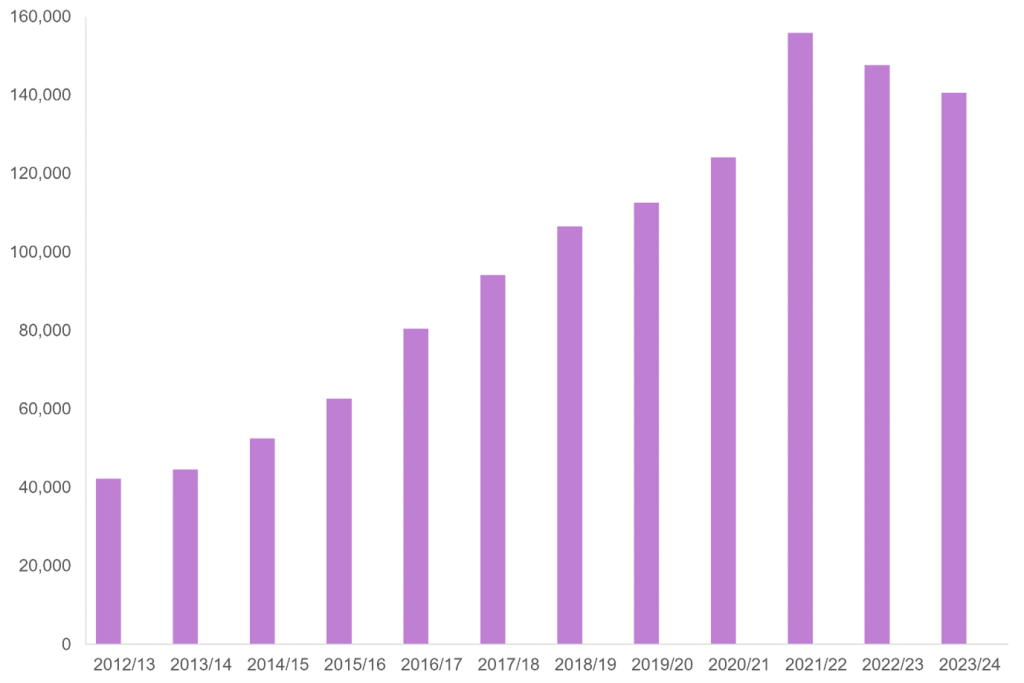
The Home Office figures from 2023/2024 reveal that there were 140,561 recorded offences in which one or more of the centrally monitored hate crime strands were considered motivating factors. This represents a 5% decrease compared to the figures from 2022/23. It is of note that this is the second annual decline since the Home Office began collecting comparable data in the year ending March 2013.
Increases in police recorded hate crime prior to this were thought to have been driven by improvements in crime recording by the police and better identification of what constitutes a hate crime.
There was a 25% increase in religious hate crimes compared with the previous year. This increase was driven by a rise in hate crimes against Jewish people and to a lesser extent Muslims and has occurred since the beginning of the Israel-Hamas conflict.
Figure 9: Number of religious hate crimes targeted against Jews and Muslims by month, year ending March 2024 (31 forces)
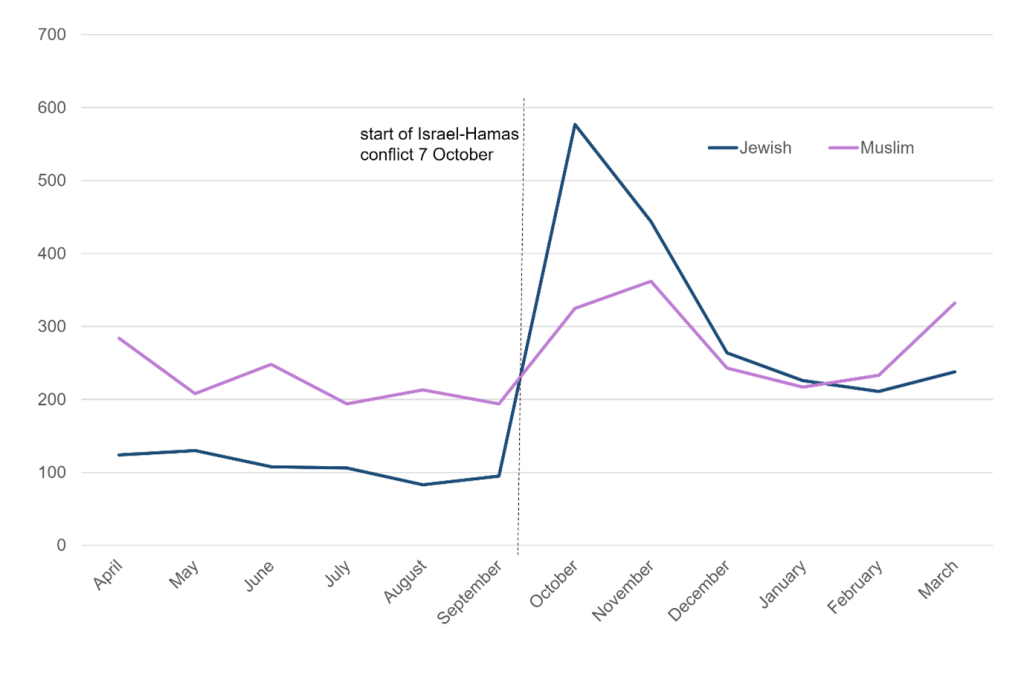
Figure 10: Proportion of offences targeted against Jews and Muslims, by offence type, year ending March 2024
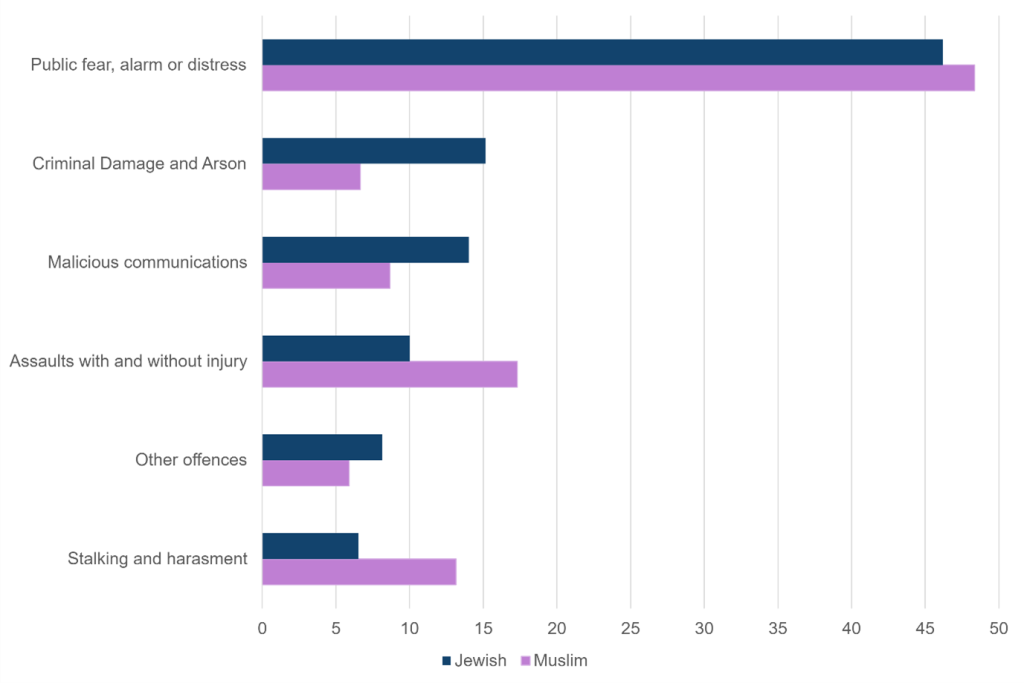
As in previous years, the majority of hate crimes were racially motivated, accounting for over two-thirds of such offences (70%; 98,799 offences).
Figure 11: Distribution of offences recorded by the police flagged as hate crimes, England and Wales, the year ending March 2024
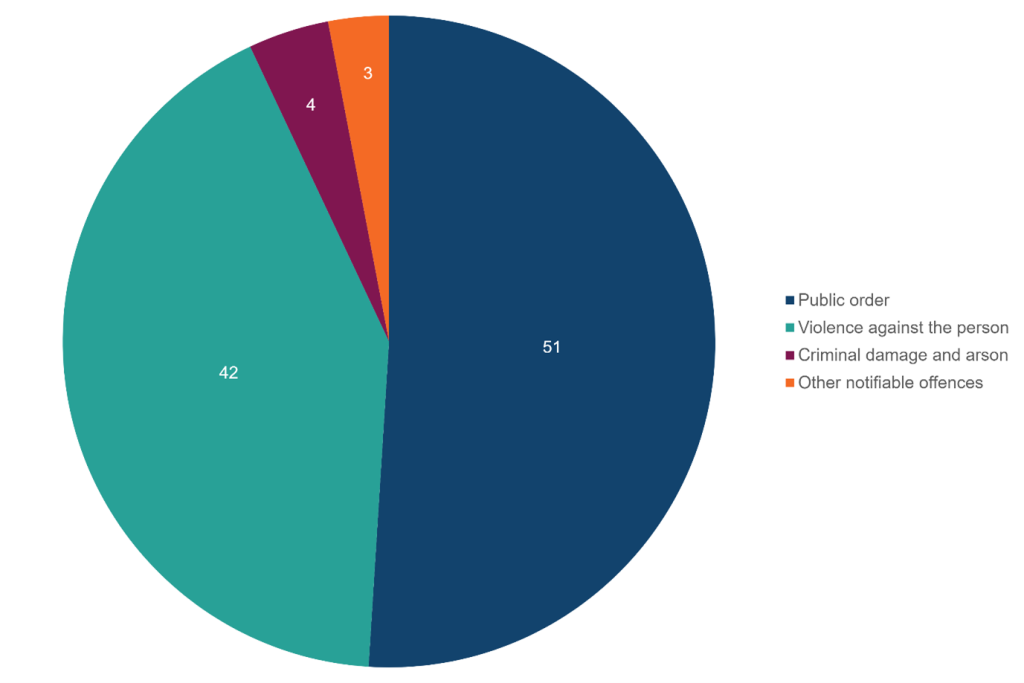
Nationally 51% of the hate crimes recorded by the police in the year ending March 2024 were for public order offences and 42% were for violence against the person offences.
Figure 12: Breakdown of hate crime by selected offence types and monitored strand, England and Wales, the year ending March 2024
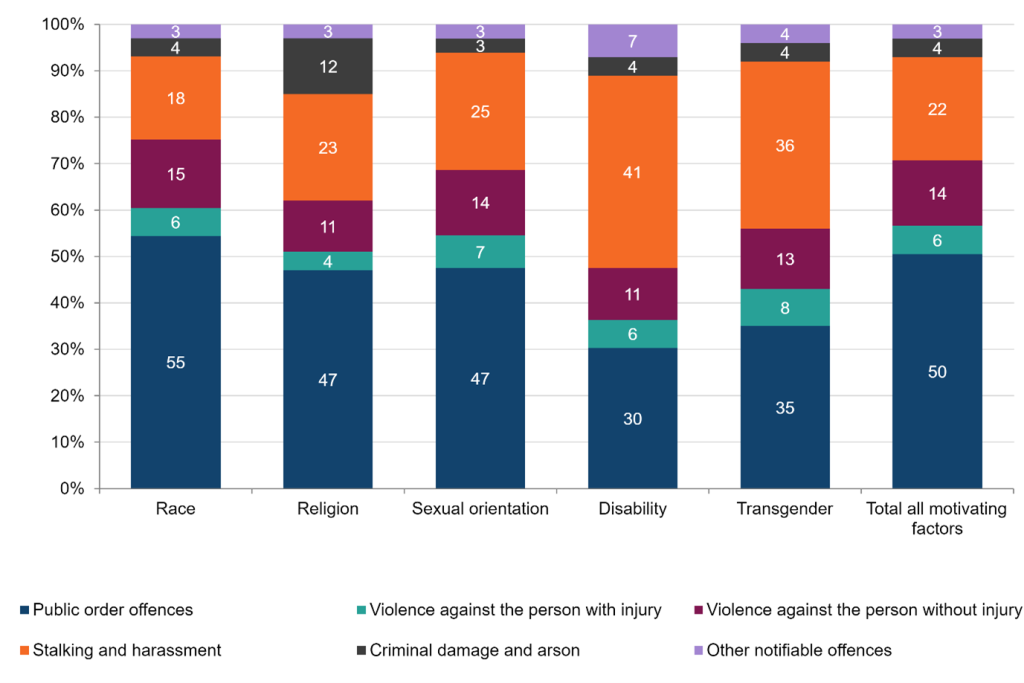
93% of hate crimes in the year ending March 2024 were for either public order or violence against the person offences, continuing the pattern seen in previous years. These 2 offence groups were thought to have been previously subject to relatively high levels of under-recording and thus improvements in crime recording since 2014 are likely to have had a larger impact on these groups than other crime types.
Local Picture
Surrey experienced a decrease in recorded hate crime offences in 2021/22. However, since January 2023, there has been a progressive increase in the number of recorded hate crimes.
As of the end of August 2024, the Force has recorded 2,731 offences, marking an increase of 334 offences (13%) compared to the previous year.
Figure 13: Total recorded hate crime offences August 2022-2023 and August 2023-2024
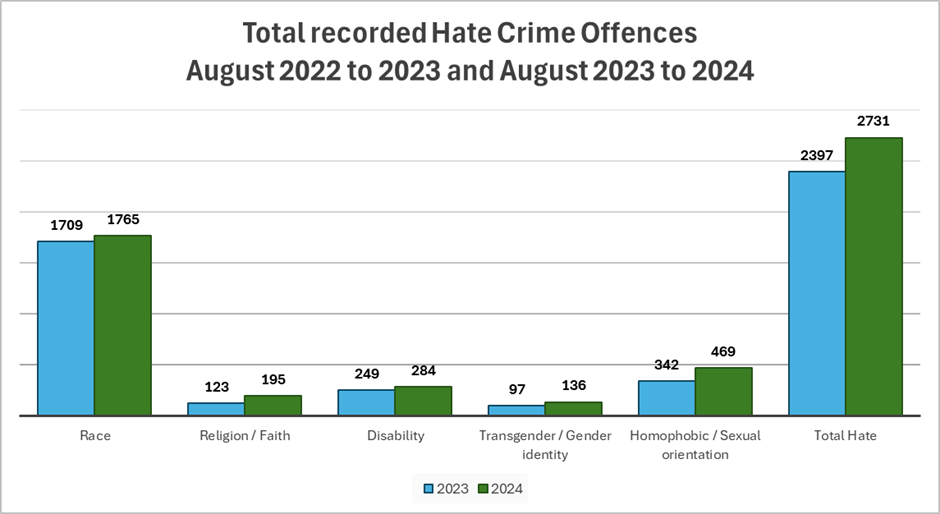
A hate related offence can be recorded in more than one category of hate.
Figure 14: Total recorded hate crime offences by category August 2023-2024
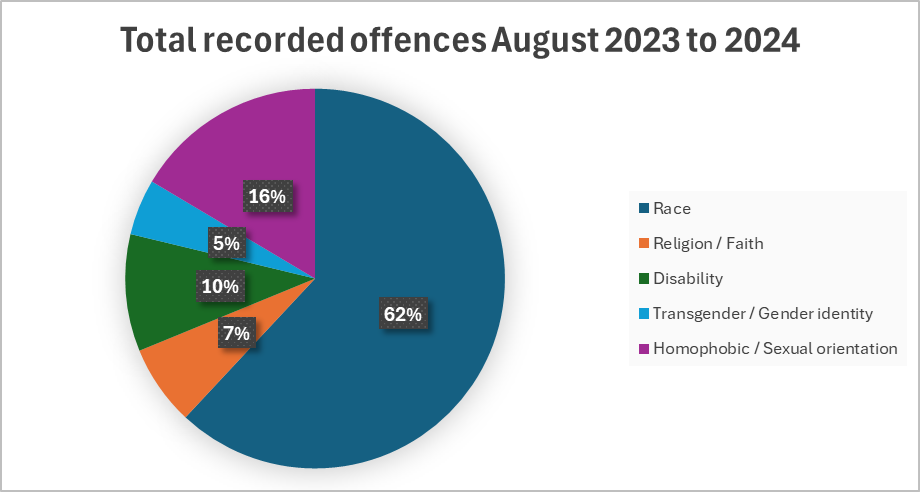
This chart shows the percentage split between the categories of hate.
The most frequently recorded aggravating factor in hate crimes is racial, reflecting a national trend where 70% of reported hate crimes are racially motivated.
In Surrey, the predominant categories of faith-related hate crimes are Anti-Jewish and Anti-Muslim. Between 7th October 2023 and 9th September 2024, there have been 189 faith-related hate crimes recorded in Surrey: 50 Anti-Jewish and 85 Anti-Muslim.
In comparison, from 7th October 2022 to 9th September 2023, Surrey recorded 110 faith-related hate crimes, with 21 Anti-Jewish and 56 Anti-Muslim incidents.
Social unrest in England
On 29th July 2024, an incident in Southport, where three children were tragically murdered, sparked nationwide unrest. From 30th July 30 to 5th August 2024, far-right, anti-immigration protests and riots erupted across England. These disturbances were fuelled by misinformation regarding the background of the Southport offender.
The nationwide unrest appears to have influenced the reporting of Anti-Muslim hate crimes which increased in August 2024. However, the full extent of this impact remains unclear, as the incident is recent, and the long-term effects have yet to be fully assessed.
Actions taken by Surrey Police – 2023 to 2024
Improvements in training
Every response officer has undergone comprehensive training on hate crime. This training emphasises the importance of investigating hate crimes, including a detailed case study. It also covers legislation, the lived experiences of victims, and insights from the Crown Prosecution Service. Additionally, the training incorporates anti-social behaviour (ASB) education provided by ASB specialists, recognising the significant overlap between hate crime and ASB.
Plans are in place to conduct an annual refresher course on hate crime.
Hate crime scrutiny Panel
The Hate Crime Scrutiny Panel was established to enhance the trust and confidence of Surrey communities. This panel offers Surrey Police and the public, transparent and independent quality assurance and scrutiny of the police response to hate crimes. Meeting quarterly, the panel reviews cases and provides critical feedback.
The panel was initially formed in May 2020 and includes members from all protected characteristics within the community. Their feedback has been instrumental in shaping the Surrey Police Hate Crime Strategy for 2022-2025.
New approach to hate crime and community cohesion
In Surrey, we have traditionally focused on police-recorded data to address the issue of hate crime. However, we are now adopting a more collaborative approach to better understand our communities and build community cohesion.
This new approach involves conducting a strategic needs assessment and agreeing a partnership action plan. Our goal is to comprehend and tackle the underlying causes of hate crimes and incidents. By doing so, we aim to enhance community cohesion, implement targeted interventions, and ultimately prevent hate crimes and incidents.
Aims of the new Hate Crime and Community Cohesion Partnership
Establish a Collaborative Partnership: Develop and sustain a partnership approach for delivering the Surrey Hate Crime and Community Cohesion Needs Assessment.
Facilitate Data Sharing: Coordinate the sharing of relevant data, insights, and information across partners to comprehensively inform the strategic needs assessment.
Develop and implement a strategy: Support the creation and rollout of a strategy to identify and address risks associated with hate crimes and incidents, establishing a collaborative approach to prevention.
Review and refresh the strategy and delivery plan: Support the ongoing review of the strategy and delivery plan, ensuring it remains up-to-date and effective in reducing hate crime and incidents across Surrey. Regularly contribute updated data and insights as needed.
Local supporting strategies
Surrey Police Hate Crime Strategy 2022-2025
Surrey Serious Violence Reduction Strategy
Surrey ASB and Community Harm Reduction Strategy 2024-2027
National supporting legislation and strategies
House of commons Hate Crime statistics 2024
GOV – Hate crime England and Wales 2022-2023
Home Office Action Against Hate – 2016.pdf
APPG – How do we build community cohesion when hate crime is on the rise?
Macpherson Report – 22 years on
Protecting our communities from harm
Anti-social behaviour
The phrase Anti-Social Behaviour takes in a range of nuisances, disorder and crimes which affects people’s lives on a daily basis. It looks different and feels different in every area and to every victim. What is considered anti-social by one person can be acceptable to another.
The Home Office describes Anti-Social Behaviour as, ‘any aggressive, intimidating or destructive activity that damages or destroys another person’s quality of life’.
The ASB, Crime and Policing Act 2014 describes ASB as:
- conduct that has caused, or is likely to cause, harassment, alarm or distress to any person,
- conduct capable of causing nuisance or annoyance to a person in relation to that person’s occupation of residential premises, or
- conduct capable of causing housing-related nuisance or annoyance to any person.
Antisocial behaviour makes people feel unsafe. It damages communities and it can destroy the lives of its victims. In the year ending 30 September 2023, about 1 million antisocial behaviour incidents were reported to the police. Each is potentially a cry for help from communities.
However, antisocial behaviour is sometimes perceived, and referred to, as low-level crime by the police, the public and the media. This attitude doesn’t reflect the significant impact it has on communities and on victims’ lives, and the trauma sustained antisocial behaviour can cause – trauma that has led to loss of lives.
Dealing with antisocial behaviour effectively needn’t be complex. In many cases, effective early intervention can prevent incidents becoming more complex and difficult to resolve.
It is now widely accepted that ASB is a precursor to occurrences linked to other crimes such as hate crime, serious and organised crime (SOC), youth violence, knife crime and exploitation of the vulnerable.
National Context
Victims
Despite victimological interest in the impacts of different types of criminal victimisation, there is little empirical work that examines the effects of ASB on victims. A 2020 study uncovered that victims experience a range of mental and physical health effects as well as behavioural changes and has provided the first in-depth insight into the impact of this type of victimisation. [3] The findings suggest the cumulative harms associated with anti-social behaviour need to be better acknowledged, understood and addressed, with greater support made available to victims. The effects were reported by the participants to have had a significant impact on their daily lives, highlighting that the mental, physical and behavioural change effects of being a victim of long-term ASB are substantially debilitating for them and their families. This research has shown that victims of long-term ASB experience a wide range of negative effects that have a significant impact on their health and quality of life, which are comparable to victims that have experienced violent crime [4].
This report comes five years after the previous Victims’ Commissioner report on anti-social behaviour in 2019. Little appears to have changed since then, prompting the Commissioner to look to further understand the impact of anti-social behaviour on victims’ lives and explore their experiences of the current reporting, resolution, and support landscape.
The report identifies that for a large proportion of victims experiencing anti-social behaviour, it is ongoing, with many reporting suffering for over five years. Additionally, the report highlights the barriers victims experience when reporting and attempting to resolve the behaviour, which is compounded by the low proportion of anti-social behaviour victims who receive support.
Victim Support
The Victims’ Code, including the principles that victims should be able to access services which support them and should have the opportunity to make their views heard in the criminal justice process. Many victims of anti-social behaviour are not recognised under the Code either because criminal offences have not been committed, or the criminal threshold has been met but police decide to treat it as a misdemeanour or neighbour dispute.
This means that victims of ASB have no statutory entitlement to access victim support services. Police Crime Commissioner (PCC) funding for victims’ services is ringfenced for victims of crime and so ASB victims are often not eligible for locally commissioned victim services, however in Surrey the OPCC has and is funding Surrey Mediation to perform this support service.
Hotspot Policing
In March 2023 the Government published a new Anti-Social Behaviour Action Plan. This included funding for ASB hotspot Response Pilots in ten police force areas. In April 2024 this was rolled out across the county to ensure an enhanced uniformed presence in ASB hotspot areas. Recognising the link between serious violence and ASB, serious violence funding was combined with the funding stream intended for ASB hotspots and this merged approach will allow for forces to utilise a full range of uniformed visible presence across hotspot areas as well as providing funding for problem solving and local initiatives.
Table 5: Surreys hotspots for ASB and Serious Violence in 2024:
| East |
| Epsom – High Street |
| Epsom – Ashley Shopping Centre |
| Redhill – Warwick Quadrant |
| Redhill – Belfry Shopping Centre |
| Horley – Consort Way/ High Street |
| North |
| Staines – Two Rivers |
| Staines – Elmsleigh Shopping Centre |
| Walton – The Heart/ High Street |
| Addlestone – Surrey Towers |
| Sunbury – Sunbury Cross |
| West |
| Guildford – Bridge Street |
| Guildford – North Street |
| Guildford – High Street |
| Woking – Chertsey Road |
| Camberley- High Street |
Local Context
Figure 15: Number and rate per 1,000 population of anti-social behaviour (ASB) offences in Surrey since 2019
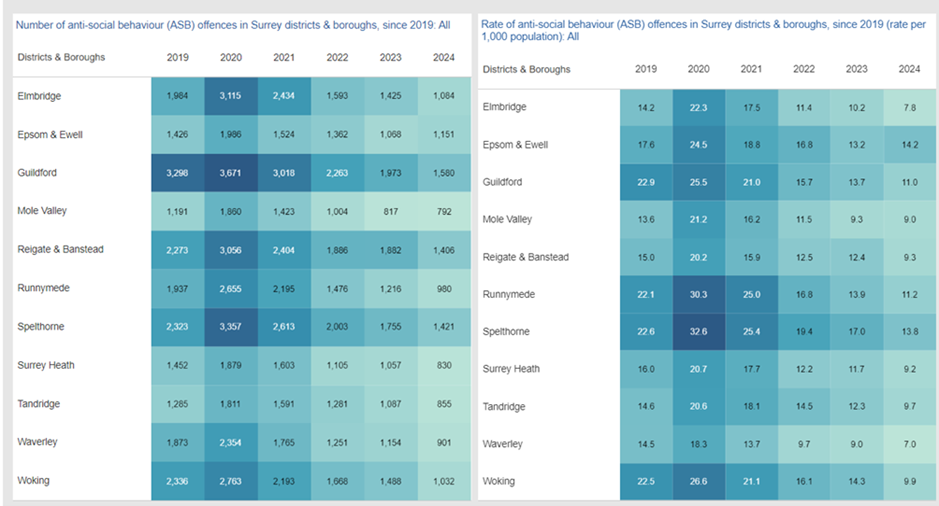
The above shows that in 2024 the districts and boroughs with the highest numbers of ASB offences are Guildford, Spelthorne and Reigate and Banstead. The rate of ASB offences as per 1,000 population differs in that the highest district and boroughs are: Epsom and Ewell, Spelthorne and Runnymede.
Surrey Police continue to see a fall in reported Anti-Social Behaviour. There are various reasons considered for this, which include:
- ASB incorrectly being recorded as crime not ASB.
- Continued communications campaign reminding victims that Police sometimes are not the first agency to contact with their ASB issue.
- Reluctance to report.
Figure 16: Trend in the number of ASB offences in Surrey by type since 2019
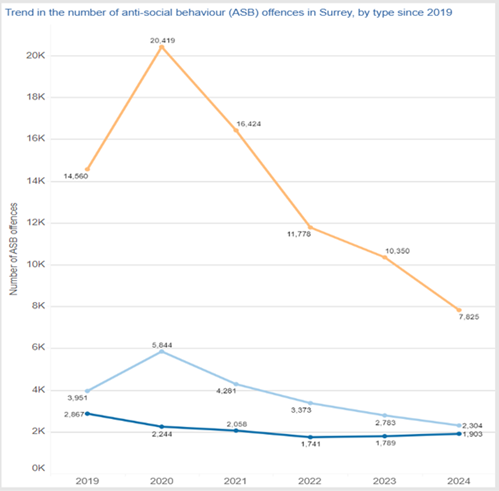
There are three main types of ASB:
Personal (light blue)- Refers to incidents that deliberately target an individual or a group. Intimidation and harassment are examples of personal ASB.
Nuisance (orange)- Refers to incidents affecting the community. This is an act, thing or person that causes trouble, annoyance or suffering to the community. They can interfere with public interests such as health and wellbeing. Drug misuse, animal problems and vehicle related nuisance are all examples.
Environmental (dark blue)- Refers to incidents where individuals or groups impact their wider surroundings. It can include environmental damage and misuse of public spaces or buildings. Environmental ASB includes graffiti, littering and damage to public buildings.
ASB Nuisance is the most common category of ASB reported to Surrey Police:
Figure 17: Percentage of ASB offences in Surrey by type since 2019
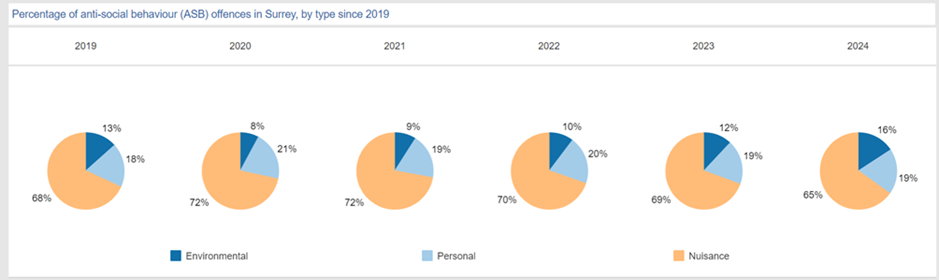
The 2024 Surrey ASB Survey had 1325 respondents, and it showed the highest concerns were;
Figure 18: Percentage of respondents of the 2024 ASB Survey with concerns in each category
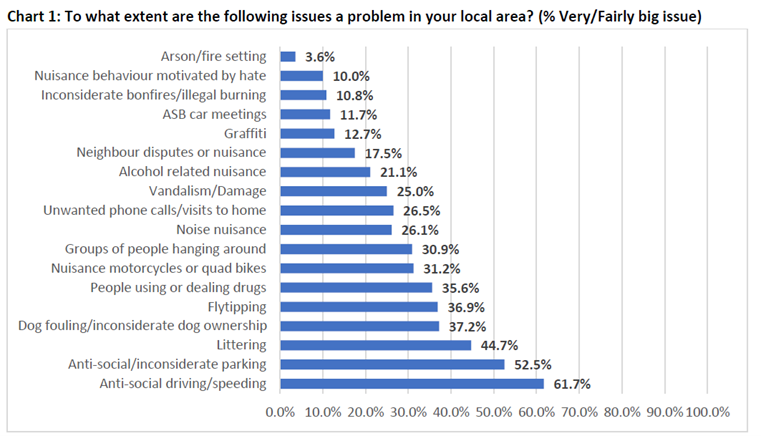
Only 4.4% of respondents considered their local area to be a better place to live now than a year ago. However, this was a slight increase on the 3.2% of respondents who considered their area a better place to live in the 2023 Survey.
Furthermore, fewer respondents (44.4%) in the 2024 survey considered their local area to be a worse place to live, with a half of the respondents saying there had been no change.
Of those that had witnessed or experienced ASB in Surrey, 72.0% of respondents felt that it was still an issue. Respondents were also asked whether they had reported the ASB they had experienced or witnessed, with 43.2% saying they had. This closely reflects the National YouGov Survey which highlighted that 49.9% of people who witness ASB do not report it.
ASB Help conducted a series of Victim Focus Workshops in 2023. Their recommendations are as follows and are being discussed at the Surrey ASB and Community Harm Reduction Partnership:
The online survey and focus group sessions identified common priorities which should be considered as areas of focus.
- Vehicles, vehicle noise, antisocial driving and parking.
- Drugs
- Student behaviour
- Neighbour disputes
- Social dynamics
- A review of processes and policies around collaborative partnership working and information sharing specifically in terms of ASB case management and using a multi-agency approach.
- Greater community engagement, giving victims reassurance that they are prioritised, and their issues are on the radar.
- Review of all resources online and paper format with regards to ASB which are available to the public. Ensure that it is clear, accessible, accurate and up to date.
- Prioritise promotion of the ASB Case Review and how it can be accessed and utilised.
- Further training for any staff involved in ASB management, from call handlers to management. Ensure all team members are sensitive to impact, are aware of policy and can appropriately identify ASB and prioritise it.
- Review victim support services available in Surrey, and how they are promoted by practitioners.
Current activity
Surreys ASB and Community Harm Reduction Partnership- This is Surreys fourth strategy (2024-27). It continues to set out how agencies across Surrey will work together to reduce the harmful effects of ASB, Serious and Organised Crime and Community Safety issues over the next three years. It will build upon the excellent partnership work already operating, at both a local district/ borough and county level and ensuring that together we continue to drive down incidents of harm and sustain residents’ high levels of public confidence and satisfaction. It will also put victims first; a key part of the strategy will be how we can provide effective support to victims, understanding the impact on their lives and seeking reassurance that processes are in place to protect them from further harm.
Community Harm and Risk Management Meeting (CHaRMM) CHaRMMs will discuss and agree action to reduce the negative impact that problem individuals and families have on Surrey’s communities through their anti-social behaviour (ASB). Using the expertise that exists on this multi-agency group, members will share information on referrals, and incidents, and put in place appropriate risk management and disruption plans to address the behaviour of the perpetrator and reduce the negative impact on victims. CHaRMMs are the agreed forum for implementation of tools and powers introduced by the ASB Crime & Policing Act where multi-agency information sharing, consultation or response may be required to support the process
The involvement of a wide variety of both statutory and voluntary agencies will ensure a harm centred approach throughout and a learning opportunity to understand what others can bring to the problem-solving process. Applying a harm reduction and risk assessment-based response aims to improve the relevance of meetings and make attendance and engagement in the process worthwhile for all involved.
Joint Action Group (JAG)
These are the designated multi-agency forums addressing place-based crime and disorder. These intelligence-led local partnerships aim to reduce the risk of harm to our communities by focusing on locations identified as community concerns.
The partnerships coordinate a multi-agency response, making the best use of all available resources through information sharing, consultation, and the development of coordinated action plans. This collaborative approach effectively reduces the harmful impact of place-based crime and disorder, including issues related to drugs, serious and organised crime, and exploitation in local communities.
Mediation and Support Coaching – Mediation Surrey aims to bring people together, through improved resilience, communication and understanding, to help them cope with, resolve and prevent disputes. Support Coaching is a service for people in Surrey experiencing anti-social behaviour or difficulties with neighbours. Community Mediation helps to resolve conflict by bringing the parties in dispute together, identifying the cause of the dispute and reaching a resolution or agreeing the terms of a settlement themselves. They are guided in the process by a mediator. Further information can be found here: https://mediationsurrey.org/
Assertive Outreach for Cuckoo Victims
Cuckooing is a type of exploitation mostly by criminal gangs but can also involve “friends” or family. It involves befriending someone, then taking over their home and exploiting them. This type of activity is sometimes closely linked to ‘county lines’ drug trafficking, where people are used to supply drugs from major cities to suburban, rural and coastal areas. In this case, the victim’s home becomes a base for developing operations in a new area. These locations/activities are usually linked to Anti-Social Behaviour and therefore the service looks to not only support the exploited person in their home but by doing this help reduce the associated ASB impacting the local community. This service is funded by the OPCC, Public Health and the Serious Violence Duty. Further information can be found here: https://catalystsupport.org.uk/services/specialist-outreach/surrey-cuckooing/
National ASB Awareness Week – The UK’s national ASB Awareness Week. Supported by HM Government, the Civil Service, all Police and Fire forces in the country, and thousands of housing providers, local authorities and community groups. Surrey Partners support this week where there will be increased activity operationally to showcase the work that goes on around the year to tackle ASB. Communications are focused on how victims of ASB can get help, the work we are doing across the boroughs and the how to find information and advice.
Annual Surrey Tackling ASB Awards
The awards recognise good work in tackling ASB in Surrey within the Force and partner agencies, and also recognises the bravery of members of the public who have stood up to anti-social behaviour in their communities, whether they had been directly or indirectly impacted, or have supported someone else who has been a victim of ASB.
Figure 19: Tackling ASB award

Gaps
- Victims of repeat ASB not being recognised nationally as part of the Victims Code and therefore OPCCs do not get MOJ funding to support victims of ASB.
- Lack of Good Quality Data to take a public health approach – Officers and staff need to uncover the main causes of antisocial behaviour and problem-solve to find lasting solutions. To do this effectively, organisations need to make good use of their data and that of other organisations. Without a full picture of what is happening, and where and when it is happening, there is a risk the approach to tackling antisocial behaviour will be ineffective. Good quality data and data analysis means organisations can plan interventions effectively, allocate the right resources and fully evaluate the effectiveness of their actions.
- Lack of suitable trained staff to tackle ASB and support victims.
Recommendations
- To continue to work with Public Health to look at opportunities to identify victims of ASB presenting to health colleagues and to encourage referrals to appropriate support services or community safety partnerships.
- To consider additional funding opportunities to ensure the resilience/longevity of the services provided for those victims of ASB seeking mediation.
- To consider additional funding opportunities to ensure the resilience/ longevity of specialist outreach services for cuckooing.
- Organisations to review their risk assessment processes for antisocial behaviour cases to make sure that risks are properly assessed from initial contact to case closure
- Ensure there are enough suitably experienced personnel to analyse antisocial behaviour data and to provide expert guidance on tactics and legal powers to address antisocial behaviour, in partnership with other organisations
- Improve awareness and utilisation of the anti-social behaviour Case Review.
Community fire and water safety
National Context
The legislation that mandates the work of Surrey Fire and Rescue Service (SFRS) is the Fire and Rescue Services Act 2004. Through this legislation, SFRS is responsible for:
- Protection of life and property
- Extinguishing fires
- Rescue and protection of individuals
- Responding to other emergencies as needed.
The legislation also details SFRS responsibilities in prevention activities to educate and inform the public about keeping safe from fire and its effects.
Local Picture
Community Risk Profile (CRP)
This has been created to demonstrate SFRS understanding and assessment of the risks facing all our communities, those who live and work in Surrey and the people who visit Surrey. Further information can be found here:
Surrey Fire and Rescue Service Community Risk Profile – Surrey County Council (surreycc.gov.uk)
This section of the JSNA Community Safety Chapter summarises some of the information within the CRP but for more detailed analysis and explanation of data sets please access the full CRP using the link. The CRP is updated on an annual basis.
SFRS provides information to help the community keep safe from fire on its website Safety at home (Surrey Fire and Rescue) – Surrey County Council (surreycc.gov.uk). Prevention messages are delivered through the website, social media and through services such as Safe and Well Visits. SFRS has introduced a service where officers visit residents to provide personalised advice about fire safety. Attending the home at the arranged time, day or night, officers will share expertise and fit smoke alarms or other prevention items free of charge if they are needed. After a chat about fire prevention, officers will request a tour of the home to provide personalised advice on:
- Cooking and smoking
- Heaters and heating
- Candles and fireplaces
- Detection systems (smoke and heat alarms)
- Bedtime checks
- What to do if there is a fire
- Extra help and support
Depending on personal circumstances, officers might also suggest extra help and support from other organisations. This could be to discuss things like fire retardant bedding or linking a smoke alarm to a Telecare system.
The Safe and Well Visit (SAWV) can happen through a referral from a partner agency, such as Adult Social Care, or through self-referral via the online questionnaire HFSC (safelincs.co.uk) .
What we know
People vulnerable to a fire
When examining historic fatal fires, several factors significantly impact an individual’s vulnerability to fire and the risk of injury or death during such incidents. These factors include:
- Smokes in their home.
- Is 65 or older.
- Lives alone.
- Has limited mobility, a hearing impairment or is blind or partially sighted.
- Would have difficulty responding to, or escaping from, a fire.
- Has had a fire previously or shows signs of burns or scorching in the home.
- Has learning disabilities.
- Is supported by family, carers and friends.
- Shows signs of neglect or abuse by others.
- Has a mental health condition such as dementia or depression.
- Has drug or alcohol dependencies.
- Doesn’t have an alarm in all areas where a fire might start.
- Collects or hoards in their home.
- Shares a home with a child or young person who sets fires.
As more people are supported to live at home for longer, the risks increase for those who are vulnerable.
The following characteristics tend to occur in more people aged over 65: living alone; unable to self-care; having a limiting long-term illness; and potentially having dementia. A significant increase in the number of residents aged over 65 is expected and this will also increase the number of people with one or more of those other characteristics. It is projected that the number of those living alone aged 65 and over will increase from 79,372 in 2023 to 89,195 in 2030, a rise of almost 12%. People with mobility issues may find it harder to self-rescue and may suffer from slips, trips and falls. Residents aged 65 and over with a limiting long-term illness are predicted to increase from 96,416 in 2023 to 108,597 by 2030, an increase of 13%. Likewise, those unable to manage at least one self-care task on their own increases by 14% from 70,087 to 80,078, and those vulnerable to having a fall leading to hospital admission is expected to increase by 18% from 8,209 to 9,684.
Poor mental health is a contributory factor to fire deaths. Those with dementia may be more at risk of causing accidental fires and may be less able to self-rescue or respond to smoke alarms.
The number of people aged 65 and over with dementia in Surrey is predicted to increase from an estimated 18,577 in 2023 to 21,428 in 2030, a rise of 15%.
The Home Office report using data from April 2022 to March 2023, found that the fire-related fatality rate per million is higher for men and older people. For men aged 65-79 the fatality rate was 14.4 per million population, while the equivalent rate for women was 5.5 per million. For those aged 80 and over, the rate for men was 18.4 per million and for women was 15.1 per million. This compares to the ‘all age’ rates of 5.9 per million for men and 3.3 per million for women. That same report states that someone is 10 times more likely to die in a fire if there is no working smoke alarm in their home.
For younger residents (18 to 24), common mental disorders, physical and learning disabilities and autistic spectrum disorders are factors that increase their vulnerability to fire. These factors show a steady state or slight decline between 2023 and 2030. Alcohol and drug dependencies and prevalence of smoking are forecast to register only small changes in that time.
Causes of fire in the home
According to Home Office statistics, in 2022/23 the largest cause of fires starting in England was cooking appliances, which caused 44% of accidental dwelling fires but only 10% of fire-related fatalities.
Smoking materials accounted for only 8% of all accidental dwelling fires, however, were involved in 35% of fire fatalities.
The chart below highlights in orange the percentage of fires and fatalities caused by smoking and in blue the percentage of fires and fatalities caused by cooking appliances.
Figure 20: Smoking and cooking appliance comparison: 2022/23 (taken from Home Office’s detailed analysis report).
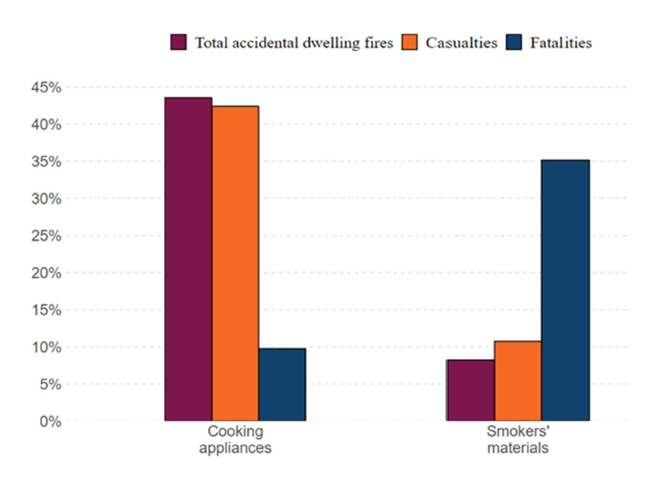
Smoking is a high-risk factor in causing fires. Looking at both Surrey and the national picture, smoking is seeing a downward trend in the percentage of adults who are current smokers since 2011. The chart below shows the percentage of adult smokers at around 20% in 2011 and steadily declining to around 13% in 2022. For Surrey the equivalent percentages are 15% and 12%. It is noticeable that following a declining trend, the year 2022 saw a relatively sharp increase from 8% in the previous year. For more information please refer to the Smoking, Vaping and Tobacco Control JSNA Chapter.
Figure 21: Smoking prevalence in adults (18+) – current smokers (APS)
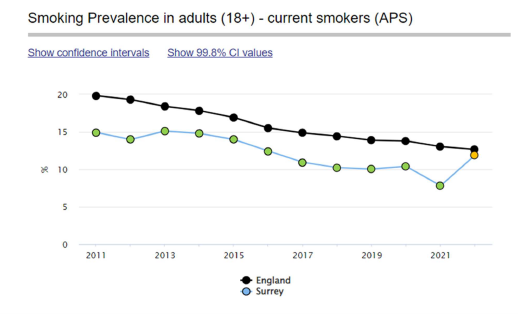
Source https://fingertips.phe.org.uk/profile/tobacco-control/
Figure 22: All dwelling fires in Surrey 1 April 2018 to 31 March 2023
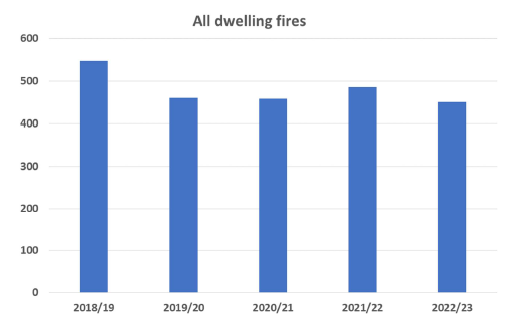
Figure 23: Accidental dwelling fires in Surrey 1 April 2018 to 31 March 2023
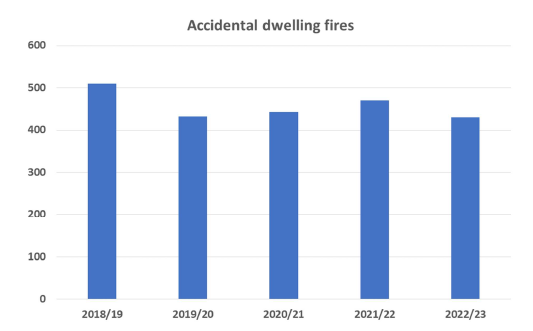
Product Risks
There are three categories of products that create risks:
- Existing products which can cause risk if not used with proper care e.g. candles, cigarettes.
- New product developments with a unique profile of risk,
- Specific makes/brands of a product being recalled due to known occurrences of incidents, e.g. mobile phones or chargers overheating, faulty tumble dryers, alternative fuelled vehicles.
Safe products, unsafe use
The Home Office identified the following factors across England in 2022/23 as the cause of accidental dwelling fires [5] (Fire statistics table 0601):
- 29% due to misuse of equipment or appliances
- 15% due to placing articles too close to heat
- 5% due to chip/fat pan fires.
With these products, the problem is not with the products themselves, but with how they are being used. The knowledge of which type of products are causing fires when used without appropriate care, informs the education and awareness campaigns, and the advice given to householders and businesses when Safe and Well visits are conducted.
Unsafe products
The Home Office identified the following factors as the cause of accidental dwelling fires across England in 2022/23:
- 14% due to faulty appliances and leads
- 10% due to faulty fuel supplies.
The remaining 27% of accidental fires are caused by playing with fire, careless handling of fire or other/unknown causes. In terms of unsafe products, many of those of potential concern will be those with a fuel supply, most often electrical but sometimes gas.
The Fire Investigation team monitors product safety alerts through channels such as:
- Association of Manufacturers of Domestic Appliances
- Electrical Safety First
- Office of Product Safety and Standards
- NFCC Fire Investigation Workplace site
- Fire Investigations
- Trading Standards investigations.
Any emerging trend or issue is then highlighted to partners for joint investigation and notice to the media team for informing the community if appropriate.
The proliferation of lithium-ion batteries and the products that run on them has resulted in an exponential increase in incidents resulting in injuries and fatalities. At global level the total number of incidents reported for each category is as follows:
- Consumer Products: 1301 Total Injuries – 131 Total Fatalities:
- Electric Vehicles (>20MPH): 118 Total Injuries – 89 Total Fatalities
- Micro-Mobility Devices (<20MPH): 1370 Total Injuries –251 Total Fatalities
- Energy Storage Systems: 51 Total Injuries – 4 Total Fatalities
At a national level, the leading cause accounting for around half of accidental dwelling fires remains unsafe use of otherwise safe products, followed by unsafe products which account for around a quarter. Understanding which products have caused fires enables the Service to educate and inform residents about their safe use and to get dangerous products withdrawn from sale. Monitoring emerging technology allows the Service to adapt by implementing new procedures and/or equipment to deal with incidents.
The presence of smoke alarms reduces the extent of fire damage and improves the likelihood of self-rescue. Research and our own experience have shown that some residents are more likely to experience a fire and to be more affected by it. These are older residents and residents with physical or mental health issues, alcohol or drug dependency, residents who smoke and residents who live alone.
Partnership working
Partnership work is crucial to ensuring residents in Surrey are kept safe from risks. SFRS work with Adult Social Care (ASC)) and the NHS to highlight when individuals could benefit from each other’s expertise. In partnership with ASC a Person at Risk Assessment (PARR) form has been developed which allows referrals and risks to be shared so that a fuller picture of the resident can be shared and recorded. This allows SFRS to give a greater level of support to those that need it.
National Resources
The Home Office in collaboration with fire services, runs the Fire Kills campaign to help keep people safe in their homes Fire safety | Fire England. It is aimed at raising awareness of everyday fire risks in the home and encourages everyone to test their fire alarms. Campaigns focussed on different issues are run throughout the year PSG – Fire Kills Calendar 2024 (nfcc.org.uk) to support safety in the home.
Water safety
National Picture
Although there is no specific legislative duty for fire and rescue services in England to respond to flooding or water rescues, the Fire and Rescue Services Act does make provision for rescuing and protecting people in the event of emergencies, other than fires and road traffic accidents. The Fire and Rescue Services (Emergencies) (Wales) (Amendment) Order contains an amendment to include a duty to prepare for and respond to flooding and rescues from inland waters.
The Fire and Rescue Services Act 2004 is specific about prevention of fires through education however this does not apply to water safety. This comes under a general prevention duty and as such, Fire and Rescue do not hold the statutory responsibilities for water safety (except in Wales). This duty falls under the Maritime Coastguard Agency, MCA. However, conversations are ongoing between parties to clarify this position and for the FRS to be acknowledged as having a specific role in water safety.
In 2014, the World Health Organization (WHO) released a seminal global drowning report which identified that drowning is a serious and neglected public health threat that claims the lives of 372,000 people a year worldwide.
Between 2019 and the end of 2023, there were an average of 625 water-related fatalities in the UK each year and, despite fire and rescue services’ (FRS) best efforts, the number of drowning deaths in the UK has remained high. In 2023, the total number of fatalities in water in the UK was 659, which is the highest total figure recorded in 10 years. On average, accidental water deaths in the UK comprise around 39% of all water related fatalities and, in 2023, 63% of accidental water deaths occurred inland in environments such as rivers, canals, reservoirs, and lakes and, in most cases, during every day or recreational activities. Many of those who die in our inland water environments had no intention of entering the water but instead slipped or fell into the water.
The number of deaths in water is more than two times higher than deaths in fires, with 269 fire-related fatalities recorded in the year ending December 2023.
The UK has over 4000 miles of inland waterways and many inland waters have been transformed from predominantly working environments to mixed use leisure, retail, and residential locations. This means that communities are more likely to use and encounter inland waterways, increasing the risk of a water safety incidents occurring. These effects will be amplified by the effects of climate change, as the number of extreme weather events increases and more people are drawn to the water during heatwaves to swim, and to take pictures during storms. Increased rainfall means that certain locations become more hazardous.
From 2020/21 to 2021/22, the number of flooding or water related incidents attended by FRS in England rose by 6% and another 11% from 2021/22 to 2022/23. Whilst the number of floods each year can vary depending on numerous factors, such as the frequency and severity of storms, the average number of flooding or water related incidents has steadily increased on average. In the five years from the 2013/14 to 2017/18 reporting periods inclusive, there were 15,180 incidents on average each year. This compares to an average of 17,001 each year in the following five-year period from 2018/19 to 2022/23, an increase of 12% totalling almost 2,000 additional incidents per year.
Climate projections indicate that, on average, winters will become wetter, and summers will become drier. However, rain that does fall in the summer is likely to be more intense which will impact on the frequency and severity of flash flooding, particularly in urban areas. Increased rainfall will make terrains more hazardous, resulting in the potential for more slips and falls.
Summer heatwaves with extreme temperatures are predicted to become more common because of climate change, and there is a direct correlation between higher air temperatures and precipitation rates. More people participate in water sports and water-based activities or simply enter water to cool down during periods of higher temperatures. It is, therefore, predictable that FRS will need to respond to increasing numbers of inland water safety incidents. The summer of 2022 was the hottest on record for the UK, and recreational activities accounted for 58% of accidental drowning fatalities in 2022.
In 2023 in the UK:
- Inland waterways, continue to be the leading locations for accidental drowning, accounting for 63% of deaths in locations including rivers, canals, lakes, reservoirs, and quarries.
- Males continue to over represent with 83% of accidental fatalities.
- Of the 236 accidental fatalities in the UK in 2023; 28 occurred in June, with 20 in July and 21 in August
- Everyday activities like walking and running accounted for 48% of accidental fatalities.
- Many of those who lost their lives were not intending to enter the water, 88 of the fatalities (37%) were walking or running before the accident.
- (Source: WAID Interactive Report | National Water Safety Forum).
Local Picture
Surrey has no coast, but it does have several rivers, lakes and reservoirs, and most are used for transport and leisure activities. The river Thames presents additional risks due to the number of dwellings on islands within the Surrey stretch of the river. Between 2010 and 2024 SFRS responded to 4,317 water-related incidents. SFRS performed rescues in 502 of those incidents and, sadly, recovered fatalities in 62 of those incidents. There were 71 fire deaths in the same period. Water and fire fatalities continue to be comparable.
Figure 24: Water rescues SFRS attended in period 1 April 2019 to 31 March 2024.
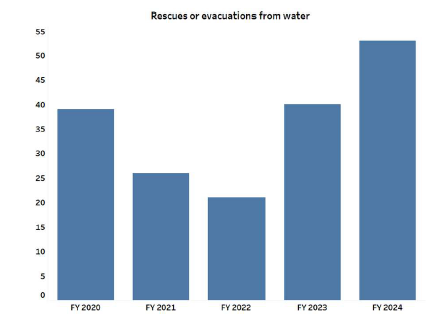
National campaigns and information sources
Float to live Float To Live – What To Do In An Emergency – RNLI
NFCC Water safety tips for runners and walkers – NFCC
UK Drowning Prevention Strategy Strategy | National Water Safety Forum
Respect the water campaign Respect The Water
RNLI SUP Stand-up Paddleboarding Safety Tips And Advice From The RNLI
WAID water incident database WAID | National Water Safety Forum
District & Boroughs
District and Boroughs can have a focus on water safety depending on their geographical risks. Where there is a water risk it is best practice for a water safety plan to be in place. This may be part of their Community Safety Plan or through collaboration with SFRS, SCC or other partnerships.
Road safety
Road traffic collisions resulting in death or serious injury can have a significant and devastating impact on those directly associated, as well as having negative affect on the wider community. Killed or serious injury collisions (KSI’s) unfortunately are still prevalent in Surrey, and although there has been a reduction in fatal collisions in 2023, (compared with 2022) serious injury collisions occurred at a consistent trend.
Being safe on the road can have a much wider impact on health than just preventing death or injury. Promoting ‘active travel’ opposed to relying on motorised transport can assist in reducing obesity and bring other health benefits. Ensuring that Surrey’s Road networks are considered safe for all types of road use is therefore a priority, promoting the message that more active methods to travel are also an option to motorised transport. In turn, this will likely also positively impact the reduction in levels of air pollution which has health and environmental benefits.
In addition to this is the socioeconomic impact that collisions can have. Collisions of any severity can cause significant demand to all emergency services, as well the public and economy.
Local Context
In 2023, there were 21 fatal and 707 seriously injured casualties because of a collision on Surrey’s roads. The most common type of collision casualty was car driver, with 207 casualties (including four fatal), followed by motorcycle casualties including pillion passengers with 175 casualties (including seven fatal). Pedestrian and cyclists also reported high casualties with 114 (including three fatal) and 103 (including one fatal). The fifth highest casualty group was car passengers with 86 casualties (including five fatal).
69% of fatal or seriously injured casualties in Surrey were male, which follows the national trend (75% of fatal and 61% of casualties of all severity were male [6]).
Age is also a factor to consider.
Table 6: Percentage age break down of KSIs in 2023
| Age Range | Number of KSI | % of KSI |
| 00 – 04 | 4 | 1% |
| 05 – 09 | 14 | 2% |
| 10 – 14 | 21 | 3% |
| 15 – 19 | 68 | 9% |
| 20 – 24 | 75 | 10% |
| 25 – 29 | 63 | 9% |
| 30 – 34 | 63 | 9% |
| 35 – 39 | 51 | 7% |
| 40 – 44 | 56 | 8% |
| 45 – 49 | 43 | 6% |
| 50 – 54 | 55 | 8% |
| 55 – 59 | 58 | 8% |
| 60 – 64 | 43 | 6% |
| 65 – 69 | 32 | 4% |
| 70 – 74 | 16 | 2% |
| 75 – 79 | 34 | 5% |
| 80 – 84 | 16 | 2% |
| 85 & over | 16 | 2% |
When looking at the residential sectors, certain postcode areas were noted as accounting for disproportionately more KSI casualties, specifically, GU21 Knaphill (11), GU21 Sheerwater (10), TW19 Stanwell/West Bedfont and TW16 Feltham Hill/Sunbury Common (9).
Strategies – addressing road safety
National Highway’s Connecting the Country: our long-term strategic plan 2050 [7] is a national strategy aiming to connect the country safely and reliably by reducing the congestion associated with road collisions. Their long-term vision is that nobody should be killed or seriously harmed while using or working on the strategic road network.
More locally within Surrey, there are both key policies and corporate objectives which focus on road safety issues.
Surrey County Council’s Local Transport Plan 4 vision:
“A future-ready transport system that allows Surrey to lead the UK in achieving a low-carbon, economically prosperous, healthy and inclusive county with excellent quality of life for all residents, whilst seeking to enhance both the built and natural environments” .
This strategy has an emphasis on behavioural change methods and ‘greener’ modes of travel, promoting avoiding unnecessary travel and suggesting more sustainable modes of travel such as public transport, walking and cycling. Contained within is the Sustainable Modes to Travel to School Strategy (SMOTSS) which aims to support and encourage Surrey’s families to make more active, safe and environmentally friendly travel to and from school. To achieve this, they focus on promoting the benefits of sustainable travel as well as providing training and education designed to improve confidence (parent and child) and ability to travel sustainably and most importantly, safely. They seek to improve journeys by developing infrastructure and services in support of sustainable modes of travel [8].
Further to this, in June 2022 Surrey County Council Cabinet Member with responsibility for road safety allocated £3million for infrastructure to help tackle excessive speeds and road safety on Surrey’s roads.
Surrey Police has dedicated resources devoted to the enforcement of road traffic law which seeks to improve road safety. This supports the National Police Chiefs’ Council National Roads Policing Strategy 2022-2025 which specifically states under the ‘preventing harm and saving lives’ pillar that preventing harm and saving lives is a core policing mission, and as such policing the roads effectively can prevent both economic and social harm.
In addition to this, education, where appropriate, can be used to prevent future re-offending and can be used as an opportunity to promote the safer use of roads [9]. Education can be promoted through various formats and by various organisations nationally as well as in Surrey. The National Police Chiefs Council (NPCC) national campaigns calendar utilises both education and enforcement as a tactic in addressing road safety matters. Additionally, the National Driver Offender Retaining Scheme (NDORS), which is utilised in Surrey (where appropriate) is offered as an alternative disposal method to prosecution for road traffic offences. The scheme allows motorists who have committed a minor road traffic offence to have education with the aim of improving the driver or rider’s knowledge and/or behaviour whilst on the road [10]. This is intended to have a long-term positive impact on the individual as well as the community, due to reduced repeat offending.
Understanding the importance for approaching road safety matters in a collaborative manner, the Surrey RoadSafe partnership consisting of Surrey Police, Surrey County Council, Office of the Police and Crime Commissioner Surrey, Surrey Fire and Rescue Service and National Highways, have written a new strategy, ‘Surrey RoadSafe Vision Zero Road Safety Strategy.’
The Vision Zero and Safe Systems approach derives from the Stockholm Declaration which was the culmination of the Third Global Ministerial Conference on Road Safety in 2020. It is now being adopted more widely by Governments, local authorities and police as the best practice approach to road safety and with the aim of reducing road casualties. A Safe System approach puts people at the centre, focusing on the view that every road death or serious injury is preventable. It is based on these main principles:
- Death and serious injury from road collisions is unacceptable.
- Human beings make mistakes that lead to road collisions.
- The human body by nature has limited ability to sustain collision forces with known tolerance to injury thresholds.
- The approach should be proactive, not reactive, and
- It is a shared responsibility between stakeholders (road users, road managers, vehicle manufacturers etc) to take appropriate actions to ensure that road collisions do not lead to serious or fatal injuries.
A Safe System approach has five multi-disciplinary components that interact and work together to minimise risk, namely:
- Safe Speeds – setting appropriate speed limits and improving compliance with existing speed limits.
- Safe Road Users – aspiring for road users to be competent, abide by the rules of the highway code and will be safe and respectful (especially towards vulnerable road users).
- Safe Roads and Streets – roads and streets being designed and well maintained so that they are more forgiving of mistakes made by road users as well as supporting active travel.
- Safe Vehicles – vehicles in Surrey will be well maintained and designed to reduce harm to road users in the event of a collision.
- Post Collision Response – fast and effective multi-agency response to collisions, including detailed investigations and victims and/or families are well supported.
The Surrey RoadSafe Vision Zero Road Safety Strategy adopts the five components in the Safe System approach. It has been developed collaboratively by the organisations in the partnership who are responsible for improving road safety in Surrey. The work under these components will be underpinned by data, research evidence and evaluation.
Figure 25: Target for 50% reduction in KSIs by 2035
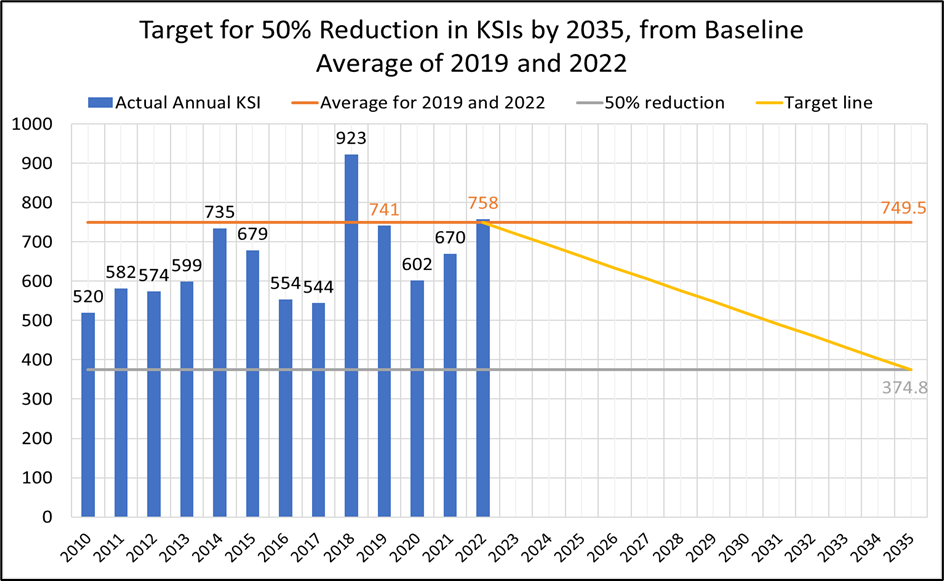
The above graph shows the trend in fatal and serious injury collisions since 2010. As can be seen there has been fluctuations in the recording, specifically noting a significant increase in 2018. It is important to note however, that the increases in recent years can be attributed
The years 2019 and 2022 are therefore more likely to be representative of the typical number of people killed or seriously injured (KSI) annually in Surrey and therefore have been used as a baseline to target set a 50% reduction in KSI’s by 2035. By 2050 the aspiration is that there will be zero killed or serious injury collisions on Surrey’s roads [11].
Priority Areas
Vulnerable road users are made up of those most at risk of injury or death on the roads, this includes pedestrians, cyclists, horse riders and motorcyclists. These road users are more vulnerable as they have less protection than occupants of a motor vehicle.
In 2023, Surrey noted a total of 477 power two-wheeler casualties (please see below table for breakdown), of which 12% were female and 88% were male. The highest proportion (more than half) occurred on 30MPH roads and in daylight hours. Guildford Borough noted the highest casualties at 13% of the total for all casualties and 12% for killed or seriously injured casualties.
Table 7: Number of power two-wheeler casualties by severity:
| Casualty severity | Number |
| Fatal | 7 |
| Serious | 168 |
| Slight | 302 |
| KSI | 175 |
| Total | 477 |
To address power two-wheeler collisions, Surrey Police launched Operation Downsway in Surrey for the first time in April 2024.
The ethos of Operation Downsway can be summarised in the following key objectives:
- Reduce KSI collisions involving powered two wheelers through informed and intelligence- led deployments to key routes and areas.
- Reduce reports of anti-social riding and driving.
- Appropriate and consistent use of engagement and enforcement in key localities.
- Use innovative technology and media strategies to enhance engagement opportunities.
- Incorporate national led campaigns within local deployment plans.
The deployment strategy is based upon KSI data which was combined with antisocial behaviour data to identify ‘high risk’ routes and locations where it was known that antisocial related riding / driving appeared prevalent.
Addressing the speed in which people travel is key to addressing road safety. As reported by the World Health Organization, driving at higher speeds significantly increases both the likelihood of a crash occurring and the severity of its consequences [12]. Compliance with existing speed limits, as well as considering suitable alternate speed management measures is important. Surrey’s Speed Management Plan covers all eleven Districts and Boroughs, assessing speed concerns through speed data collection and data relating to previous collisions resulting in injury recorded by the police. Surrey RoadSafe, Surrey County Council and Surrey Police road safety specialists meet to discuss such sites, agreeing require the most attention and what the most appropriate intervention may be.
Surrey County Council are addressing the national default speed limit on single carriageway rural roads by implementing a rural speed limit review. This review aims to replace all the existing 60mph national speed limits on rural roads with lower speed limits, which are set at a level in keeping with the use and nature of the road (and at a speed that most the drivers are travelling at). The first of these were implemented in July 2023, with the review being completed and fully implemented by the end of 2028 [13].
Forming a part of the Vision Zero Road Safety Strategy, Surrey County Council have also reviewed their approach to implementing 20MPH speed limits. This provides a flexible approach, not advocating for a blanket approach and recognising that some main roads should remain at 30MPH. Lower speeds will not be imposed on communities, with the County Council taking extra care to consider the views of local people and police before deciding whether to proceed or not. This policy also requires that additional support measures, such as traffic calming will be required to ensure that the new 20MPH limits will be self-enforcing without the need for police enforcement [14].
Whilst all of Surrey Police’s officers contribute to the enforcement of road traffic law to improve road safety, there are also teams within Surrey Police who have a dedicated remit to enforce road traffic law, improving road safety and reducing road casualties. Specifically, Surrey Police’s Road Policing Unit (RPU) which is a collaborative function across Surrey and Sussex and whose core responsibility is: responding to emergencies on the road including killed or serious injured collisions, reducing killed or serious injured collisions through Fatal 5 enforcement and tackling criminals using Surrey’s roads.
The Fatal 5 refers to the top contributing factors in collisions where people are killed or seriously injured. These offences are outlined below with the number of people who were killed or seriously injured between 2021 and 2023 in Surrey alone.
- Speed (excess of the limit or inappropriate) – 741 people (34%)
- Careless driving – 601 people (28%)
- Not wearing a seatbelt (any person in a vehicle) – 79 people (15%)
- Drink and/or drug driving – 220 people (10%)
- Distracted driving (including using a phone) – 121 people (6%)
Surrey’s Vanguard Road Safety Team focuses specifically on Fatal 5 offences, by delivering additional traffic enforcement, targeting collision ‘hotspots’ and by targeting individuals where information/intelligence suggests their driving caused a risk of harm to themselves or the public.
Throughout the year and to address road safety issues in Surrey, campaigns and activities are undertaken. Examples of these include:
- Operation Limit is one of the longest running campaigns focussing on drink/drug driving, taking place for 5/6 weeks in the winter.
- Operation Downsway focuses on motorcycle safety with police officers targeting specific areas where they see an increase in motorcyclists between April and September
- Operation Close Pass focuses on vulnerable road users for example cyclists and horse riders. This operation involves plain clothed police officers riding a bicycle working together with nearby police officers who are notified if motorists drive too close to the cyclist or commit other motoring offences.
- Operation Tutelage is a national police-led operation working together with partners to reduce the impact of untaxed, uninsured, untraceable, and unsafe vehicles.
- Operation Tramline is a National Highways owned operation which Surrey Police support, approximately five times a year. Focussed on enforcing road safety by targeting drivers who are not in proper control of their vehicle on the strategic road network. As the “Tramline Truck” cab is much higher than a car, it gives the officers a clearer view down into vehicles and across to other drivers of larger HGVs.
Recommendations
This needs assessment makes several recommendations in the following areas:
Further Work:
To continue to work with Public Health to look at opportunities to identify victims of ASB presenting to health colleagues and to encourage referrals to appropriate support services or community safety partnerships.
Organisations to review their risk assessment processes for antisocial behaviour cases to make sure that risks are properly assessed from initial contact to case closure
Ensure there are enough suitably experienced personnel to analyse antisocial behaviour data and to provide expert guidance on tactics and legal powers to address antisocial behaviour, in partnership with other organisations
Improve awareness and utilisation of the anti-social behaviour Case Review.
Commissioning
Children as Victims
The Domestic Abuse Act 2021 made it so that children or witness domestic abuse are considered victims. As with any victim of domestic abuse it is important there are specialist services available to them and an acknowledgement of the impact the abuse will have had on them.
Surrey outreach services do provide support for children of adults who are being supported by their services, however Surrey currently has no specialist provision that is exclusively for children or young people who are experiencing abuse in their early intimate relationships. Early intimate relationships often begin in adolescence which is an age group which is due to increase as a percentage of the overall Surrey population.
Safe Accommodation
There is a total of 80 refuge spaces, up 23% from November 2021. We need to continue to support the services that we have but aim towards the Council of Europe recommendation of one refuge unit per 10,00 head of population, which would require 121 units based on the mid-2022 population estimate for Surrey.
Serious Crime Groups targeting of the Homeless
There is a recognition that in other areas of the county organised crime groups have targeted the homeless and that organised begging can become an area of concern.
Critical need for specialist support in FGM
There is an identified critical need for specialist support for Afghan and Middle East and North African (MENA) women and girls who are at risk of “honour” based abuse, female genital mutilation, forced marriage, child marriage, domestic abuse and other forms of violence against women and girls.
Perpetrator interventions
Surrey has pre conviction domestic abuse and stalker perpetrator programmes provided by Intervention Alliance. This is funded only to March 2025. Sustainable funding will be needed for these to continue.
Lack of dedicated services to tackle online/digital violence
Reporting online and digital harassment malicious messaging and distribution of private sexual images without consent is through the police or contacting the social networks directly. Given the prevalence of image abuse even in local schools and colleges as recognised by the Surrey Police Campaign against crime related to Youth Produced Sexual Imagery (YPSI), this is an area that would benefit from more localised resources.
ASB Services
To consider additional funding opportunities to ensure the resilience/longevity of the services provided by Mediation Surrey and Catalyst Assertive Outreach Team
References
[1] Top 10 safest places to live in the UK – HomeViews
[2] JSNA Community Safety, May 2017 Version
[3] Exploring the effects of long-term anti-social behaviour victimisation – Sheffield Hallam University Research Archive
[4] Physical and mental health effects of intimate partner violence for men and women – PubMed; The impact of criminal justice involvement on victims’ mental health – PubMed
[5] Detailed analysis of fires attended by fire and rescue services, England, April 2022 to March 2023
[6] Reported road casualties Great Britain, provisional results: 2023. Online 18/07/2024: Reported road casualties Great Britain, provisional results: 2023
[7] Connecting the Country: our long-term strategic plan 2050. Online 07/08/2024: National Highways: Connecting the country
[8] Local Transport Plan 4 (LTP4) – Sustainable Modes to Travel to School Strategy (SMOTSS). Online 06/08/2024: Surrey County Council – Sustainable Modes of Travel to School Strategy (SMOTSS)
[9] National Roads Policing Strategy 2022-2025. Online 06/08/2024: National Roads Policing Strategy 2022-2025 PDF
[10] NDORS – The Scheme. Online: 06/08/2024: UKROED Scheme
[11] Vision Zero Road Safety Strategy 2035-2050 Online 08/08/2024: Surrey County Council ‘Vision Zero’ Road Safety Strategy 2024 to 2035
[12] Health Topics – Road Traffic Injuries. Online 08/08/2024: World Health Organisation: Road Traffic Injuries
[13] Vision Zero Road Safety Strategy – Setting Appropriate Speeds – Rural Speed Limit Review. Online 08/08/2024: Surrey County Council ‘Vision Zero’ Road Safety Strategy 2024 to 2035
[14] Vision Zero Road Safety Strategy – Setting Appropriate Speeds – 20mph speed limit policy. Online 08/08/2024: Surrey County Council ‘Vision Zero’ Road Safety Strategy 2024 to 2035