
Theme 2: Education and learning
Understanding Inequality in Surrey
Theme 2: Education and Learning
Skip to:
What does the data tell us about Surrey?
What does this mean for Surrey?
What does the data tell us about Surrey?
Census data gives us an overview of the level of qualifications among our residents. Overall, Surrey residents have higher levels of qualifications than the England average. However, there are significant variations in qualifications by ethnic group. The graph below shows the highest level of qualification attained by residents in Surrey broken down by detailed ethnic categories:
Highest level of qualification by ethnicity
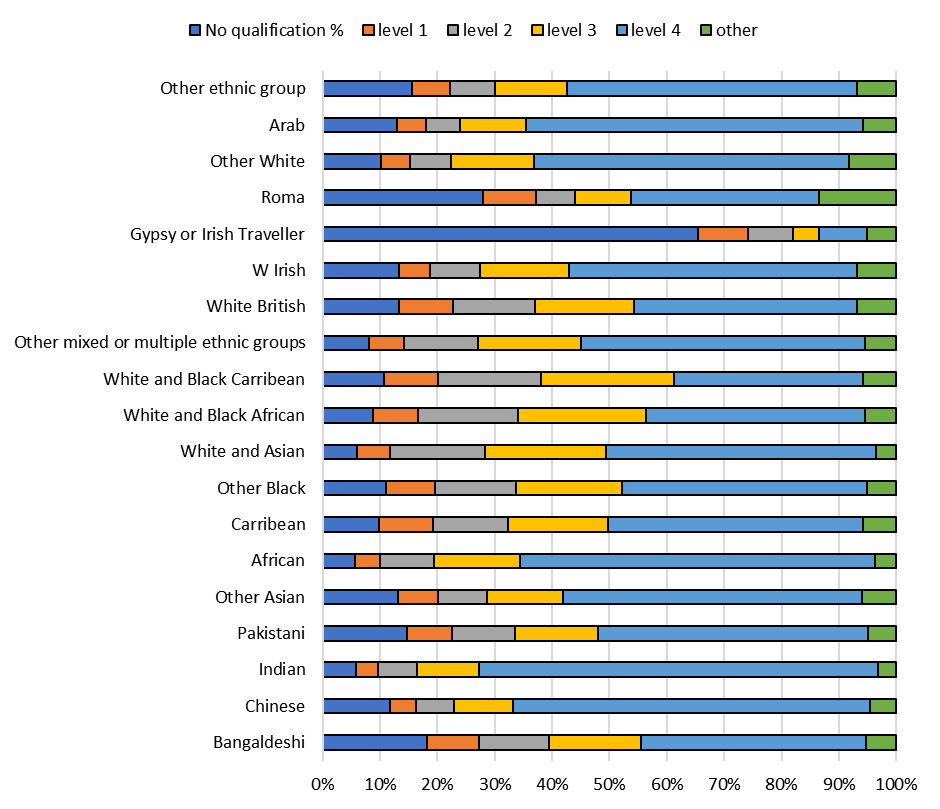
This graph shows that residents from Gypsy and Irish Traveller backgrounds are by far the most likely to not have any qualifications (65%), followed by Roma (28%), Bangladeshi (18%) and Other Ethnic Groups (16%). The most likely to have a level 4 (~degree level) or above qualification are Indian (70%), African (62%), Chinese (62%), Arab (59%) and other White (55%). As noted above, however, the outcomes for degree holders in terms of getting into managerial and professional roles is still much worse for some ethnically diverse groups which may indicate a lesser benefit from higher education among some groups.
Evidence in the Surrey Skills Strategy, which is being expecting publication in 2025, has shown that Surrey residents who lack skills are more likely to be economically inactive than the national average. This highlights the important relationship between skills and qualifications, and better work outcomes for our residents.
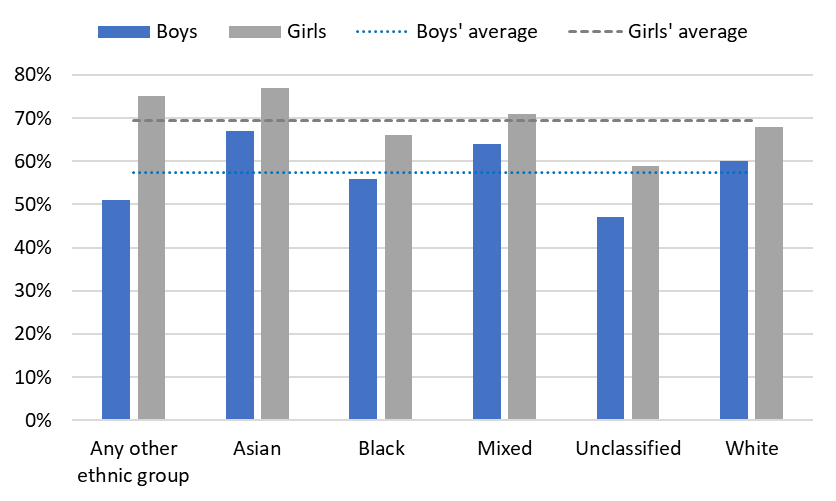
We know that nationally and locally girls and young women obtain higher results than boys and young men in most of the measures set by our education system. At Key Stage 2, 69% of girls in Surrey meet the expected standard in reading, writing and maths combined compared to 58% of boys.
These results are broken down by the high-level ethnicity categories of: Any other ethnic group, Asian, Black, Mixed, Unclassified, and White. There are significant variations between these groups, with Asian (72%), Mixed (67%) and White (64%) ethnic groups being more likely to meet expected standards, and people from ‘any other ethnic group’ (62%), Black (61%) and Unclassified (53%) backgrounds less likely to do so.
When looking at ethnicity and gender together, the differences are even more pronounced. Girls in all ethnic groups are more likely to achieve the expected standards, but the largest gender attainment gap is in the ‘any other ethnic group’ category. Girls in this group are more likely than the Surrey girls average to meet the expected standard while boys in this group are less likely than the Surrey boys average to meet the expected standard. Black pupils and those from unclassified ethnicities are less likely to meet the expected standard compared to the Surrey average in both genders:
Percentage of Surrey pupils achieving combined expected standard KS2 by ethnic group
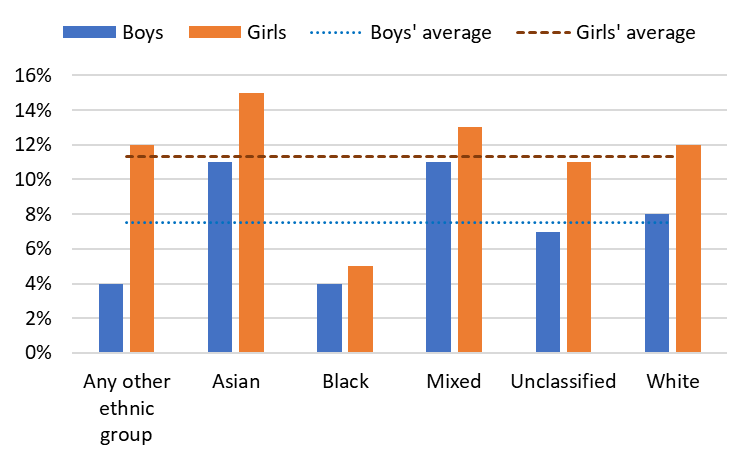
Looking at the number of children who meet the higher standard at KS2, a similar picture emerges (below). 11% of Surrey girls meet the higher standard for reading, writing and maths compared to 8% of boys. Again, girls are more likely to meet the higher standard than boys across all ethnicities, with the largest disparity in ‘any other ethnic group’. Significantly, both boys and girls from Black backgrounds are least likely to meet the higher standard.
It should be noted that this data is not disaggregated by socio-economic status and we know that nationally White, working-class boys do also experience inequality of outcome in schools. This cohort is likely to be masked here by the number of White boys from other socio-economic backgrounds.
Percentage of Surrey pupils achieving higher standard KS2 by ethnic group
The Government Inclusive Britain report in May 2024 included results of research into schools successfully reducing the ethnicity attainment gap which may be of interest for work in Surrey.
The gender disparity persists through to post-16 further education in Surrey. While both male and female students achieve slightly higher point scores at all level 3 qualifications than the South East average, this drops when looking at A level results, where males achieve a slightly lower average score compared to the South East average. When looking at who gets the top grades at A-levels, the difference is much greater. Young women in Surrey are significantly more likely (compared to the South East average) to get A* to A grades and even more likely to get AAB grades at A-level, while Surrey young men are less likely than the South East average to get these grades.
Surrey level 3 achievement compared to South East Average
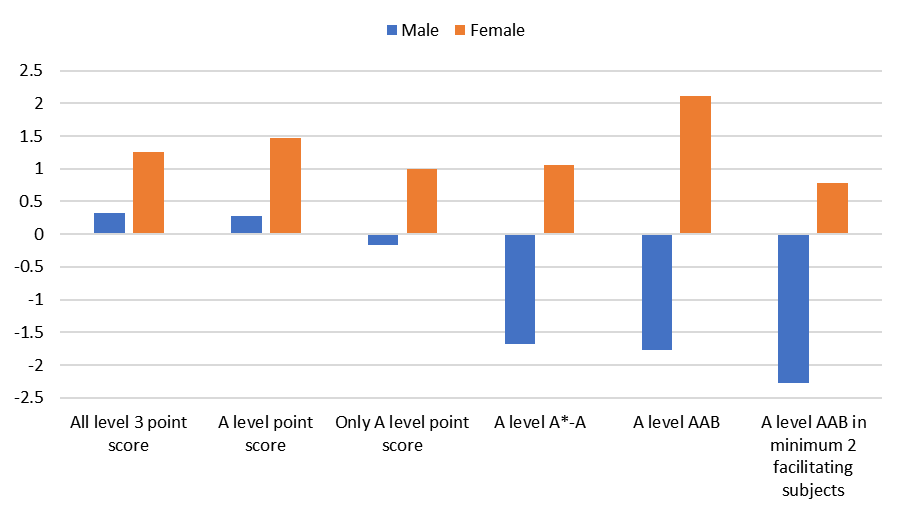
The above graph shows how male and female level 3 students in Surrey compare to the South East average. A result above zero is higher than the South East average, with anything below zero being below it.
As noted earlier in this evidence base, our younger populations are more diverse than our older populations and that people who migrate to Surrey have a generally younger age profile. While it is hard to quantify how many young people in our schools are from recently arrived and sanctuary-seeking population groups, we know that these young people face particular challenges in accessing education. The Race Equality and Minority Achievement (REMA) service in Surrey collects data on first languages spoken in our schools, which show that 146 languages were recorded in Surrey schools in 2024, and 15.5% of pupils were recorded as having English as an additional language, compared to 6.5% a decade ago. The top 5 first languages other than English are Polish, Urdu, Chinese, Portugues and Romanian. There have been increases in recent years in the number of young people speaking Ukrainian, Chinese languages, as well as Farsi, Dari and some African languages such as Yoruba.
Research from the Surrey Migration Strategy also highlighted issues facing sanctuary seeking populations around education. These included the way overseas qualifications are often not recognised in the UK, meaning highly qualified people are unable to access work they are trained to do, and the difficulty that recently arrived younger people have in finding suitable educational opportunities for their circumstances.
What does this mean for Surrey?
We can see from the data that the education system is producing better outcomes for some groups than others in Surrey, with some ethnic groups being disadvantaged and boys experiencing worse outcomes than girls across most measures.
There are some particularly notable differences, such as the gender attainment gap among ‘other’ ethnic groups that we should try to better understand and address. There is evidence from elsewhere in the country around ‘what works’ in closing ethnicity attainment gaps and this should be taken into consideration in schools in Surrey. We know from this that where young people feel their cultural diversity is celebrated in schools, they are better enabled to engage fully with education and reach their full potential. In our most recent schools survey (2022) only 74% of year 6 pupils said they felt that people with different backgrounds in their school were valued, meaning that over a quarter of young people felt that their school does not value people with different backgrounds. National research on the educational experiences of pupils from Gypsy, Roma and Traveller backgrounds has also shown the high levels of racism and discrimination young people from these backgrounds face in schools.
We need to be aware of the significant variations in levels of qualifications held by people from different ethnic backgrounds in Surrey. Improving people’s skills levels can be an important driver for improving other outcomes, including financial and mental wellbeing. However, we need to also recognise that standard educational ‘success’ routes may not work for all and look to provide opportunities that meet the needs and aspirations of all of our residents and that do not compound inequality by narrowing the routes available.
We also need to be aware of and provide support for the needs of young people who have English as an additional language, particularly those who are from sanctuary-seeking populations who may have experienced trauma and disruption to their education. We must ensure that both their needs and their strengths are properly assessed and addressed in the education system to enable them to thrive in Surrey.
Where can you find out more?
Information sources quoted in the text:
Report on tackling ethnic disparities in education (Gov.uk, 2024)
Study on schools aiming to reduce ethnicity achievement gaps (Gov.uk, 2023)
Report on health-related behaviour in schools (Surrey-i, 2022)
Report on the experiences of GRT communities in school (The Traveller Movement, 2020)
Signposting to further reading:
Briefing on inequalities for GRT communities in education (Friends, Families and Travellers, 2023)
Report on coercive exclusions of GRT children in schools (The Traveller Movement, 2024)