
Theme 3: Health and Wellbeing
Understanding Inequality in Surrey
Theme 3: Health and Wellbeing
Skip to:
Emotional and mental wellbeing
Health needs of vulnerable migrant communities
What does this mean for Surrey?
Physical wellbeing
The Joint Strategic Needs Assessment and the Surrey Health and Wellbeing Strategy give a rich and thoroughly evidenced picture of the health inequalities across Surrey. They provide in depth analysis of patterns of life expectancy and how long people can expect to live in good health across detailed geographies in Surrey. They also provide analysis of rates of disease prevalence and behaviours, such as smoking rates, that contribute to ill health. These sources clearly demonstrate how a huge range of external factors (the ‘wider determinants of health’) can impact people’s mental and physical wellbeing. The Health and Wellbeing Strategy also defines a series of priority populations, defined as those who experience the poorest health outcomes in our county:
- Carers and young carers
- Looked after children and adults with care experience
- Children with additional needs and disabilities
- Adults with learning disabilities and/or autism
- People with long term health conditions, disabilities or sensory impairments
- Older people 80+ and those in care homes
- Black and Minority Ethnic groups
- Gypsy Roma Traveller community
- Young people out of work
- People experiencing domestic abuse
- People with serious mental illness
- People with drug and alcohol problems
- People experiencing homelessness
Census 2021 provides data around people’s self-reported health which can be compared with other demographic data such as ethnicity and age to provide some insight into which of our communities are experiencing poorer health.
The 2021 Census asked people to rate their general level of health. 91% of people aged under 65 in Surrey rated their health as ‘good’ or ‘very good’, with a further 7% rating their health as ‘fair’. This means only 2% of the under 65 population rated their health as ‘bad’ or ‘very bad’.
Among our Gypsy and Irish Traveller populations, however, people rating their health as bad or very bad jumps to 9%, nearly 5 times the average. Only 78% of under 65s in this group rate their health as ‘good’ or ‘very good’, with 13% rating it as ‘fair’. Other groups with lower rates of ‘good/very good’ health in the under 65s include people from Bangladeshi (87%), Black Caribbean (89%) and Pakistani (90%) ethnic backgrounds.
Some ethnic groups have higher levels of self-reported good/very good health than the average, including people with mixed white and Asian heritage (95%), people from Indian, Black African and Other White backgrounds (94%).
As is to be expected, people’s health declines with age. When we look at the over 65s, 60% of the whole population of Surrey report good/very good health. Gypsy and Irish Traveller communities still have the lowest rates of self-reported good/very good health (34%), but we can also see that rates of self-reported good/very good health drop sharply in people from Bangladeshi backgrounds (38%).
Over 65s from Bangladeshi backgrounds have the highest reported levels of ‘bad/very bad’ health in Surrey too, at 30% or nearly 1 in every 3 people. In the wider population this is closer to 1 in 10 people (12%).
The Census also asks people if they have a long-term illness or condition that affects their ability to carry out day to day activities – the definition of a disability in the Equality Act 2010. Answers to this question also reveal significant variations across different ethnic communities in Surrey. A chapter on people with physical disabilities and sensory impairment is being developed as part of the JSNA which will provide more detail on this topic.
One in 10 under 65s in Surrey report that they are disabled (10%), but among Gypsy and Irish Traveller communities this is over 1 in 4 (26%). Other groups with slightly above average rates of disability include people from mixed white and Black Caribbean (14%), mixed white and Black African (12%), and mixed/multiple ethnic backgrounds (12%). Groups with lower-than-average rates of disability include Chinese (4%), Indian (5%), Other Asian (6%), Black African (6%) and Other White (6%).
Percentage of Surrey residents aged under 65s who are disabled
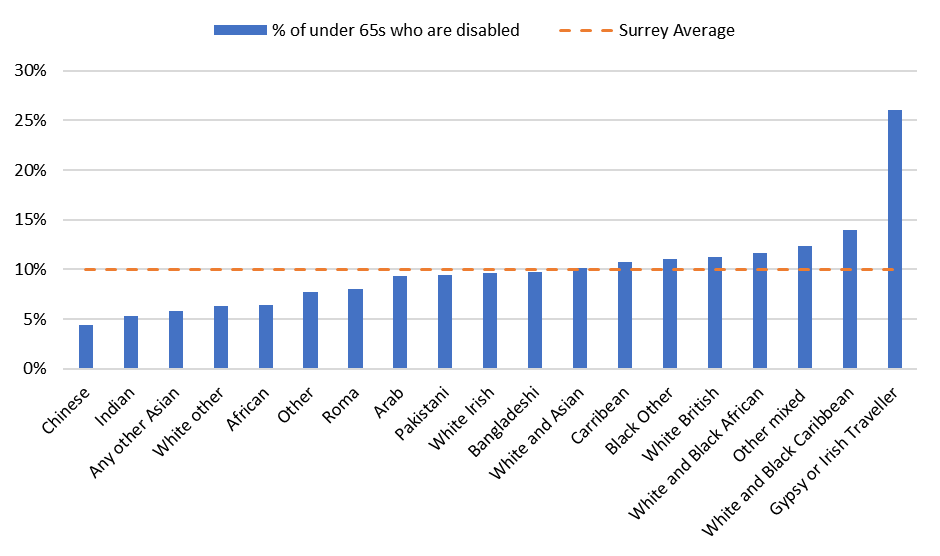
Among over 65s in Surrey, nearly 1 in 3 people (31%) reported being disabled. The highest rates of over 65s who are disabled is among people from Bangladeshi backgrounds, with 1 in every 2 people reporting a disability (50%). This is despite under 65s from Bangladeshi backgrounds in Surrey reporting average levels of disability (10%). Gypsy and Irish Traveller over-65s also have rates of disability much higher than the Surrey average, at nearly 1 in 2 (48%).
Percentage of over 65s who are disabled
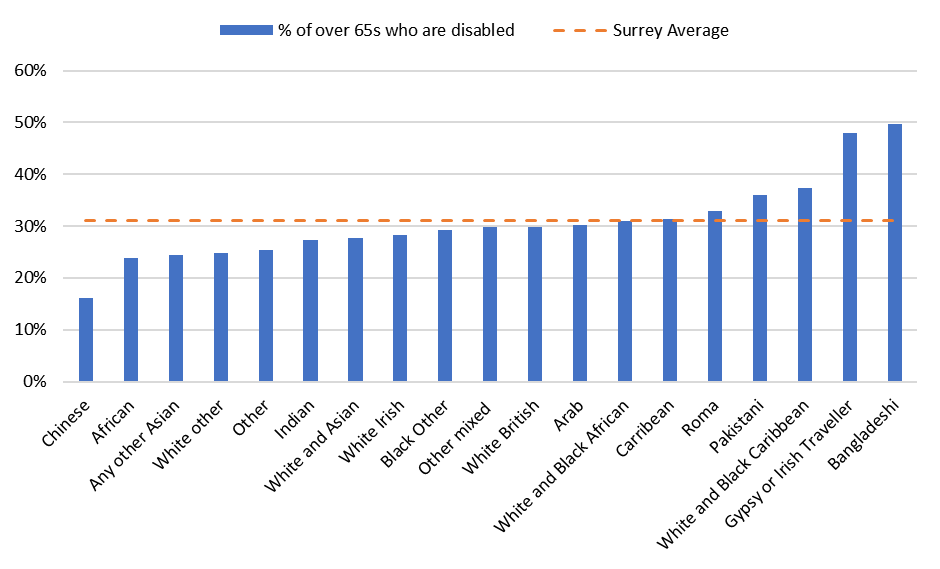
The ethnic group with lowest rates of disability among over 65s by some margin is Chinese (16%), followed by Black African (24%), Other Asian (24%), White Other (25%) and any other ethnic group (25%).
Another area where there is well documented health inequality by ethnicity is around maternal care and childbirth, with national reports into perinatal mortality showing stark inequalities. Black women are 4 times more likely to die during pregnancy than white women, and Asian or Asian British babies have a 73% increased risk of neonatal death compared to white babies. In Surrey, 1 in 6 babies are born to ethnically diverse mothers, and over a third of births are to parents born outside the UK. The Perinatal Equity Action Plan set out by Surrey Heartlands Health and Care Partnership shows that women from ethnic minority backgrounds in Surrey are more likely to have a baby before 27 weeks. Compared to white women in Surrey, Black women are almost twice as likely to have an induction, twice as likely to have an instrumental delivery and 2.7 times more likely to undergo an unplanned C-section.
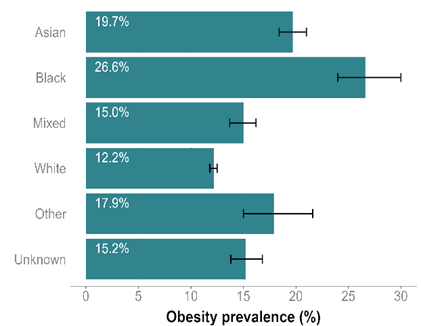
There is also evidence that obesity, a major driver of health problems, affects different ethnic groups at different rates. Children from Black ethnic backgrounds are the most likely to be classed as obese when leaving school in Year 6 (26.6%), followed by those from Asian (19.7%), Other (17.9%) and Mixed (15%) ethnic backgrounds. White children are the least likely, with 12.% of this group classed as obese.
Obesity prevalence by ethnic group in Surrey in year 6 based on National Child Measurement Programme 2017-2023:
Emotional and mental wellbeing
The Health and Wellbeing Strategy and JSNA also provide in depth analysis of emotional and mental wellbeing in the County, including an analysis of population groups who are more vulnerable to mental ill health. Some key findings from this assessment include:
- Prevalence of depression has risen noticeably in Surrey (in line with national trends) since 2014/15
- The rate of excess deaths for under 75s with serious mental illness (SMI) measures the extent to which adults with SMI die younger than adults without SMI, and in Surrey this is over 524% – higher than the England average of 386%
- In line with national trends, 75% of deaths by suicide in Surrey are male, with the mean age of death of 53
- Poor mental health is strongly correlated with higher rates of deprivation; nationally most therapists agree the cost of living is causing increases in poor mental health and research by the Centre for Mental Health shows that the poorest children are 4 times more likely to have a mental health difficulty by the age of 11 compared to the wealthiest children
- Rates of mental ill health among young people have increased significantly since covid-19, from 10% in 2017 to over 17% of young people having a probable mental disorder – 1 in 6 young people in Surrey
- Rates of probable mental disorder in children and young people are higher in White British and mixed or other ethnic groups
- More than 1 out of every 2 young people with additional needs and disabilities have a probable mental disorder compared 1 in 8 of those without additional needs or disabilities
- Teenage mothers have poorer mental health for up to 3 years after the birth of their child
- Seven in 10 autistic young people have a mental health condition
- Rates of social, emotional and mental health needs in schools are significantly worse than pre-pandemic and higher than both regional and national figures.
- In 2020-21, 2.6% of Primary School age pupils in Surrey had social, emotional and mental health needs. This is significantly worse compared to previous trends and is worse than both Regional (2.5%) and England (2.4%) rates. Among Secondary School age pupils in Surrey, 3% have social, emotional and mental health needs, which also is worse than previous rates and above regional (2.8%) and England averages (2.9%).
- In 2020-21, the emotional wellbeing of 38.1% of looked after children in Surrey was a cause for concern (39% Regionally, 36.8% in England), which is of no significant change from previous years
- National research into babies born during the pandemic showed that nearly two-thirds of parents had significant concerns about their mental health
- People who identify as LGBTQ+ have higher rates of common mental health problems – including depression and anxiety and lower wellbeing – than heterosexual people; and the gap is greater for adults over 55 and those under 35
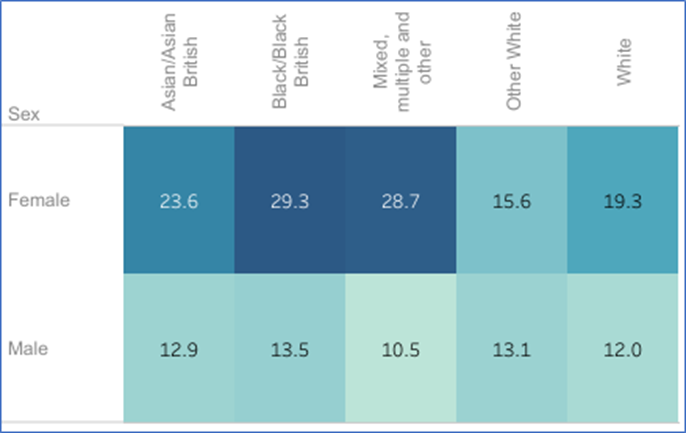
Rates of common mental disorders among residents in Surrey by ethnic group:
Data from our Adults, Wellbeing and Health Partnerships service shows that people from Black and minority ethnic backgrounds are twice as likely to be detained under the Mental Health act as people from White backgrounds.
Health needs of vulnerable migrant communities
A recent report from the Director of Public Health highlights the particular health needs of vulnerable migrants – those who arrive in the UK as asylum seekers or refugees, unaccompanied children, people who have been trafficked, undocumented migrants and low paid migrant workers. The report highlights how backlogs in the asylum system have created a challenging environment for supporting sanctuary-seeking people, as well as the disparity in access to support that different groups face depending on the route through which they came to the UK. Issues faced include difficulties created by people being moved around the system, leading to barriers to accessing services and lack of continuity of care. Vulnerable migrants are also at increased risk of poor mental health due to their experiences prior to, during or after their migration to the UK. Asylum housing is often unsuitable with people subject to multiple moves at short notice. People who have experienced exploitation and trafficking may be additionally prevented from accessing care and support needed through fear or coercion.
Caring responsibilities
Surrey has an ageing population, and more people are living for longer with ill-health. We know we have significant proportions of our population (90,000 people) who are providing unpaid care for a friend or family member. Across all age ranges, women provide more unpaid care than men, with 54,000 women reporting to be carers in the 2021 Census compared to 36,000 men. One in 11 women are carers, compared to 1 in 17 men. The gender care gap is lowest in under 16s and over 65s, meaning that women of working age undertake largest proportion of unpaid care in Surrey.
People providing unpaid care in Surrey: hours of care provided per week by age and sex
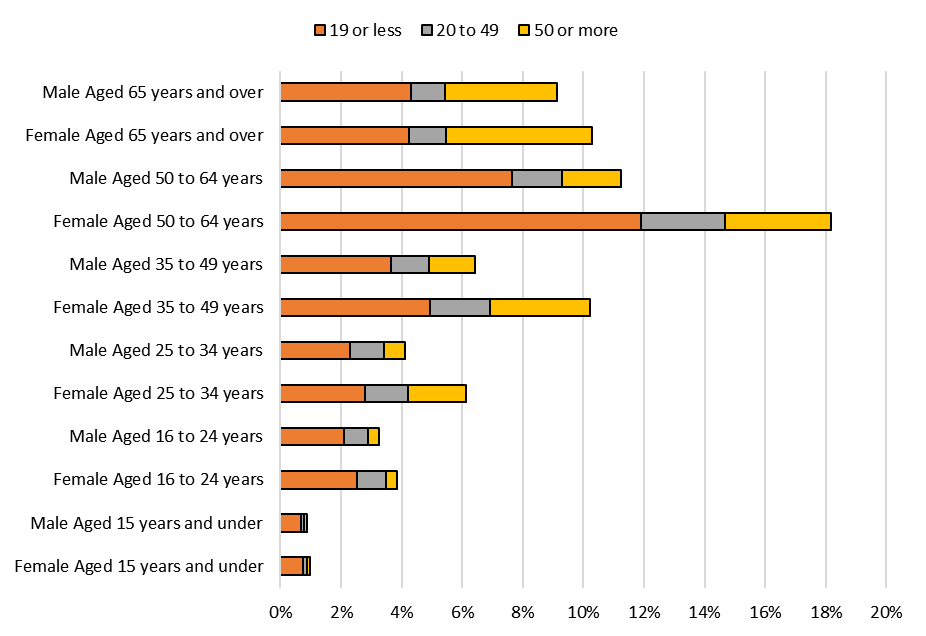
By age group, the highest proportion of carers is among 50- to 64-year-olds. In this age group nearly 1 in 5 women provide unpaid care, compared to 1 in 9 men. The over 65s are the most likely of all age groups to provide more than 50 hours of care per week, including 5,000 women and nearly 4,000 men over the age of 65.
Self-reported levels of providing unpaid care are lower in some ethnic groups than the average, and the figure for White British carers is above average. There is research to show, however, that some communities, for example people from South Asian backgrounds, are less likely to recognise and report caring duties, as it is seen as a normal part of family life. Surrey County Council’s Adult Social Care service has reviewed who is presenting to the Council for their care needs to be assessed by different ethnic groups. The data shows that some ethnic groups access assessments for care at lower rates than others. Adults from Asian backgrounds make up 8% of the Surrey population but only account for 4% of Adult Social Care assessments. People from Muslim and Sikh backgrounds are more likely than average to be found eligible for care when they are assessed, and to have fewer contacts with social care before being found eligible, which may indicate they are not accessing an assessment as early as some other groups.
Research has been carried out by SCC to better understand the barriers that Black, Biracial and Asian residents face in accessing adult social care services. This research highlights issues such as difficulty in navigating services, often due to language barriers, lack of awareness or the lack of culturally sensitive and appropriate care available. It also raises issues of historical mistrust of Council services which impacts on the confidence of some community members to access adult social care.
While young carers make up a small proportion of the overall carer population in Surrey, we know that being a young carer can have significant impact on a young person’s life. In the most recent Schools Survey (2022) in Surrey, 8% of primary school and 5% of secondary school pupils reported that they are young carers. However, only a quarter of primary school pupils who are young carers said that their school knows that they are. Again, we know from local and national engagement on this issue, that families from ethnically diverse backgrounds are more likely to have mistrust in statutory institutions such as councils. This makes it less likely that families from these backgrounds report caring needs and young carers from these groups are underreported and less likely to be accessing support.
What does this mean for Surrey?
There is a complex relationship between people’s physical and mental wellbeing, financial deprivation and other factors including ethnicity, age, sex and disability. Understanding the many various ways these factors intersect with each other is well beyond the scope of this report but recognising the ways in which people with different protected characteristics often experience worse outcomes in health and wellbeing terms is important. While socio economic factors are among the strongest predictors of outcomes for people’s health, there appear to be structural inequalities experienced some groups that cannot simply be explained by this. When we provide services to meet the needs of our most vulnerable communities, we need to be aware of the full range of factors that might have an implication for outcomes the experience.
A recent report on Structural Racism, Ethnicity and Health Inequalities in London in 2024 concluded that racism is widespread and persistent, and has a detrimental effect on individuals and wider society. Its effects are compounded by socio-economic deprivation but also by other dimensions of exclusion such as disability, sex and age. Research from 2022 carried out by the Surrey Minority Ethnic Forum highlighted issues that people from ethnic minority communities face when accessing health and care services in the county. These included issues such as lack of trust in services, difficulty in navigating complex systems, language barriers, and fear of judgement or stigma. There are also issues with cultural appropriateness of services, which may cause people to feel excluded or to self-exclude from something that does not feel inclusive of them.
Issues facing sanctuary-seeking populations are even starker, with many of this group also experiencing additional physical and mental health needs due to the circumstances they are fleeing from and the ways they have arrived in the UK.
As we come to terms as a country with an ever-aging population with increasing care needs, we need to recognise how this impacts on different groups in different ways. We need to recognise who is providing unpaid care, and what the impacts of this are on other areas of life such as employment, finances and mental wellbeing. We also need to be better at recognising who is and isn’t accessing health and care services and what the reasons for this may be.
Where can you find out more?
Information sources quoted in the text:
Surrey Health and Wellbeing Strategy webpage
Reports into Perinatal Mortality (MBRACE-UK, 2022)
Perinatal Equity Action Plan, 2022-2027 (Surrey Heartlands)
JSNA chapter on Emotional and Mental Wellbeing in Surrey Adults (Surrey-i, 2023)
Link to Public Health data collection tool (Department for Health and Social Care)
Study on the mental health of UK 11 year-olds (Centre for Mental Health, 2015)
Report on the health needs of vulnerable migrants (Surrey County Council, 2024)
Schools Health and Wellbeing Survey (Surrey-i, 2022)
Signposting to further reading:
JSNA Children and Young People’s Emotional Wellbeing and Mental Health Strategy 2022-2027 (Surrey-i)
JSNA chapter on Children and Young People with Additional Needs and Disabilities (Surrey-i, 2023)
JSNA chapter on the Rapid Needs Assessment for Migrant Health (Surrey-i, 2023)
News piece on the Frimley Perinatal Equity Strategy (Frimley Health and Care, 2022)
Research project on ethnicity-based health inequalities (Unity Insights, 2024)
Health related behaviour questionnaire results (Surrey-i)
Explanation of data on disability from the 2021 Census (Surrey-i, 2021)
Our Voice Matters survey results on Young Carers (Surrey County Council, 2022)
JSNA chapter on Multiple Disadvantage Core Risk Factors (Surrey-i)
Article on the Hearing Loop Campaign (Surrey Coalition of Disabled People and Sight for Surrey)