
Armed Forces Community
Armed Forces Community
Publication Date
This chapter was published in December 2024.
Contents
- Foreword
- Executive Summary
- Introduction
- Overview of the Armed Forces community in Surrey
- Healthcare
- Housing
- Education
- Employment
- Other services for the Armed Forces community
- Links to other JSNA Chapters
- Glossary of terminology and acronyms
- Stakeholders
- References
Foreword
It is a statutory duty for the Surrey Health and Wellbeing board to publish and keep up to date a Joint Strategic Needs Assessment (JSNA) as a way of understanding what our Surrey population looks like, how many people live where, what the health conditions are, what services they use, and where they are.
For the first time, we have published a chapter on the Armed Forces community based and living in Surrey and their specific needs, covering: education; employment; healthcare and housing provision. This community includes serving members, reservists, ex-service and veterans and their families
Surrey is very much a military county with 3,920 Regular members of the Armed Forces (includes 500 from the Rangers Regiment), 290 Royal Navy and 190 RAF. There are also 625 known service families with 1,224 service children in 208 different Surrey schools. There are just under 3,500 Cadets with 750 Cadet Force Adult Volunteers and 32,500 ex-service and veterans.
In addition, public services recognise the benefits of employing ex-service personnel. For example, Surrey County Council is seen as a ‘military friendly employer of choice’ employing over 750 people who are ex-Service, Reservists or Cadet Adult Volunteers. There are 720 Reservists in the County including 28 working for Surrey County Council and Surrey Fire & Rescue Service.
In the following sections, you will see that the JSNA is a way of understanding what our Armed Forces community looks like, how many people live here, what the health conditions are, what services they use, and where they are located.
In short, this JSNA is about “understanding need”.
This JSNA nicely follows the passing into law of the Armed Forces Act 2021 followed by the implementation of the Statutory Guidelines which imposed on all councils and other public bodies, including the NHS, a new duty of ‘due regard’ in exercising specific public functions. These include the areas of education, healthcare and housing provision, thereby ensuring that no one is disadvantaged because of their service to the Nation. We added employment to our remit as we know of a number of cases where Military spouses are specifically disadvantaged because of their spouses’ / partners’ service.
Surrey County Council has been working closely with all our partners through our Surrey Civilian-Military Partnership Board to help ensure that under the new Duty they will all consciously consider the Armed Forces community when developing policy and making decisions.
The JSNA is key in knowing where alignment or variation lies, which enables the system to better understand what the Armed Forces community needs are, driving their health economies and where there is opportunity for further support.
This JSNA is a continuous process to assess the current and future health, care and wellbeing needs of the Armed Forces community to inform local decision making, using a variety of data sources, and highlights our key findings and recommendations.
We do therefore thank all those contributors who have worked together in partnership over the months to ensure that all four key sectors of greatest concern to the Armed Forces community have been properly researched and reviewed to ensure that the community starts well, lives well and ages well in Surrey.
Saj Hussain, Chair of Surrey CC
Andrea Newman, Strategic Director Communications and Engagement
Executive Summary
This Joint Strategic Needs Assessment (JSNA) chapter has been an important piece of work to understand the challenges faced by the Armed Forces community and further work that the system can do to support these challenges. It has also, however, provided the opportunity to focus on the positive impact that life in the Armed Forces can bring and highlights the range of specific services available to the community to support them, both during their time in Service as well as after.
The Surrey Health & Wellbeing Strategy makes a commitment to ensure that everybody is able to achieve their full potential and contribute to their community, and no one is left behind. This chapter sets the foundation with a particular focus on the areas of healthcare, housing, education and employment and considers the needs of the whole Armed Forces community, including serving Regulars and Reservists and their families, as well as veteran/ex-service personnel and their families. We have also included the MOD sponsored cadets in this paper, because even though they are youth organisations and not part of the Armed Forces, they are sponsored by the Armed Forces. The chapter draws on a wide range of data available, as well as experience from agencies and charities across the system.
Support for our Armed Forces community is evident across every part of our partnership, which is shown through a great foundation of work ranging from armed forces awareness training, established services, dedication of Armed Forces Champions and excellent take-up of relevant accreditation schemes. All stakeholders are extremely enthusiastic about contributing to this work and committed to making Surrey a great place to be as a member of the Armed Forces community.
However, there is still more that can be done to support our Armed Forces community. Issues can arise for serving families as a result of being moved around regularly and the resultant impact on employment opportunities for spouses, schooling, medical waiting lists and continuity of treatment. There are also potential physical and mental injuries that can arise due to service – the principal causes of medical discharge from the Services are musculoskeletal disorders and injuries, mental and behavioural disorders and hearing deficits. Although the majority of serving personnel transition out of the Armed Forces successfully, there are some who require additional support in some areas including accessing employment, public services, housing and appropriate medical care.
A recurring theme throughout the report is the need for better data around our Armed Forces community. This is important as there are many specialist services for the Armed Forces community, however, referral rates to these dedicated services in Surrey are low compared to our regional peers, even allowing for a relatively smaller veteran population within the county. Identification of the Armed Forces community and awareness of services available will undoubtedly lead to an increase in referrals, thereby helping to ensure the Armed Forces get the support they require in a timely manner.
With a large serving Regular presence in the west of the county, we must make sure that local services which support the population around The Soldier Academy (South) in Pirbright, Keogh Barracks in Mytchett and Royal Military Academy (RMAS) Sandhurst, are fully integrated into our local partnerships, whilst not forgetting those families which are based in MOD accommodation or private accommodation across the county. Families of both Regular and Reserve personnel need to be an area of particular focus, as they may fall between services for serving personnel and those which focus on veterans. Capturing Reserve personnel is invariable more difficult due to the nature of Reserve service but where particular support maybe required is on mobilisation and the period after it as the Reservist reintegrates into civilian life.
With these points in mind, we are striving to:
- Develop an understanding of the unique life in the armed forces and the potential issues that this community can face when they need to access services both during their time in service and after
- Raise awareness of the support and services available to the Armed Forces community (including access to civilian support services as well as those specific to the Armed Forces)
- Increase identification of members of the Armed Forces community and referrals into services to support them
- Highlight and manage expectations of the Armed Forces community in relation to the Armed Forces Covenant
Introduction
1.1 Aims and objectives
The Joint Strategic Needs Assessment (JSNA) is an assessment of the current and future health and social care needs of the local community. It supports local leaders and commissioners to make informed decisions and to shape services in a way that best serves their communities. This chapter aims to describe the situation in Surrey for members of the Armed Forces community (which comprises: ex-service and veterans; regulars; reservists; cadet force adult volunteers; service leavers; individuals who are wounded, injured, or sick (WIS) and the partners or children of serving personnel (Regular and Reserve)) and how it affects their health to inform commissioners and stakeholders. We aim to lay out the current provision of services and highlight gaps to identify the needs of all those living in Surrey. This Needs Assessment makes recommendations highlighting the issues people can face as a result of Service life, and illustrates good practice in the areas of healthcare, education, housing and employment to help those responsible for planning and delivering services meet their legal responsibilities. The recommendations will be used to form an action plan which will be overseen by the Surrey Civilian-Military Partnership Board.
1.2 Scope
This chapter covers all members of the Armed Forces community in Surrey. This applies particularly to serving military personnel (Regular and Reserve), veterans/ex-service and relevant family members as defined in the Armed Forces Covenant Duty Statutory Guidance. Where relevant, it will also consider the needs of the wider Armed Forces community, which includes the Cadet Forces and Cadet Force Adult Volunteers.
1.3 Recommendations
The following priorities have been identified:
| Recommendation | Overarching Recommendations |
| 1 | Recognise the Armed Forces community as a priority population within the Surrey Health and Wellbeing Strategy due to the unique life they lead and specific issues they can face. |
| 2 | Ensure services are aware of the unique obligations of Service life within the Armed Forces and the issues they may face. |
| 3 | Ensure that members of the Armed Forces community are identified at first point of contact with service providers to enable them to be referred to most appropriate services. |
| 4 | Improved data collection to provide a clearer picture of the Armed Forces community within Surrey to help ensure they are not being disadvantaged as a result of their service. |
| 5 | Ensure the Armed Forces Duty of ‘due regard’ is reflected within all appropriate system partners’ policies, plans and strategies. This duty will ensure that the Armed Forces Covenant is consciously considered when relevant functions are carried out in the areas of education, healthcare and housing to help ensure the Armed Forces Community are treated fairly and not disadvantaged as a result of their service. |
| 6 | Increased awareness amongst the Armed Forces community around the services available to them and the role of the Armed Forces Covenant to ensure expectations are managed. |
| Recommendation | Healthcare Recommendations |
| 7 | Ensure all parts of the healthcare system consciously consider the unique responsibilities and sacrifices made by members of the Armed Forces, in line with the statutory requirement to pay ‘due regard’ to the Armed Forces Covenant Duty; negating the potential disadvantages faced by the Armed Forces community when looking to access local services. This includes, but is not limited to, the commissioning and provision of services, including: continuity and equity of care; access to screening programmes and health promotion services; as well as retention of places on waiting lists as a result of service moves. |
| 8 | Encourage all system partners to develop awareness of the Armed Forces Covenant Duty and become signatories of the Armed Forces Covenant and related accreditation schemes such as the: Employer Recognition Scheme Award; Royal College of General Practitioners (RCGPs) Veteran Friendly Practice Accreditation Programme; Veteran Aware Hospitals and Veteran Friendly Framework. |
| Recommendation | Housing Recommendations |
| 9 | Welfare Benefits – When assessing income for means-tested benefits, local authorities should consider excluding Armed-Forces related income in special recognition of their service. Where possible, this approach should be consistent across the County. |
| 10 | Housing Register Allocations – When assessing an application for social housing, discretion should be considered for Armed Forces applicants where their service commitment means that they cannot meet local eligibility criteria. |
| 11 | Homelessness and Rough Sleeping – It is vital for advice on housing to be provided at the earliest opportunity to Armed Forces Personnel to ensure that they are aware of their housing options before leaving service. It is paramount for local authorities to identify any additional needs that a client may have during the early assessment stages of a homeless application; this includes asking the applicant if they have a current or previous connection to the Armed Forces. |
| Recommendation | Education Recommendations |
| 12 | Ensure education providers (from early years through school, further education and higher education) are aware of the Armed Forces Covenant, the importance of identifying service children, understanding particular issues they may face and services available to support them. |
| 13 | Encourage education bodies in scope of the Armed Forces Act to meet their duty of ‘due regard’ to ensure Service children and young people in Surrey are not disadvantaged by their parents’ service in the areas of admissions; attainment; attendance; wellbeing; safeguarding; transport; additional needs and attendance. |
| Recommendation | Employment Recommendations |
| 14 | Encourage Surrey organisations and businesses to sign up to, and progress through, the Defence Employer Recognition Scheme Award. |
1.4 National Policy
The Armed Forces Covenant
The Armed Forces Covenant is a promise by the nation that those who serve, or who have served in the Armed Forces, and their families, should be treated fairly and should suffer no disadvantage as a result of that service.
The three principles of the Armed Forces Covenant are:
- Acknowledging the unique obligations of, and sacrifices made by, the UK Armed Forces
- Working together to mitigate disadvantage compared to other citizens in the provision of public and commercial services
- Understanding that special consideration is appropriate in some cases, especially for those who have given most, such as the injured and the bereaved
The Armed Forces Act 2021 and Covenant Duty
From its inception in 2011, the Covenant was a voluntary pledge that a range of public and private sector organisations could make to demonstrate their commitment to supporting the Armed Forces community.
More recently, the Armed Forces Act 2021 places a legal duty on specified public bodies to have ‘due regard’ to the principles of the Armed Forces Covenant when exercising certain statutory functions in the fields of: healthcare, education, and housing provision. To support specified bodies, the MOD has issued statutory guidance to assist them in complying with their legal obligations.
Table 1: Settings and functions covered by the Covenant Duty: (Statutory Guidance page 9)
| Setting | Functions |
| NHS Primary Care, NHS Secondary Care, and local authority delivered healthcare services | The provision of services, planning & funding, and co-operation between bodies and professionals |
| Housing | Allocations policy for social housing; tenancy strategies (England only); homelessness; and disabled facilities grants |
| Compulsory education settings | Admissions; educational attainment and curriculum; child wellbeing; transport; attendance; additional needs support; and use of Service Pupil Premium funding |
The Covenant Duty applies to: local authorities; governing bodies of maintained schools and further education institutions; proprietors of academies; non-maintained special schools and special post-16 institutions; NHS England; NHS Integrated Care Boards; NHS Trusts; and NHS Foundation Trusts. When relevant functions have been contracted out to private companies or third sector organisations, the specified public body responsible for that function needs to ensure that any third parties also comply with the Covenant Duty (Statutory Guidance page 13).
A toolkit is available to support organisations when establishing whether the Covenant Duty applies to a specific set of circumstances. Organisations should consider the following:
- Is the organisation providing the service in scope of the Duty?
- Is the service that is being provided in scope of the Duty?
- Is the person a member of the Armed Forces Community within scope of the Duty?
- Have they experienced a disadvantage compared to someone in a similar position who is not a member of the Armed Forces Community, that has arisen from Service life, or could special provision be justified in this case?
Surrey County Council provide Armed Forces Awareness training for staff who want to improve their understanding of the Armed Forces community, their needs and how to address them. This training is available to staff employed by local authorities, health, emergency services, and the voluntary sector. For more information teams can email [email protected].
The Veterans’ Strategy
The UK Government has written a Strategy for our veterans that lays out the following vision:
“Those who have served in the UK Armed Forces, and their families, transition smoothly back into civilian life and contribute fully to a society that understands and values what they have done and what they have to offer.”
The Strategy sets out key themes and cross-cutting factors which include: collaboration; coordination of services; data; public perceptions; and recognition – so that Veterans feel that their service and experience is recognised and valued by society. It encourages the enhanced collection, use and analysis of data across the public, private and charitable sectors to build an evidence base to effectively identify and address the needs of the Armed Forces community. It notes that while some reliable data already exists across government, it can be fragmented, making analysis and prediction of needs difficult.
Women Veterans Strategy
In 2023 the Office of Veterans’ Affairs (OVA) announced that it was going to develop a Women Veterans’ Strategy to look at the specific needs and challenges faced by female veterans and celebrate their successes. The strategy will tackle areas where female veterans might be missing out on support, as well as any accessibility issues within the wide variety of services already being delivered by the veteran community. There are more than 235,000 women in England and Wales who have proudly served in our Armed Forces. However, female veterans have been reported to face issues accessing support services, particularly where those services are inadvertently orientated towards men.
Looking at the particular needs and challenges faced by female veterans compared to their male counterparts, the OVA will identify what further support may be given to female veterans to meet their specific needs. Working with experts in academia, charities and other government departments, this will cover areas such as mental health, physical welfare and employment.
1.5 The Surrey Health & Wellbeing Strategy
The Community Vision for Surrey 2030 states that:
“By 2030, Surrey will be a uniquely special place where everyone has a great start to life, people live healthy and fulfilling lives, are enabled to achieve their full potential and contribute to their community, and no one is left behind.”
The 2022 refresh of the Health & Wellbeing Strategy identifies priority populations which are often overlooked and currently most at risk of experiencing poor health outcomes. This does not currently include members of the Armed Forces community, which means this group may be overlooked when teams are conducting impact assessments or implementing related frameworks like NHS England’s Core20Plus5 framework for reducing healthcare inequalities.
1.6 The Surrey Civilian-Military Partnership Board
The Surrey Civilian-Military Partnership Board (SCMPB) fosters close working relationships with the Armed Forces and is made up of lead agencies and military partners, meeting twice a year, as well as holding an annual conference. Led by the Chairman of Surrey County Council, the board considers key issues affecting the Armed Forces community across the county and aims to ensure that the armed forces community and their families are not disadvantaged as a result of their service. The SCMPB is ideally placed to oversee the implementation of the recommendations arising from this JSNA.
1.7 Armed Forces Champions and Covenant Lead Officers
The implementation of the Armed Forces Covenant in Surrey is supported by a network of Elected Councillor Armed Forces Champions and Covenant Lead Officers. The County Council and all district and borough councils in Surrey have a nominated lead at both officer and councillor level to champion the Armed Forces and act as a point of contact. In addition, many other key agencies across the county also nominate a lead Armed Forces contact including Surrey Heartlands, acute trusts, Police and DWP.
1.8 Veteran Hubs
Surrey is lucky to have a network of veteran hubs across the county which provide a relaxed place for veterans to drop in and share a cup of tea in the company of others who have served. They also provide a way to gain advice, support and services under one roof. Detail of the times and locations of the Surrey hubs can be found on the Surrey County Council website here.
Overview of the Armed Forces community in Surrey
2.1 Serving personnel
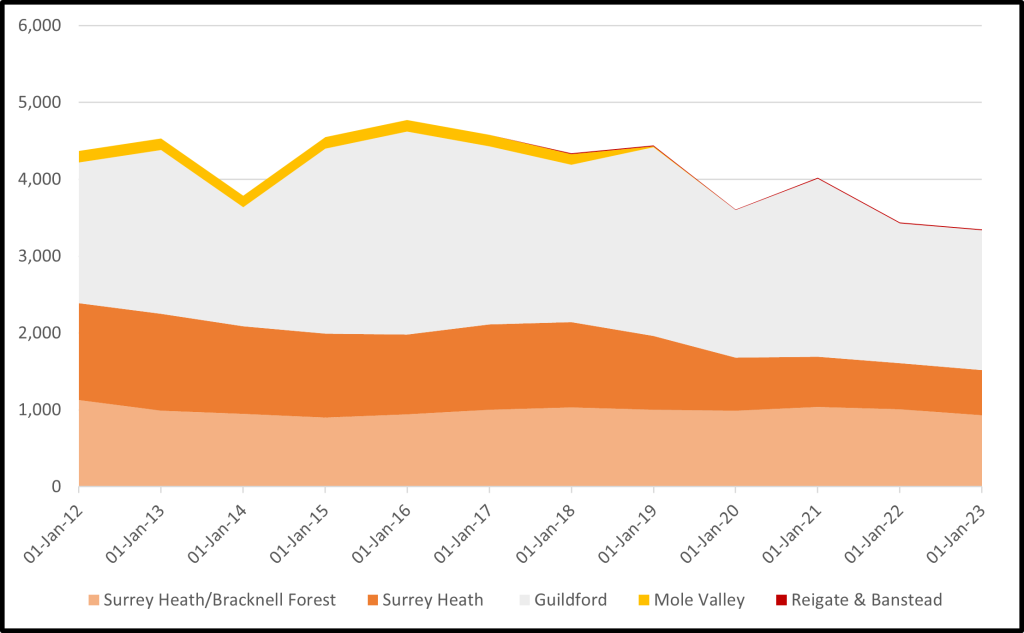
Surrey is home to a relatively large serving population, mostly from the Army, and includes two nationally important sites in the UK for training officers (at the Royal Military Academy Sandhurst – RMAS) and soldiers (at the Soldier Academy South at Pirbright), as well as hosting a number of operational Regular and Reserve units. Surrey also has a key relationship with Army Headquarters South East based in Aldershot. Its proximity to London and Hampshire also means that a large number of personnel, including many from the Royal Navy and Royal Air Force, based outside of the county will live in Surrey with their families, whether that is in Service Families Accommodation or their own homes. Due to that proximity, Surrey also boasts a sizable veteran community – a point expanded on in section 2.2. Figure 1 below shows the number of Regular military personnel based in Surrey between 2012 and 2023. Bracknell Forest is also shown due to the Royal Military Academy Sandhurst being based across border in Surrey Heath and Bracknell Forest. Figure 2 shows the locations on Army bases in Surrey.
Figure 1: the number of Regular military personnel based in Surrey
Source: Location of all UK Regular service and civilian personnel annual statistics: index – GOV.UK (www.gov.uk), accessed 3 May 2024.
Figure 2: the location of Regular and Reserve units in Surrey
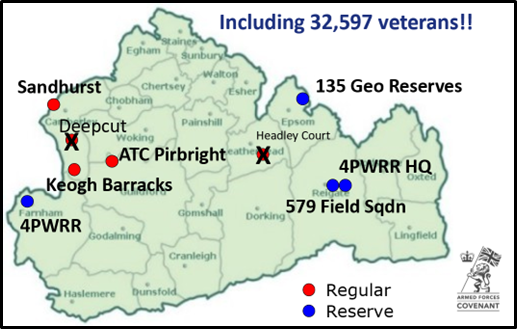
Under the Army’s Future Soldier Programme, the Army Training Regiment at Winchester will close in 2026, and Army Phase 1 Training in the south of England will be consolidated at The Soldier Academy (South) in Pirbright. This is expected to increase the military establishment at Pirbright by approximately 200 personnel, around half of whom may be accompanied by their families, potentially increasing pressure on military Service Families Accommodation and local services. The move of personnel is expected to be completed by March 2026.
Service Life for Regular Service Personnel
Service personnel and their families lead very different lives to the civilian population and this way of life can continue to have an impact on them once they leave the Armed Forces. The key difference is that they knowingly putting their lives at risk and are prepared to make the ultimate sacrifice for our Nation – this of course will also have a huge impact on the wider family network. They will periodically be required to deploy on operations, sometimes at very short notice, at times for protracted periods. There is often little or no choice for the Service person or their family in this separation. If the worst happens when deployed the consequences can be catastrophic on the family and children who may have lost a spouse or parent. The serving person may have witnessed loss of friends and comrades or receive life changing injuries which result in the permanent loss of their role in the Armed Forces. This is why the Armed Forces Covenant is so important because in these circumstances, special provision for those who have given the most may be necessary.
During their service, the Service person may be moved around the country and abroad regularly, sometimes with little notice and usually no say in where they are going. Their family usually goes with them, which can impact on many aspects of life including employment opportunities for spouses and schooling for children. If they leave friends and family behind this can also have an impact. Some families choose to enrol children in boarding school to provide continuity of education. If spouses/partners or children are on waiting lists or receiving medical or dental care, this can be interrupted if moving out of county or health borders. This could result in assessments needing to be repeated or the need to rejoin waiting lists, resulting in further delays for treatment and support. There are also the daily realities of Service life, such as working long or unsociable hours with the associated impact this can have on the family, for example, additional pressure on childcare responsibilities.
The majority of service personnel and their families live in Service accommodation on bases – these are usually isolated from the wider community behind the ‘wire’ and heavily guarded gates. This, along with the regular moves can lead to feelings of isolation, particularly for the family members.
Along with housing, service personnel and their families are provided with access to leisure and sports facilities as well as medical facilities (some Defence Medical Services are provided to families – if this is not available then family members need to register with a civilian GP). The serving person also has access to a defence dentist. As a result of this lifestyle and the services provided on base, the Armed Forces community are generally not used to accessing public services or wider services in the community because they have never had to.
One of the key strengths of service personnel is their strong sense of pride. This is generally carried with them throughout their life, and as a result they don’t like to ask for help after service and often don’t usually talk about their time in the Armed Forces. As such, this part of their lives can be hidden from their family, friends and practitioners, particularly if those they are talking to have not served.
Service Life for Reservists
Reservists are men and women of many ages who volunteer to undertake Reserve Force training with the Royal Naval Reserve; Royal Marines Reserves; Army Reserve or Royal Air Force Reserve outside of their civilian career. The civilian career of a Reservist generally does not dictate the role they undertake within the Reserve Forces, apart from those involved in certain specialisations, such as the medical profession. Members of the Reserve Forces enhance the Regular forces as operational demand requires it. Reservists can specialise in specific areas and the training they receive can complement their civilian career and personal development.
Reservists make the same commitment to the nation and face the same risks if they are mobilised. The wrap around support for the Reservist is inevitably thinner than their Regular counterpart and anecdotally where Reservists are mobilised, the period when they return from mobilisation can put strain on the individual and their family. Mobilisation is a facet of service life which other members of our community do not experience and is unique to the Reserve Forces.
2.2 Veterans
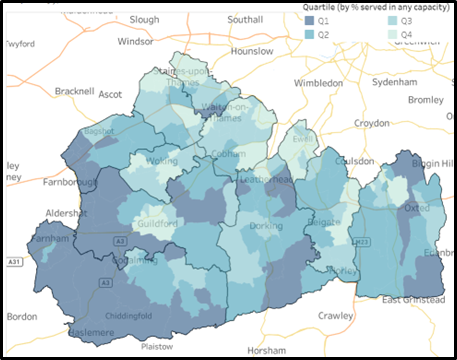
Veterans are individuals who have served for at least one day’s paid service in the Armed Forces, whether as a Regular or as a Reservist. This includes those who undertook National Service (which finished in 1960 and therefore at the time of writing means that most men over 82 have served) who often do not consider that they have served. The term veteran is used throughout this report, however, some veterans preferred to be described as ex-service. Therefore, where the term is used in this report it includes those who consider themselves as veterans as well as those who consider themselves ex-service. In the 2021 Census, Surrey had a total of 32,596 veterans, comprising 3.4% of the total eligible population; just lower than the England position of 3.8%. The overwhelming majority of these veterans were men (87%).
Amongst districts and boroughs, veterans ranged from 2.6% of the population in Epsom and Ewell to 4.2% in Waverley and 4.4% in Surrey Heath.
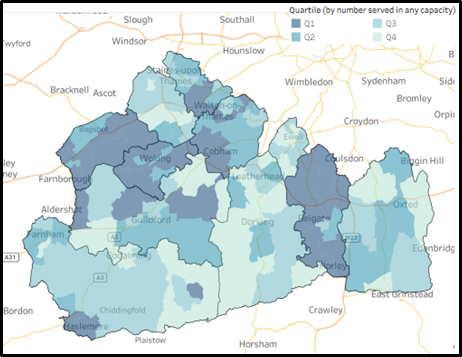
Veterans are therefore present in significant numbers in every part of the county.
Figure 3: Heat map of Surrey (electoral wards shaded according to the proportion of population who are veterans). Geographies have been ordered by value and separated into four quartiles so that a heat map of prevalence can be constructed. Q1 (darkest colour) represents the 25% of Surrey with highest prevalence of veterans.
Source: Veterans in Surrey – Census 2021 Maps | Tableau Public
Figure 4: Heat map of Surrey (electoral wards shaded according to the total number of residents who are veterans
Source: Veterans in Surrey – Census 2021 Maps | Tableau Public
The age structure of veterans reflects changing patterns in the size of the armed forces over time, including the cessation of national service in 1960, as well as reflecting the fact that younger people are more likely to still be members rather than former members of the armed forces. Nonetheless, across Surrey we see very young veterans (139 aged between 16 and 19 years), right through all age groups to those aged 85 years or older (9,091).
The nature of former service experienced by these men and women will vary immensely, as will their current and future support needs.
Veterans in Surrey tend to have an older average age than for England as a whole. For example, 60.3% of Surrey veterans are aged 65 years or above; for England, this is just 53.2%. For those of most advanced years, across Surrey almost a third of veterans are aged 85 or above (27.9%); for England this is less than one-fifth (18.7%).
Veteran demographics will also change over time as the size of the Armed Forces has steadily declined since the end of National Service in the 1960s. Whilst the overall number of veterans residing in Great Britain is projected to decrease, the percentage of veterans of working age is projected to increase to almost half of the veteran population by 2028 (Mod, Population Projections: UK Armed Forces Veterans residing in Great Britain, 2016 to 2028, Published 10 January 2019.). Moreover, as the number of females and those from ethnic minority groups serving in the Armed Forces increases, over time these changes will also be reflected in the veteran population.
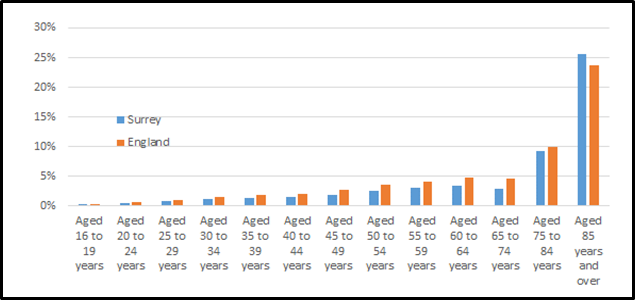
When looking at veterans of different age groups as a proportion of all residents of that same age, the proportion of veterans in Surrey is lower than the England position for all age groups other than those aged 85 or above as is shown in figure 5 below. This means that veterans are “rarer” in Surrey amongst their non-serving peers across all life stages other than the most elderly. This relative local rarity may mean there is lower appreciation and understanding of veterans’ experiences and requirements.
Figure 5: Veterans as a proportion of age group, Surrey versus England comparison
96% of Service Personnel have a positive experience of their service within the Armed Forces and make a seamless transition out of the Services into civilian life, where they are an asset to employers and the wider population; consequently, there is very little written about or research into this group. Others who may have served a short engagement, a full career or been compulsory discharged may feel that their transition to civilian life is unwelcome which can make the necessary personal and family adjustment more difficult to achieve.
For this small section (4%) of Service Personnel that do run into difficulties, in general, their difficulties are no different to those of the population in general, however, they tend to be more complex due to their military service. Service Leavers join civilian life with unique and valuable experience, transferable skills, discipline and personal qualities that will be an asset to employers and the community at large and distinguish them from the civilian workforce.
Some of the possible emotions on leaving the service are:
- Feeling of loss (bereavement) for their military career
- Not understood or appreciated by “civvies”
- Loss of camaraderie
- Not knowing yourself anymore
- Feeling that “civvy” work is unfulfilling
- Fear of the unknown or the future
- Annoyance with “trivial” family matters
- Not feeling competent
- Financial worries
- Lack of control
- Fatigue/Insomnia
- General anxiety and worry
- Feeling of not being valued
- Wanting to be alone
- Feeling of inadequacy
- Loss of identity and status
- Temptation towards alcohol abuse
- Loss of purpose
LGBT Veterans
It was an offence under the Army Act 1955, the Air Force Act 1955 and the Naval Discipline Act 1957 to be guilty of “any disgraceful conduct of a cruel, indecent and unnatural kind” or “any conduct … to the prejudice of good order and …discipline”. Prior to 2000 homosexual acts were regarded under the policy of Her Majesty’s Armed Forces as falling within both of those descriptions.
Aside from those offences, the policy of all three services of the Armed Forces was that homosexuality, whether male or female, was of itself incompatible with service in the Armed Forces. If personnel were found to be or admitted to being homosexual, they would be required to leave the Forces, irrespective of whether they had engaged in homosexual conduct or remained celibate. The Ministry of Defence (MOD) and the Office for Veterans’ Affairs (OVA) jointly commissioned an independent review to better understand the impacts and implications of the policy that homosexuality was incompatible with life in HM Armed Forces between 1967 and 2000.
The government acknowledged that the historic policy prohibiting homosexuality in the armed forces was unacceptable and wrong. The government published the formal response to the review on 13 December 2023.
The final review and recommendations was published on 19 July 2023: LGBT Veterans Independent Review. A number of restorative measures have been put in place with more planned.
Fighting with Pride is a military charity supporting LGBT+ veterans, serving personnel and their families, particularly those who were affected by the ‘gay ban’. They are working with veteran supporting organisations to build capacity for LGBT+ veteran support, to recognise their service and help resolve the challenges they face in their lives beyond military service.
Fighting with Pride has developed the Pride in Veterans Standard which is open to any organisation that wishes to demonstrate its commitment to being inclusive and welcoming to LGBT+ veterans, serving personnel and their families.
Foreign and Commonwealth
There are currently nearly 12,000 Service Personnel, including Gurkhas, who are from Foreign and Commonwealth (F&C) countries. The UK Border Agency (UKBA) has agreed to a general principle that F&C Service Personnel should not be disadvantaged in comparison with non-military individuals permitted to remain in the UK and gain employment through the points-based system.
Gurkhas who served after July 1997 and who were discharged with more than four years’ service have had the ability to settle in the UK since 2004. This brought them in line with all other discharged F&C Service Personnel. Since 2009, Gurkhas who retired before 1 July 1997 with more than four years’ service have had the ability to apply for settlement in the UK.
As a Serving member of HM Armed Forces, Gurkhas and Foreign and Commonwealth Service Personnel and their families are exempt from UK immigration control. This exemption ends immediately on their date of discharge and they will then be subject to UK immigration control.
2.3 Armed Forces Pension and Compensation Scheme Recipients
The Armed Forces Compensation Scheme (AFCS) is a compensation scheme for UK serving and former service personnel injured as a result of their service in His Majesty’s Armed Forces. There are two types of AFCS award: a tax-free lump sum payment for pain and suffering; and a Guaranteed Income Payment (GIP) which is a tax free, index linked monthly payment. The War Pension Scheme (WPS) compensates for any injury, illness or death which was caused by service before 6 April 2005. Together, AFCS and WPS provide an indication of the number of serving personnel and veterans with substantive additional needs as a result of an injury sustained while serving.
Figure 6: Armed Forces Pension and Compensation Scheme recipients by council
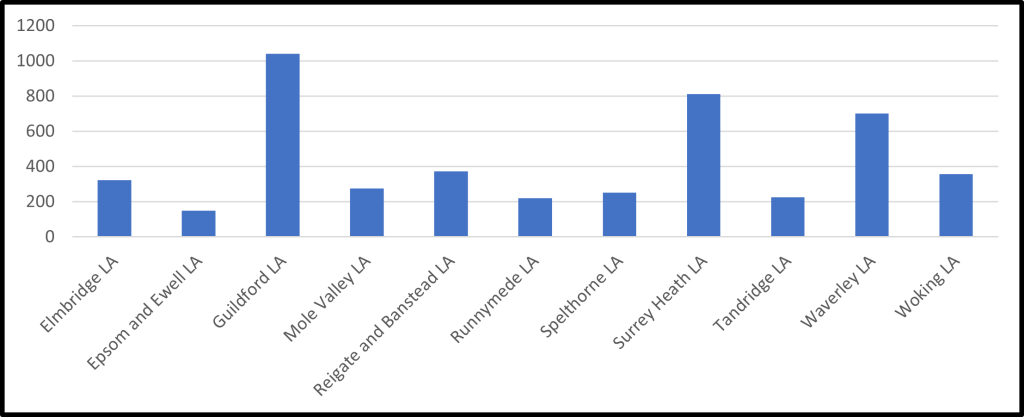
Source: Location of armed forces pension and compensation recipients: 2023 – GOV.UK (www.gov.uk), accessed 2 May 2024.
Table 2: Armed Forces Pension and Compensation Scheme recipients by council
| Area Name | All [note 1] | Of which veterans [note 1] | AFPS Recipients [note 2] | WPS Recipients: Veterans (Disablement Pensioners) [note 3] | WPS Recipients: War Widow(er)s | WPS Recipients: Other War Pensioners [note 6] | AFCS Recipients: Serving Personnel [note 3] | AFCS Recipients: Veterans [note 3], [note 5] | AFCS Recipients: GIPs in payment |
| Elmbridge | 323 | 297 | 253 | 58 | 17 | [c] | 9 | 15 | [c] |
| Epsom and Ewell | 148 | 135 | 115 | 31 | 11 | 0 | [c] | 8 | [c] |
| Guildford | 1,040 | 891 | 540 | 119 | 26 | 0 | 124 | 313 | 9 |
| Mole Valley | 275 | 250 | 203 | 54 | 14 | [c] | 10 | 24 | 6 |
| Reigate & Banstead | 373 | 349 | 295 | 68 | 17 | [c] | 7 | 15 | 4 |
| Runnymede | 219 | 200 | 178 | 27 | 4 | 0 | 15 | 11 | 4 |
| Spelthorne | 251 | 232 | 194 | 53 | 14 | 0 | [c] | 12 | 3 |
| Surrey Heath | 811 | 717 | 609 | 92 | 17 | 0 | 77 | 87 | 13 |
| Tandridge | 224 | 203 | 170 | 53 | 15 | 0 | 6 | 8 | 5 |
| Waverley | 701 | 646 | 586 | 116 | 34 | [c] | 20 | 16 | 5 |
| Woking | 356 | 332 | 300 | 58 | 11 | 0 | 13 | 11 | 4 |
| Surrey Total | 472 | 4252 | 3443 | 729 | 180 | 0 | 281 | 520 | 53 |
Note 2: All veterans in receipt of their pension under AFPS 75 and AFPS 05. Excludes pensioners in receipt of their pension under AFPS 15. Please see Background Quality Report for more details.
Note 3: All veterans in receipt of a Disablement Pension under the WPS as at 31 March 2023.
Note 4: Figures do not match other published AFCS statistics on lump sum recipients as this bulletin excludes those who have a date of death recorded on the CAPS.
Note 5: All individuals awarded compensation under the AFCS after leaving Service, and in-Service recipients of compensation who had later left Service as at 31 March 2023.
Note 6: Includes War Orphans, War Parents, Adult Dependents and recipients of a Child Allowance under the WPS.
Note 7: Recipients of a Guaranteed Income Payment (GIPs) under the AFCS.
[c] In line with the JSP 200 directive on statistical disclosure control, numbers fewer than 3 have been suppressed. Secondary cell suppression has also been applied to the next smallest numbers so that the values of suppressed cells cannot be derived from totals and sub-totals.
Source: Location of armed forces pension and compensation recipients: 2023 – GOV.UK (www.gov.uk), accessed 2 May 2024.
2.4 Service families
The Armed Forces Covenant Duty Statutory Guidance defines service families on the basis of their cohabitation with, or dependency on, a member or former member of the Armed Forces. This includes partners, children under the age of 18, and relatives living in the same household, wholly or partially dependent on the service member or service partner, or for whom the service member or service partner has assumed regular and substantial caring responsibilities. (Armed Forces Covenant Duty Statutory Guidance – GOV.UK (www.gov.uk), Para 1.45, accessed 7 May 2024.)
According to national data, 49% of service personnel are married or in a civil partnership, and 51% of service personnel have dependent children, with around 121,600 children from serving Armed Forces families in the UK. (UK Armed Forces Families Strategy 2022 to 2032 – GOV.UK (www.gov.uk), accessed 22 April 2024.)
The changing nature of Defence brings new challenges. An increasing number of families are opting for geographical stability by living in their own home and developing local support networks, but this can lead to increased separation from the service person and a lack of support from local services who are unaware of the challenges of military life. The military is equally impacted by recent changes in wider society, with an increase in cohabitation, family separation, single parent families, and changing gender roles which can have a particularly significant impact on Armed Forces families. (Living in our shoes full report (publishing.service.gov.uk), accessed 22 April 2024.)
Data analysis revealed a wealth of information on the support and challenges faced by serving members and veterans. However, there was a notable lack of data on the experiences of their families, who may be overlooked in service provision. To address this gap, a series of focus group sessions were conducted with Armed Forces spouses/partners from a range of different living situations (both on base, in Service Family Accommodation and in their own home) and from across all three services to capture the lived experiences of partners and spouses within the armed forces community. The collective experiences and perceptions of the participants regarding the covenant and its provisions are reflected throughout this document.
All participants demonstrated some level of awareness of the Covenant and what it meant “members and families are treated fairly and well even if leaving service”, although there was less understanding of which organisations came under the umbrella of the Armed Forces Act and the Covenant duty. However, there was a lack of awareness of how the covenant could be used in their lives – quotes from participants included:
- “If I need to use it, I kind of research it then, but I wouldn’t say I’m confident in knowing exactly what it does and how I can use it.”
- “[I] can’t confidently talk exactly about what that practically looks like in real life. And I think you only really find out the answer to that when you have an issue or a problem and you need to use the Covenant.”
- “There can be a gap in public understanding of the Covenant, leading to insufficient community support for veterans and their families.”
All quotes in this document relate to a series of focus groups held with spouses/partners of Serving personnel during October 2024.
Overall, the feedback strongly asserted that they had had “no bad experiences so far” in the implementation of the Covenant – “I and my family have great education and other opportunities” and “Never seen it not being adhered to.”.
Participants felt pride and comfort in their military family status. However, the majority would not disclose unless asked specifically:
- “All of us are proud spouses, most times I don’t tell unless I am asked, but always comfortable and happy to disclose.”
- “I’m not exactly comfortable about disclosing status as a military family except when appropriately necessary.”
Many said that if a professional was to ask, they would prefer this to be a person-centred way, and that it is often the relationship with professionals that makes them feel safe. Some participants recognised and supported the efficiency of including military family status on sign up or enrolment documentation to help professionals direct them to targeted support – quotes from participants included:
- “In-Person Conversations: A casual, respectful approach during face-to-face interactions allows families to feel comfortable sharing their status without pressure.”
- “If the service provider appears knowledgeable and supportive of military families, individuals may feel more inclined to share their status.”
Although not explicitly seeking to understand the impact that being an armed forces family member has on the social lives of our participants, several discussed openly the feeling of social isolation that they felt. Often this was due to the transient nature of some of their lives, some felt that they struggled to make friends – quotes included:
- “Because of my spouse’s involvement, with the Royal Navy, we’ve had to move a couple of times. This has made it difficult for me to form and, maintain some social connections.”
- “We live in quite an isolated part of Surrey. There’s not much community around here to be part of. […] that community impact is probably, out of everything you’ve asked us about is the biggest, not issue, but biggest thing for me.”
The focus groups also explored the areas of healthcare, housing, education and employment and feedback for these areas are included in relevant parts of this report.
2.5 Estimated total size of the Armed Forces community in Surrey
Taking into account all data sources, the table below shows that the estimated total size of the Armed Forces community in Surrey is around 75,000 people, or just over 6% of the total population. There is significant variation across the County, ranging from 4.3% in Epsom & Ewell up to more than 10% in Surrey Heath. These figures are likely to be an under-estimation.
Table 3: estimated size of the Armed Forces community in Surrey
| Local Authority | Veterans | Veteran Spouse (1) | Veteran child or step-child (2) | Based Regular personnel | Regular personnel spouse (3) | Regular personnel child or step-child (4) | Reserves (5) | RAF and Navy living in Surrey (7) | Total | % of total population |
| Elmbridge | 3,191 | 2,074 | 1,308 | 0 | 0 | 0 | n/a | n/a | 6,573 | 4.7% |
| Epsom and Ewell | 1,671 | 1,086 | 685 | 0 | 0 | 0 | n/a | n/a | 3,442 | 4.3% |
| Guildford | 4,138 | 2,690 | 1,697 | 1,820 | 928 | 892 | n/a | n/a | 12,164 | 8.5% |
| Mole Valley | 2,697 | 1,753 | 1,106 | 0 | 0 | 0 | n/a | n/a | 5,556 | 6.4% |
| Reigate and Banstead | 3,812 | 2,478 | 1,563 | 10 | 5 | 5 | n/a | n/a | 7,873 | 5.2% |
| Runnymede | 2,061 | 1,340 | 845 | 0 | 0 | 0 | n/a | n/a | 4,246 | 4.8% |
| Spelthorne | 2,512 | 1,633 | 1,030 | 0 | 0 | 0 | n/a | n/a | 5,175 | 5.0% |
| Surrey Heath (6) | 3,246 | 2,110 | 1,331 | 1,520 | 775 | 745 | n/a | n/a | 9,727 | 10.8% |
| Tandridge | 2,496 | 1,622 | 1,023 | 0 | 0 | 0 | n/a | n/a | 5,142 | 5.9% |
| Waverley | 4,347 | 2,826 | 1,782 | 0 | 0 | 0 | n/a | n/a | 8,955 | 7.0% |
| Woking | 2,426 | 1,577 | 995 | 0 | 0 | 0 | n/a | n/a | 4,998 | 4.8% |
| Total | 32,597 | 21,188 | 13,365 | 3,350 | 1,709 | 1,642 | 720 | 480 | 75,050 | 6.1% |
Note 2: Estimated from ONS data based on the number of children and stepchildren living with a veteran in England and Wales.
Note 3: Based on FAMCAS survey data that 49% of service personnel live with a spouse of partner.
Note 4: Based on FAMCAS survey data that 51% of service personnel live with dependent children.
Note 5: Data not available by district and borough council areas.
Note 6: Based Regular personnel in Surrey Heath includes the Royal Military Academy on the border with Bracknell Forest.
Note 7: Data obtained from MOD as set out in table 4 below
Whilst there are no Royal Navy or RAF bases within the county, a number of service personnel from these services are based in Surrey as set out in table 4 below. As such it is important that service providers recognise this and engage with the RAF as well as the Royal Navy. There may also be additional Army personnel who are based outside of Surrey but have a home address in the county.
Table 4: Number of service personnel with a home address in Surrey
This information was extracted from the Joint Personnel Administration MI system on 23 July 2024.
| Service | Regular SLA | Regular SFA | Regular SSSA | Regular Other | Reserve | Employee Count |
| Army | 2800 | 300 | 50 | 290 | 640 | 4080 |
| Navy | 190 | 10 | 10 | 80 | 60 | 350 |
| RAF | 120 | 10 | 10 | 50 | 20 | 210 |
| Grand Total | 3110 | 320 | 70 | 420 | 720 | 4640 |
The table above shows a count of Service Personnel where their county address is recorded as Surrey. All figures have been rounded to the nearest 10. Numbers ending in 5 are rounded to the nearest multiple of 20 to prevent systematic bias.
The table below shows that between 1 April 2014 and 31 March 2024, 1,170 service personnel left the services and moved into a home address in Surrey. The vast majority of these were trained service personnel from the UK.
Table 5: Number of service leavers discharged to a home address in Surrey and the reason for leaving
| Service | Strength – Trained | Strength – Untrained | Employee Count |
| Army | 880 | 40 | 920 |
| Navy | 130 | [k] | 130 |
| RAF | 120 | [k] | 120 |
| Grand Total | 1130 | 40 | 1170 |
| Service | Nationality Non-UK | Nationality UK | Employee Count |
| Army | 80 | 830 | 920 |
| Navy | [k] | 130 | 140 |
| RAF | 0 | 120 | 120 |
| Grand Total | 90 | 1080 | 1170 |
| Service | Leaving reason: Administrative | Leaving reason: Did not show | Leaving reason: Discipline | Leaving reason: Medical | Leaving reason: Normal | Leaving reason: Own request | Employee Count |
| Army | 80 | 10 | [k] | 130 | 250 | 450 | 920 |
| Navy | [k] | [k] | [k] | 10 | 20 | 100 | 140 |
| RAF | [k] | [k] | [k] | 10 | 40 | 70 | 120 |
| Grand Total | 90 | 10 | [k] | 150 | 300 | 620 | 1170 |
The table above shows a count of Service Personnel who left service between 01 April 2014 and 31 March 2024 and have recorded their Resettlement Post Discharge address county as Surrey.
All figures have been rounded to the nearest 10. Numbers ending in 5 are rounded to the nearest multiple of 20 to prevent systematic bias. Totals have been rounded independently and therefore may not equal the sum of their rounded parts.
Cadets
Although not formally covered by the Armed Forces Covenant, the Cadets make up a proportion of the Armed Forces community. In Surrey there are over 2,836 Cadets supported by 531 Cadet Force Adult Volunteers. They are not part of the Armed Forces, but are voluntary youth organisations, sponsored by the Ministry of Defence, in 69 units across the County. They provide critical opportunities for the youth of the County.
The Sea Cadet Corps (SCC), Army Cadet Force (ACF), and the Royal Air Force Air Cadets (ATC) are amongst the community in local towns. The Combined Cadet Force (CCF) are based in schools; traditionally the CCFs have been based in private schools, but in the last few years, some state schools have joined this scheme, including Ash Manor School and Southborough High (Surbiton).
The Cadet organisations provide fun, friendship, action and adventure and inspire young people, who are mostly between the ages of 12 and 18, (the Sea Cadets start at 10) to challenge their limits and develop valuable skills. Teamwork, leadership, self-discipline and individual confidence are enhanced through exciting and challenging experiences.
A recent national report by Northampton University has analysed the value of Cadet service and proved that the experience increases social mobility and decreases social disadvantage. It has also highlighted that the life skills gained are valued by the Cadets, parents, educational organisations and employers. Based on the 20% sample within the report, it was calculated that young people in the Cadet Forces produce an indicative annual return on investment of c. £95 million (using 2019 prices), made up of:
- A reduction in GP visits, worth c. £502,000 per annum
- A reduction in use of mental health services, worth c. £681,000 per annum
- Lifetime private benefits from their increased likelihood of attending FE/HE of c. £70,300,000
- Lifetime public benefits in increased tax receipts from their increased likelihood of attending FE/HE of c. £23,400,000
Links: University of Northampton Report – Social Impact Resulting from Expenditure on Cadets
The Cadets deserve the County’s support. Adult Volunteers are critical in the running of the Cadets and every effort should be made to encourage them to volunteer; the County will benefit from well-developed young citizens. Link: Home | Cadet Force Adult Volunteer
Healthcare
3.1 Overview
The Health and Social Care Act (2012) contains provisions to enable the NHS, local government and other sectors in England to work together in a collaborative manner to help improve local population outcomes. For the armed forces community, this includes serving personnel (Regulars and Reservists), veterans, and their families. An important part of this has been the partnership between the NHS and the Ministry of Defence (MOD), which is backed by the Armed Forces Covenant and also embedded in the NHS Constitution where it states that patients will be at the heart of everything the NHS does. With a commitment being made to ensure that the NHS, in line with the Armed Forces Covenant, will ensure that those in the Armed Forces, Reservists, their families and Veterans are not disadvantaged in accessing health services in the area they reside. This commitment will support fair access to treatment to ensure that the Armed Forces community be afforded the same standard of, and access to healthcare as that received by any other UK citizen in the area they live.
This essentially means that where members of the Armed Forces community receive their healthcare from the NHS, they should receive priority treatment where it relates to a condition which either results from their service in the Armed Forces, subject to clinical need or to facilitate continuity of care for family members as a consequence of frequent moves which are inherent in service life.
Those injured in Service, whether physically or mentally, should be cared for in a way which reflects the Nation’s moral obligation to them whilst respecting the individual’s wishes. For those with concerns about their health, where symptoms may not present for some time after leaving Service, they should be able to access services with health professionals who have an understanding of Armed Forces culture.
The NHS Long Term Plan also describes the steps required to create an NHS fit for the future. The actions it sets out are intended to deliver better healthcare to the whole population – including the Armed Forces community. In response to the obligations set out in the Armed Forces Covenant, NHS England’s Healthcare for the Armed Forces community: a forward view makes the following commitments to ensure it meets the needs of the Armed Forces community in this regard:
- Commitment 1: Working in partnership to commission safe, high-quality care for serving personnel and their families
- Commitment 2: Supporting families, carers, children and young people in the Armed Forces community
- Commitment 3: Helping the transition from the Armed Forces to civilian life
- Commitment 4: Identifying and supporting Armed Forces veterans
- Commitment 5: Improving veterans’ and their families’ mental health
- Commitment 6: Supporting veterans in the criminal justice system
- Commitment 7: Identifying and addressing inequalities in access to healthcare
- Commitment 8: Using data and technology to improve services
- Commitment 9: Driving research and innovation in Armed Forces healthcare
It is important to note that responsibility for Armed Forces healthcare is split between the MOD and the NHS. The Defence Medical services (DMS) provide a range of services for Regular serving personnel in the UK, those serving overseas and in some cases their families at home and abroad. From an NHS perspective, commissioning responsibilities are discharged through NHS England as a direct commissioner of services for those registered with a DMS practice, and through Integrated Care Boards (ICBs) (which are the statutory NHS bodies of individual Integrated Care Systems (ICS)) for patients registered with an NHS GP, such as most families and all veterans. In addition, NHS England commissions some bespoke services for veterans. Defence Medical Services responsibilities for the armed forces personnel in England also includes the commissioning and provision of:
- occupational health for military personnel
- primary care for serving personnel (and mobilised Reservists) and GP services for families registered with DMS GP practices
- all health care when on active operations and prior to return to UK
- rehabilitation services for musculoskeletal (MSK) and some neurological injuries, specifically for serving personnel
- inpatient and community mental health services for serving personnel via a number of regional military Departments of Community Mental Health in the UK
The table below gives a visual interpretation of these responsibilities for further reference.
Table 6: Responsibilities of specific bodies
| Service Provision | Serving person posted in England | Serving person posted overseas | AF families registered with DMS in England | AF families registered with DMS overseas | AF families registered with NHS GP practice | Mobilised Reservists | Veterans and non-mobilised Reservists |
| Primary | DMS | DMS | DMS | DMS | ICBs | ICSs and DMS | ICBs |
| Community and mental health | DMS | DMS | ICBs and NHS England | DMS | ICBs | DMS | ICSs and NHS England |
| Secondary acute | NHS England | DMS | NHS England | DMS | ICBs | NHS England | ICBs |
In England, local upper tier and unitary authorities are responsible for meeting the health and wellbeing needs of armed forces families, Reservists and veterans as part of the local population.
The armed forces community are entitled to access these services in the same way as any other members of the local population. In April 2013 upper tier and unitary authorities in England assumed legal responsibility for improving the health of their population.
They are mandated to provide the following services to the local population:
- sexual health services (excluding HIV treatment)
- NHS Health Checks
- health protection – to ensure plans are in place to protect the health of the population and to have a supporting role in infectious disease surveillance and control and in emergency preparation, preparedness and response
- public health advice to Integrated Care Boards (ICBs)
- National Child Measurement Programme
Additionally, upper tier and unitary authorities are also required to provide, or commission, a wide range of other services to improve and protect the health of the local population and reduce health inequalities. These discretionary services include (but are not limited to):
- alcohol and drug misuse services
- public health programmes for children aged 5-19
- stop smoking services and tobacco control
- interventions to prevent and manage obesity
- physical activity
- public mental health programmes
- health at work
- nutrition and healthy eating
- community safety, violence prevention and social exclusion
- dental public health
- seasonal mortality interventions
Clinical Need
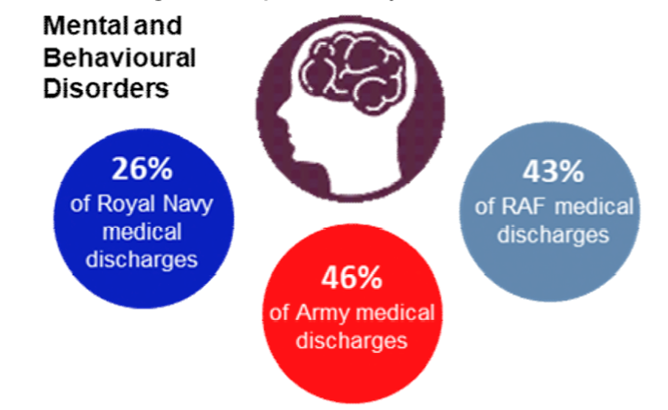
For context, serving personnel and their families are generally fit and well as a population. The MOD publishes annual data on medical discharges in the UK Regular Armed Forces. Data is available for 1 April 2022 to 31 March 2023 with trend data back to 1 April 2018. In 2022/23 data shows that there were 396 medical discharges in the Royal Navy, 964 in the Army and 216 in the RAF. A total of 1,576 medical discharges occurred in 2022/23, representing approximately 4 UK Regular armed forces personnel medically discharged each day. For all three services, the most common principal cause of medical discharge were Musculoskeletal Disorders and Injuries, Mental and Behavioural Disorders and hearing deficits. This was in line with findings from previous years and is likely to be due to the physical demands of the UK armed forces; challenges in retaining personnel with severe or enduring mental ill-health given the nature of their role and access to weapons, as well as the commonality of these conditions among the general population. Around half (45%) of all medical discharges were the result of more than one medical condition.
Figure 7: Percentage of medical discharges for musculoskeletal disorders and injuries
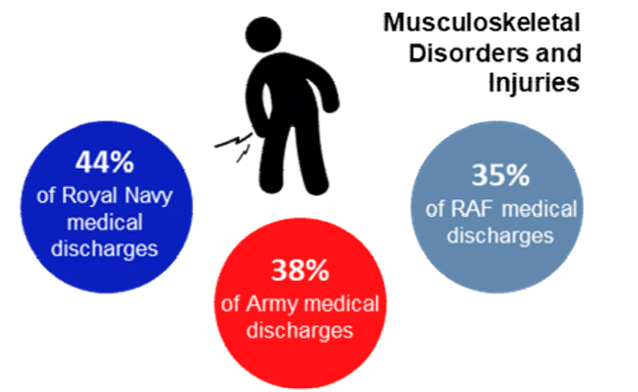
Figure 8: Percentage of medical discharges for mental and behavioural disorders
Some of the main problems faced by service families with specific clinical needs occur where there is a lack of NHS understanding around their mobility demands, where families can be posted across the country or overseas at relatively short notice. With that comes the potential impact of families not receiving continuous care. Particularly if services discharge these patients, as opposed to transferring them to receiving medical authorities. This relates predominantly to waiting list management, where a member of a service family could potentially lose their place on a list through no fault of their own.
With that, mechanisms need to be put in place to meet Armed Forces Covenant requirements to ensure that these groups are not disadvantaged as a consequence of their posting. This can include ensuring that when registering with GP Practices, all people are asked if they have served in the Armed Forces or are part of the Community. If so, they can be then coded on systems accordingly. This can also prompt conversation around any continuing care requirements that could be accommodated with the Armed Forces Covenant in mind. Conversely, when families de-register as a consequence of a posting, they can be asked if they need any specific care services transferred to their new receiving areas so that their care can be continued.
In terms of veterans, there are many myths published in the media around the health of this particular group. In general, mental health conditions are rated as on par with the civilian population per capita. However, PTSD is rated at about 9% (population 4%) with 17% of those having been in war fighting roles. Suicide rates are not higher overall but are higher in young men. The main issues in this regard focus on alcohol abuse, substance misuse and depression.
3.2 Veteran health
According to the 2021 Census, Surrey veterans who previously served in the Reserve forces or in both Regular and Reserve forces were slightly more likely to be in good health than their peers across England as a whole. In general, this is due to the expected physical fitness required to join and serve in the armed forces, its social support networks available, and access to health care and employment. Many service personnel are very fit and active and tend to be younger than the general population, with the majority aged between 20 and 40 years old and male. This is borne out and shown in Table 6 both nationally and locally.
Table 7: Proportion of Veterans in “Good health”: England/Surrey comparison
| Proportion of veterans in “Good health” | Previously served in the UK Regular armed forces | Previously served in UK Reserve armed forces | Previously served in both Regular and Reserve UK armed forces | Previously served in any capacity | Did not previously serve |
| England | 63% | 72% | 62% | 64% | 79% |
| Surrey | 63% | 77% | 69% | 66% | 84% |
However, care should be taken in considering the ramifications of this finding, since veterans are generally more likely to be male and older, whereas those who have never served will constitute a generally younger population, with more women. A direct comparison between veterans and non-veterans is therefore difficult to draw with accuracy.
Amongst veterans, the proportion who are disabled is significantly above the level seen in those who have never served.
This is also likely to be partially explained by the tendency of the veteran community to be older than those who have never served, and partially will arise from injuries or experiences received during the course of their service, potentially due to the higher levels of occupational physical activity for armed forces personnel where there is a higher prevalence of musculoskeletal injury.
Of note, overall tobacco smoking rates are still higher than for the general population. Additionally, there is evidence that alcohol consumption within the armed forces is greater than in a comparable general population. One recent study identified that 65% of serving personnel were frequently consuming alcohol at hazardous or harmful levels.
Contrary to some reports there is not a ‘bow wave’ of mental health problems amongst UK Regulars or Reservists, and post-traumatic stress disorder (PTSD) accounts for only a small number of cases – approximately 4% – across the whole of the UK armed forces, with those who have seen combat and Reservists at higher risk. Recent research has highlighted the prevalence of anxiety, depression and common mental health disorders amongst armed forces serving personnel. A longitudinal study of 10,000 Regulars and Reservists by King’s College London’s Centre for Military Research and the Academic Department for Military Mental Health found 19.7% reported common mental health conditions. Whilst other studies report elevated levels of mental health illness amongst UK Military personnel, it is generally accepted that prevalence rates roughly equate to the general population with slight increases in reported mental health illness amongst combat troops and Reservists. Early service leavers – those who leave prior to four years of service – and Reservists have been found to have a higher risk of developing mental health problems than their peers. With this overview in mind, there is a hypothesis to say that this part of our population may need specific support and interventions in these key areas in order to mitigate potential health inequalities, leading to required thinking as to how the Armed Forces community can be supported through programmes designed to reflect their needs. This could include these programmes being operated by professionals who are ex-military or know the military culture because they have a deeper understanding of what individuals and their families are going through, which, in turn, would help build trust with those seeking help.
It is not possible with the current data releases to provide further analysis of this point.
However, just under one-third of Surrey resident veterans are disabled (31%; 10,058 people). This is on a par with the national position for veterans (32%) but double the incidence of disability for the population of Surrey who have never served (15%).
14.5% of Surrey resident veterans have their daily activities limited a lot, and 16.4% a little, through disability, equating to 4,718 and 5,340 people respectively.
3.3 Data
When considering the specific challenges facing the Armed Forces community in Surrey, a lack of local data makes it difficult to provide a complete picture. An audit of GP records in 2022 identified only 1,010 veterans across the 104 practices in Surrey Heartlands. When compared to the 2021 Census, this suggests that fewer than one in 20 has their veteran status accurately reflected in their GP patient record (which is likely to be even less for military families). Hospitals also ask about membership of the Armed Forces community, but again numbers recorded remain relatively low.
NHS England has recently published a list of recommended Systemised Nomenclature of Medicine – Clinical Terms (SNOMED CT) with these codes being the most comprehensive and internationally validated system used to record clinical information in the patient record. In this context, these codes are used when recording Armed Forces community status (see table 8 below). The Department of Health and Social Care has produced communication material as part of the ‘Say you Served’ campaign to encourage veterans to let their GP practice know they have served in the UK Armed Forces.
Table 8: recommended SNOMED codes to identify the Armed Forces community
| SNOMED CT Code | Title | Definition |
| 753651000000107 | Military veteran | Anybody who has served at least a day in HM Forces, whether as a Regular or Reservist |
| 988811000000102 | Family of active serving member of the Armed Forces | Relevant family members of serving personnel, as defined in Paragraph 1.45 of the Armed Forces Covenant Duty Statutory Guidance |
| 702348006 | Active military duty | Individuals currently serving as members of the Naval Services (including the Royal Navy and Royal Marines), Army, and Royal Air Force |
| 933041000000109 | Armed Forces Reservist | Members of one of the volunteer Reserve forces (the Royal Naval Reserve, the Royal Marines Reserve, the Army Reserve and the Royal Auxiliary Air Force) or the ex-Regular or Reserve forces (the Royal Fleet Reserve, the Regular Reserve and the Royal Air Force Reserve) |
| 844341000000104 | Dependant of former serving member of British Armed Forces (a request has been submitted to change the word ‘dependent’ to ‘family’) | The immediate family of a military veteran. This is defined as spouses, civil partners and children for whom they are responsible but where appropriate can extend to parents, unmarried partners and other family members |
3.4 Access to healthcare for service families
The latest Tri-Service Families Continuous Attitude Survey identified that the majority of serving families required access to GP services (92%) and dental services (89%) over the previous year. Of those requiring access, the proportion of families doing so without difficulties have decreased significantly since 2015 and are lowest for mental health treatment (37%) and dental treatment (35%). A quarter of families were unable to access mental health treatment at all and three in ten were unable to access dental treatment. Up to 10% of families reported having moved while undergoing healthcare treatment, with half of families reporting they were unable to continue dental treatment following a move.
Of those who were on a waiting list for an operation or consultant appointment, 48% felt their waiting time had increased because of moving. (UK Tri-Service Families Continuous Attitude Survey Results 2023 (publishing.service.gov.uk), accessed 19 April 2024.)
Surrey faces the full range of challenges in serving the Armed Forces community. As well as over 32,000 veterans and their families, it is home to over 3,000 serving personnel who are based in the County, plus personnel who may work outside Surrey but live here with their families (both in Service Family Accommodation and in their own homes). The DMS practices at Army Training Centre (ATC) Pirbright and the Royal Military Academy Sandhurst allow families to register with them, with NHS England being the responsible commissioner in this regard who ensure that those patient needs are met. This responsibility however sits with the ICB for those serving families who choose to register with a local NHS GP.
In terms of experience from Service spouses/partners, those spoken to within the focus groups generally had a positive experience with the NHS in Surrey, although wait times and queues were a common, though not universal, issue – quotes included:
- “The first GP appointment was quick and accessible for my kids.”
- “Not a bad experience… good service offer but GP and dentist long wait.”
- “So far quite good – only caveat – queue for specialist through the welfare system took 2-3 weeks but service was good once got access. The next session is one month away though so a small delay.”
- “Dentist was a long wait but service was great and the GP was quite quick.”
- “The Covenant helped because priority healthcare was received and adequate.”
- “It takes time, especially if you’ve just moved.”
- “It’s a pain sometimes having to, you know, register with a new dentist and be on waiting lists and different things like that. But I wouldn’t necessarily think that is specifically due to being a part of the Armed forces community and being kind of specifically disadvantaged.”
Several participants discussed how moving due to their partner’s role in the armed forces affected their access to healthcare. Issues with record transfers were raised by several participants:
“For me in terms of GP, that’s been easy enough. The difficulty there more so lays with like the records and getting them transferred and stuff was a bit of a tricky one.”
Additionally, some participants mentioned that moving mid-treatment added complexity to an already stressful time. In some cases, for convenience, they continued accessing treatment at their previous location for the duration of a treatment cycle, which resulted in higher travel costs – quotes included:
- “Many personnel in the armed forces community may experience interruptions in healthcare provision, such as referrals to specialists, due to frequent relocations.”
- “New healthcare providers may require reassessments before continuing care, leading to delays in receiving necessary treatments.”
Regarding dental care, a few participants highlighted the general lack of available NHS spaces. One participant mentioned that due to the lack of local provision, they had not switched from their previous dentist and instead planned their dental visits around trips to visit family:
“Dentist. However, I’ve just not changed it from home so I but I’ve told them and said, ‘you know, I’m moving away now, but I’ll be coming home to visit family and just want to keep the dentist hear’. And they’ve said it’s fine. But dentist, especially in Surrey, I don’t think there’s hardly any NHS dentists or if there are, I haven’t seen them. And the only ones I ever see are private, which you know are extortionate. So I’ve just not wanted to leave my NHS one back home, to be honest.”
Case Study: When application of the Armed Forces Covenant Works
In October of 2023, the Patient Quality and Care Co-ordinator from Armed Forces Health (England), a department of NHS England, referred a case to the Surrey Heartlands Armed Forces Champion in relation to an instance involving a service family posted into the Surrey area from overseas.
The spouse of the serving member had been undergoing extensive treatment for a chronic musculoskeletal condition which had required extensive surgical interventions and use of very strong pain relief. The patient left their overseas posting with a set medication regime, which included specific opioid therapies as well as other medications to carry them through until they were placed on the appropriate pathway by their new General Practitioner (GP) and reviewed accordingly. They were also in possession of all relevant notes relating to their condition and treatment for reference.
On return to the UK, the family registered with a civilian GP. However, the patient immediately experienced problems in obtaining timely referrals for their continuity of care, and due to prescribing limitations as stated in National Institute for Health & Excellence (NICE) and General Medical Council (GMC) safe prescribing guidelines, the GP was not permitted to re-prescribe the same medication as received overseas until the patient had been seen in a UK Pain Clinic; prescribing them alternatives which were proving to be less than optimal in managing the patient’s pain effectively.
A further problem was highlighted in that the patient was essentially treated as a new referral, with their treatment overseas not being taking into account in terms of prioritisation. Consequently, it was determined that before the Pain Clinic referral could be made, the patient would need to undergo an MRI and with that, was placed on the waiting list with a local provider. It was determined that the wait would be four to six weeks with the results having to be read and reported, which could have taken a further four weeks. Only then could a referral be made to the Pain Clinic which had a waiting list of up 16 weeks.
Whilst the limitations put on the GP were absolutely understood, taking into consideration the patient’s complex history and ongoing treatment overseas, this timescale felt like a protracted period which would impact on the patient’s pain management regime, through no fault of their own.
The Practice was contacted to ascertain whether or not it recognised the patient under the Armed Forces Covenant. Anecdotally, administrative staff had noted that the patient was a spouse of a service person but were unsure of how this applied in the context of the Armed Forces Covenant. This was therefore not noted in any referrals.
With that the ICB Armed Forces Champion engaged with the Practice, highlighting specific areas of the Armed Forces Covenant relating to healthcare and the legal duty for organisations to consider the Covenant in their dealings with service families. The Practice was receptive and grateful of the advice given and made the appropriate amendments to the referral to highlight the patient’s status. This was acknowledged by the receiving hospital, who were accredited by the Veterans’ Covenant Healthcare Alliance Veteran Aware scheme. With that, the patient’s case was reviewed and appropriately prioritised based on the patient’s previous treatment, leading to expedited appointments and treatment, ensuring that the continuity of the patient’s treatment was not compromised as a consequence of their spouse’s service. It also helped the Practice to understand it’s role in applying the principles of the Armed Forces Covenant and motivated them to register for the GP Veteran Friendly Accreditation scheme.
The Healthcare for the Armed Forces community: a forward view commits us to:
- have due regard to health and social care needs of the Armed Forces community in planning and commissioning high quality healthcare services
- ensure that those in the Armed Forces community who are on a waiting list for treatment should never lose their place on a waiting list if they move from one area to another
- ensure changing location does not result in a reduction in the quality of care or a gap in the provision of services
- implement the guidance ‘The role of health visitors and school nurses: supporting the health and wellbeing of military families’ to support children in Armed Forces families
- ensure that all eligible DMS-registered patients are automatically included in the NHS adult and child screening programmes, including those for breast and bowel cancer
- improve access for DMS-registered patients to health promotion services commissioned by local authorities, such as those for weight loss, smoking cessation, alcohol and drug misuse and sexual health support
- ensure that carers in the Armed Forces community can benefit from additional support and raise Armed Forces families’ awareness of the support available to carers
3.5 Accreditation Schemes
Veterans’ Covenant Healthcare Alliance
NHS Veteran Aware is an accreditation programme designed to support NHS trusts in understanding and meeting the needs of the Armed Forces community. Accreditation is administered by the Veterans Covenant Healthcare Alliance (VCHA), an NHS England funded programme of work hosted by the Royal National Orthopaedic Hospital NHS Trust.
Veteran Aware accreditation supports NHS, and other healthcare organisations, to meet the commitments of the Armed Forces Act 2021, and supports the implementation of the nine commitments made in Healthcare for the Armed Forces: a forward view.
As of April 2024, all NHS Trusts and Foundation Trusts in Surrey were accredited with the NHS Veterans Aware programme. More recently, independent sector providers, hospices and community providers have also joined the programme, although none have done so yet in Surrey Heartlands.
GP Veteran Friendly Practice Accreditation
The Veteran Friendly Accreditation Scheme by the Royal College of GPs and NHS England is a quick-to-implement, free support programme for GP practices in England that enables practices to identify, understand and support veterans and, where appropriate, refer them to specialist healthcare services designed especially for them. As of May 2024, 52% of GP practices in Surrey Heartlands and Frimley are registered with the scheme, ahead of the NHS England target of 40% and in line with the national average (see chart below). (Email, Veteran Friendly GP Practices – All Practice Information up to EOD 11/06/24, dated 15 June 2024.) As of May 2024 there were still two Primary Care Networks in Surrey Heartlands without an accredited practice. (Email, National Figures By ICB for VFGP Accredited GP Practices up to EOD 14/05/24, dated 15 May 2024.)
Figure 9: % of practices accredited with the RCGP scheme by ICB in the South East
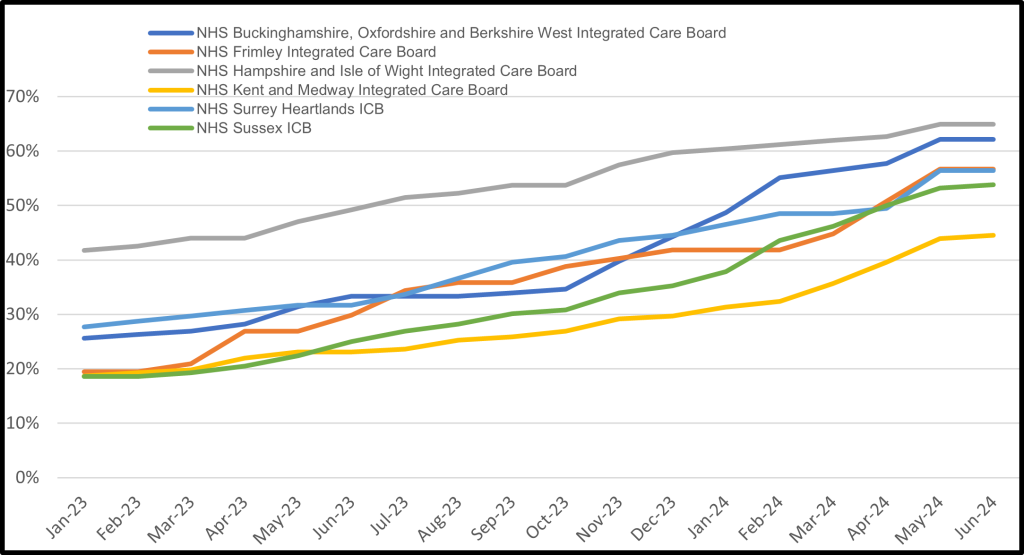
Care Homes
Designed for use in residential settings for older people, the Veteran Friendly Framework (VFF) helps care providers to offer appropriate support for the thousands of veterans living in care homes across England. It is a collaboration between Armed Forces charities Royal Star & Garter, the Royal British Legion and the NHS Veterans Covenant Healthcare Alliance.
The Framework supports providers in identifying veterans and their wellbeing needs, addressing social isolation and providing signposting to statutory and charitable services. It also helps create a culture of understanding for those people who have served.
3.6 Mental Health and Op COURAGE
For most people, service in the Armed Forces has a positive impact on their life and the majority of service personnel do not experience mental health problems while they are in service or when they transition into civilian life, and incidences of common mental health disorders such as depression and anxiety are similar to those seen in the general public.
Experiences during service and the later transition to civilian life mean that different factors may trigger mental health issues.
Mental health issues can sometimes be exacerbated by post-service factors, such as difficulties in making the transition to civilian life, marital problems, and loss of family and social support networks. Some younger or single veterans are more likely to run into difficulties than others, with pre-service problems being an important factor. Veterans are also vulnerable to social exclusion and homelessness, both of which are risk factors for mental ill health.
There is growing evidence that some mental health conditions may present many years after leaving the services – research shows that it takes 12 years on average for an ex-service person to ask for support. Most veterans developing mental health problems experience a common mental disorder such as depression or anxiety, with a smaller number diagnosed with PTSD. The rates of PTSD in the combined Regular Forces and Veteran population is about 6% compared to between 4% and 5% in the general population. In the Reserve Forces the rate is reported as being around 6% to 7%. Veterans also experience a higher rate of alcohol abuse. Further information can be found in the Emotional and Mental Wellbeing chapter of the JSNA.
Op COURAGE is an NHS mental health specialist service designed to help serving personnel due to leave the military, Reservists, armed forces veterans and their families. It supports veterans living in England who are registered with a GP (or are willing and eligible to register) and who have a mental health problem of any type or severity, which does not have to be connected to their service.
Berkshire Healthcare NHS Foundation Trust leads on Op COURAGE in the South East, which entails Surrey, Sussex, Kent and Medway and is delivered by Sussex Partnership NHS Foundation Trust. The service accepts referrals from anywhere and as shown in the chart below, they come from a range of sources including from the patient themselves or a carer, NHS Primary Care services, or other local services like housing, probation or Job Centres.
Figure 10: referral sources for Op COURAGE in the South East 2023/24
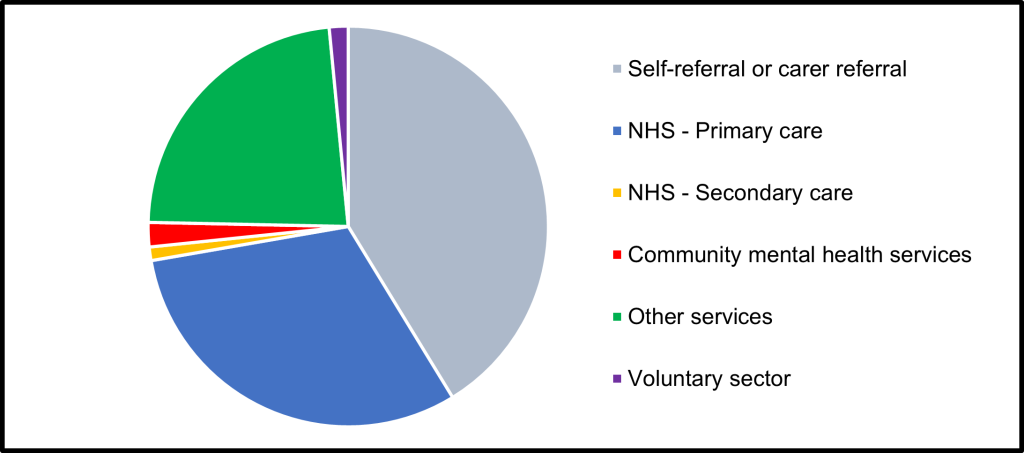
In 2023/24, Surrey accounted for just 15% of referrals across the three counties and (although Kent and Sussex have more veterans) this translates to 21 referrals per 10,000 veterans in Surrey (compared to 35 in Sussex and 38 in Kent). (Email, Op COURAGE Surrey Data, dated 10 May 2024.)
3.7 Suicide Prevention
The national Armed forces suicide prevention strategy and action plan was published in 2023. The action plan identifies eight focus areas. These are:
- Understand high risk groups within the armed forces
- Educate armed forces about suicide
- Enable individual resilience and personal support needs
- Enable safe military environments
- Enable organizational management of those at risk
- Enable access to support for those at risk
- Develop accessible postvention support (actions taken following death by suicide)
- Improve organizational learning
Although local data is not available, below are some key facts on suicides in UK armed forces veterans, England and Wales – Office for National Statistics (ons.gov.uk):
- In 2021 in England and Wales, 253 suicides occurred in UK armed forces veterans
- Of the 253 UK armed forces veteran suicides occurring in 2021, 93.7% (237) were male and 6.3% (16) were female
- After accounting for age, there was no evidence of a difference in the rate of suicide between male UK armed forces veterans and the male general population
- Male UK armed forces veterans aged 25 to 44 years had a higher rate of suicide compared with males aged 25 to 44 years in the general population
In addition, NCISH | Suicide after leaving the UK Armed Forces 1996-2018: a cohort study (manchester.ac.uk) found that:
- Overall, veterans were not at increased risk of suicide compared to the general population
- The risk of suicide was 2-3 times higher in male and female veterans aged under 25 years
The study also found that suicide rates were higher after having service in the armed forces for people with the below factors:
- Being male
- Younger age at discharge
- Short length of service
- Army service
However, the below factors saw a lower rate of suicide:
- Being married
- Higher rank
- Serving on operational tours
- Training
Figure 11: Suicide after leaving the Armed Forces
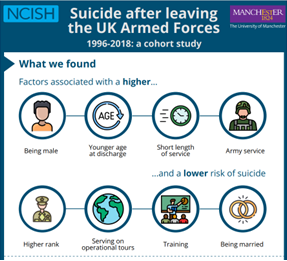
The following action is highlighted within the Surrey suicide prevention strategy to support those at risk of or affected by suicide: Work with local armed forces and veterans’ boards and working groups to develop a joint suicide prevention working group to review and support the delivery of the eight focus areas.
3.8 Physical Health and Op RESTORE
Generally, veterans report having similar standards of health to the general population. This can mask some specific issues for particular groups or individuals, such as those with hearing difficulties, mental ill health and musculoskeletal conditions. Medical advances mean that veterans with service-attributable, life-altering injuries are living longer than previously, creating a need for life-long care. (Healthcare-for-the-Armed-Forces-community-forward-view-March-2021.pdf (england.nhs.uk), accessed 18 June 2024.)
Op RESTORE provides specialist care and treatment to individuals who have served in, or are leaving, the UK Armed Forces and have continuing, physical health injuries and related medical problems attributed to their time in service. It supports residents in England who have: served in the UK armed forces for a full day and are registered with a GP practice in England; sustained a physical health injury of any type or severity that is attributable to their time in service (they do need to have been medically discharged or had an Armed Forces Compensation Scheme payment), regardless of when it happened; and they have ongoing medical problems related to the physical injury sustained in Service.
In Surrey, there were only eight referrals into Op RESTORE in 2023/24 (2.45 per 10,000 veterans), compared to 30 in Hampshire and the Isle of White (3.42 per 10,000). Referrals for Surrey residents were received from just seven GP practices: two in South West London, two in Frimley, and three in Surrey Heartlands.
3.9 Accessible Points of Contact and Op COMMUNITY
Op COMMUNITY provides a single phone number and email address for the Armed Forces community living in each local area to call if they have a medical enquiry and are not sure where to go. People calling into the helpline will be signposted to the most appropriate NHS or community service available in their area.
This service is currently in its NHS England-led pilot phase, with one ICB in each region leading on different models of providing support. The South East pilot is being led by Kent & Medway ICB, however it has not been commissioned to cover Surrey. Once the pilot is complete, NHS England is expected to write to all ICBs and advise them of how to implement the scheme.
3.10 Veterans in the Criminal Justice System
Soldiers, Sailors, Airmen and Families Association (SSAFA) provides a continuing service for Armed Forces veterans even if they are in custody within the Criminal Justice Service (CJS). However, given the practical difficulties of undertaking complex casework administration in a prison environment, SSAFA will do as much as is possible to help those both serving inmates in prison and on leaving prison. SSAFA has specially trained volunteers called Prison-in-reach (PIR) volunteers who visit former members of the Armed Forces veterans in prison within their Branch (county) and will seek funding or other help as required. SSAFA is a non-judgemental organisation and, provided the individual concerned meets the standard criteria for assistance, i.e. having served for one day in either the Regular or Reserve, then the PIR will take on their case if possible. However, in many instances, former servicemen and women may not want it to be known amongst their peers that they formerly served in HM Forces and so accurate statistics of the number of the veterans in the CJS are difficult to define.
Op NOVA is an NHS England commissioned service to support veterans who are in contact with the justice system, which includes pre-arrest, arrest, post arrest and those sentenced to a term of imprisonment, by providing emotional and practical support; enabling veterans to access specialist support in areas such as accommodation, mental health and wellbeing, drugs and alcohol use, self-care, training and employment, parenting and caring. They take referrals from the Police, the NHS Liaison and Diversion Teams, Probation Service, Prison Service, other key partners and charities and self-referrals.
The service is based on a holistic needs assessment to coordinate seamless practical and emotional support to empower veterans to engage with appropriate services. Their caseworkers work closely with other services like Op COURAGE and Op RESTORE, as well as NHS RECONNECT. NHS RECONNECT is a care after custody service that seeks to improve the continuity of care of people leaving prison with an identified health need, which means that they would otherwise struggle to engage with community-based healthcare services and/or relevant support services.
The Op NOVA case worker role is now established for Surrey, although referrals have yet to reach the same level as neighbouring Hampshire, as the table below shows. Further work is required with Surrey Police to increase referrals as appropriate.
The table below shows total Surrey referrals to date = 32. In 2023, 5 referrals were via Police or Liaison & Diversion (L&D – NHS provision within custody suites/courts/prison). There have been no Police referrals in 2024 to date.
Table 9: Op Nova Referrals in Surrey in 2023 and 2024
| Referral source – 2023 | Number |
| Liaison and Diversion – a NHS provision within custody suites / courts / prison. | 2 |
| Military Charity | 2 |
| Police and Liaison and Diversion | 1 |
| Police Custody and PIC | 2 |
| Self | 1 |
| Total | 8 |
| Referral source – 2024 | Number |
| Care after Combat | 12 |
| HMPPS | 2 |
| Military Charity | 5 |
| NHS (other) | 4 |
| NPS | 1 |
| Total | 24 |
The table below shows referrals per Police Area – these are either referred by that Police Service and/or the veteran’s home address is in that Police area.
Table 10: Op Nova referrals by Police area
| Area | 2023 | 2024 |
| Avon & Somerset | 18 | 38 |
| Bedfordshire | 21 | 15 |
| Cambridgeshire | 38 | 41 |
| Cheshire | 39 | 32 |
| City of London | 1 | 12 |
| Cleveland | 20 | 29 |
| Cumbria | 66 | 85 |
| Derbyshire | 53 | 84 |
| Devon & Cornwall | 90 | 151 |
| Dorset | 16 | 39 |
| Durham | 38 | 136 |
| Essex | 137 | 148 |
| Gloucestershire | 16 | 59 |
| Greater Manchester Police | 353 | 410 |
| Hampshire | 58 | 444 |
| Hertfordshire | 20 | 23 |
| Humberside | 65 | 59 |
| Kent | 68 | 96 |
| Lancashire | 185 | 189 |
| Leicestershire | 16 | 47 |
| Lincolnshire | 46 | 66 |
| Merseyside | 215 | 211 |
| Metropolitan Police | 22 | 35 |
| Norfolk | 56 | 92 |
| North Yorkshire | 30 | 37 |
| Northamptonshire | 42 | 69 |
| Northumbria | 70 | 104 |
| Nottinghamshire | 69 | 97 |
| Other | 37 | 88 |
| Police Not Involved | – | 3 |
| South Yorkshire | 75 | 197 |
| Staffordshire | 17 | 75 |
| Suffolk | 46 | 72 |
| Surrey | 8 | 24 |
| Sussex | 15 | 29 |
| Thames Valley | 21 | 21 |
| Unknown | 10 | 4 |
| Warwickshire | 6 | 11 |
| West Mercia | 26 | 50 |
| West Midlands | 103 | 128 |
| West Yorkshire | 16 | 43 |
| Wiltshire | 13 | 28 |
| Total | 2,261 | 3,593 |
3.11 Armed Forces Carers
The Surrey Carers Programme is committed to supporting unpaid carers and young carers from all communities including carers within the armed forces. The programme commissions carer support services, and, more specifically, the Carer Hubs service offers support to carers on a needs basis. This could be via support groups or 1:1 support from a trained support worker. Armed Forces carers are identified at the triage initial assessment, offered support and onward referral if needed.
In Surrey, we have a referral mechanism known as the Carers Prescription, to enable professionals to refer carers to support services. Within the Carers Prescription, we ask whether the carer or someone they care for has ever served in the armed forces. This is to ensure that health, social care and other services are able to support the carer in the right way specific to the carer’s needs. Since the Census in 2021, 269 carers within the armed forces have been identified through the Carers Prescription.
If a carer has been referred for a Carers Needs Assessment, the carer will be asked whether they, or the person they care for, have served in the armed forces during the appointment.
Young Carers are supported within the commissioned young carers support service in Surrey. The number of young carers who care for someone who has served in the armed forces is 63. Young Carers support is guaranteed for two years from the service and consists of support groups, family fun days and a higher need support including 1:1 sessions.
A common barrier to providing appropriate support is the lack of identification of our Armed Forces carers and young carers. Addressing this is key to ensuring relevant support is provided along with appropriate onward referral to services.
Housing
4.1 Types of accommodation for serving personnel
It is a condition of Service in recognition of their inherently mobile lifestyles, frequently remote bases and terms of service, that Regular Service (including some Full Time Reserve Service) personnel are provided with subsidised accommodation. Most Reservists are not provided with any Service accommodation. Serving personnel may be staying in a range of accommodation types.
Table 11: types of service accommodation
| Type | Description |
| Single Living Accommodation (SLA) | Any type of purpose-built accommodation, whether permanent or temporary, owned, leased, requisitioned or provided by, or on behalf of MOD for the authorised use of single and unaccompanied Service personnel. |
| Substitute Single Living Accommodation (SSLA) | Accommodation which broadly replicates SLA when SLA may not be available. This could take the form of rented accommodation provided, allocated and managed by an MOD contractor, or an allowance payable to Service personnel to enable them to make private arrangements to live in rented accommodation. |
| Service Families Accommodation (SFA) | Accommodation provided for Service and entitled civilian personnel with dependent families. |
| Substitute Service Family Accommodation (SSFA) | Where SFA is not available, privately rented accommodation will be provided, allocated and managed by an MOD contractor. |
SFA is the most typical accommodation to be found outside of (although often adjacent to) a military base, while SSLA and SSFA will be used when the core estate is under strain or not available. There are over 1,200 SFA homes in Surrey and the surrounding London boroughs, as shown in the chart below, more than two-thirds of which are in Guildford and Surrey Heath.
Figure 12: SFA in Surrey and adjacent boroughs
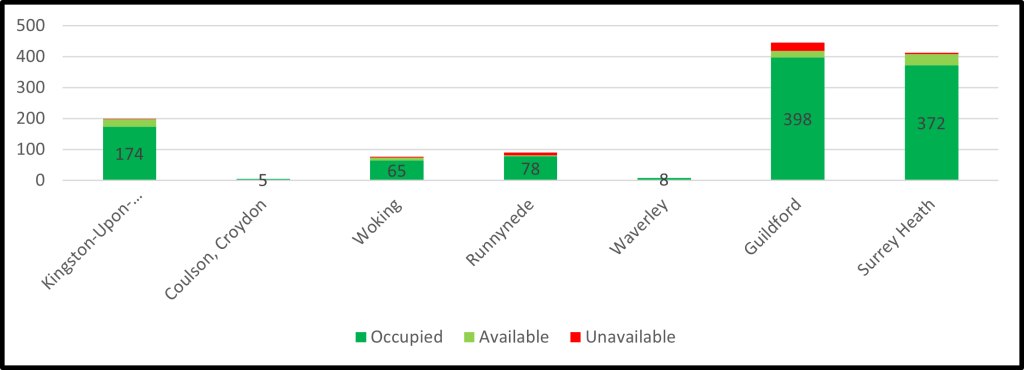
4.2 Legal Framework for Housing
The Armed Forces Covenant Duty
The Armed Forces Covenant places a duty on local authorities (along with other statutory organisations) to pay due regard to the Covenant principles in housing and homelessness. Government guidance defines how certain ‘reasonable preference’ categories of the Armed Forces community, particularly those who have sustained injuries in Service, should receive additional preference when they have urgent housing needs either on leaving Service or subsequently in civilian life. Housing associations have the option of signing up to the Armed Forces Covenant. However, the Covenant does not generally provide any guarantee for housing or priority for veterans and consequently local authorities interpret their responsibilities under the Covenant in different ways. At a local level, the Armed Forces Covenant is supported by an action plan and key pledges. This could include key housing pledges such as social housing allocation and the employment of specialist housing workers.
One of the aims of the Covenant is to provide assistance with meeting the local connection test. Due to the unique obligation and sacrifice of geographical mobility, veterans or Service families might find they have not built up sufficient ‘local connection’ in accordance with a local authority’s allocation scheme, reducing their access to social housing in the area where they live. This could prevent them accessing waiting lists for social housing once they leave the Armed Forces and are no longer eligible for Service accommodation. Statutory Guidance on the Armed Forces Covenant Duty set out criteria under which members of the Armed Forces community in England cannot be disqualified from social housing because of a local connection requirement. The June 2020 statutory guidance for local authorities in England makes clear that local authorities in England are expected to disapply any local connection requirement from divorced or separated spouses or civil partners of Service personnel who are required to move out of accommodation provided by the Ministry of Defence (MOD).
Also, due to the unique obligation and sacrifice of danger, veterans might have particular social housing needs caused by physical or mental injury arising from their time in Service. For example, supported housing, or a home which allows wheelchair access. Other members of the Armed Forces community, such as Service families, might also have urgent social housing needs. However, they might find they are not prioritised to receive suitable social housing or experience a lack of available social housing. Statutory guidance on the allocation of accommodation in England, ensures that ‘additional preference’ (high priority) for social housing is given to certain groups in the Armed Forces community. Also, the June 2020 statutory guidance sets out how local authorities in England can ensure that members of the Armed Forces community suffering from mental ill health (wholly or partly attributable to Service) are given appropriate priority for social housing. It should be noted that a mental health issue as a result of Service can continue or start years after the person has left the Armed Forces
Households who are homeless or at risk of homelessness in the next 56 days can apply to their local housing authority for housing assistance in England. A number of tests apply for rehousing and some exceptions are in place for ex-Service personnel. This includes that people cannot be intentionally homeless because of leaving the Forces (including dishonourable discharge); the local connection requirement is waived for anyone who has served in the last five years; and a veteran may be deemed ‘vulnerable’ under the legislation due to their experiences of Service.
The Homelessness Act 2002
The Homelessness Act 2002 introduced a requirement for local authorities to undertake a homelessness review and subsequently to create a homelessness strategy. The Code of Guidance 2018 states that all groups at risk of homelessness need to be taken into account and specifically mention veterans as a possible group, but this is not a requirement and can lead to inconsistent approaches to veterans across local authorities.
4.3 Housing challenges – the national context
The majority of the Armed Forces community make a smooth transition from military to civilian life. Only a minority of veterans struggle to settle down and maintain housing. Veterans might require housing services in terms of social housing, tenancies, and adaptations. They will need to access housing services, provided by the housing bodies subject to the Duty. When members of the Armed Forces community do need to access housing services, they can experience disadvantages arising from the unique obligations and sacrifices of Service life, such as:
- A lack of knowledge about the social housing services available in their local area, or how to access them
- Not building up sufficient ‘local connection’ in accordance with a local authority’s allocation scheme, reducing their access to social housing in the area where they live
- Not being prioritised to receive suitable social housing, or experience a lack of available social housing, that meets particular housing needs caused by physical or mental injury sustained in Service
- Finding it more difficult to communicate with a housing body. Veterans and Service families might experience mental health issues which exacerbate their challenges in accessing services from which they could benefit
- A lack of knowledge about how to navigate the civilian housing sector, welfare system and budgeting, leading to difficulty gaining or maintaining a social housing tenancy or increasing their likelihood of becoming homeless
- A reluctance to seek early help to avoid homelessness, due to stigma, shame, or a belief that civilian bodies will not understand their experience, which could also increase their likelihood of becoming homeless
- Requiring adaptations to be made to their home when they move to a new area, or lacking knowledge of what grants are available, how to make applications for them, and what information is required to support their application
- Housing staff knowledge of how to recognise members of the Armed Forces community will underpin successful responses to these issues
Current data shows that 16,250 personnel left the Armed Forces in the UK in the 12 months leading up to September 2022. This compares to the corresponding figures for 2021 (13,850) and 2020 (12,950) (MOD 2022). Over half of those leaving in the 12 months leading up to September 2022 were under 30 years of age (52.6%) and 1,540 of these were women. The number of non-UK personnel leaving was 160, which has remained stable over the last ten years, with a total of 9,240 non-UK nationals leaving Service since 2012. Data collected by the Armed Forces charity, SSAFA, a UK charity that provides lifelong support to serving men and women and veterans, indicates high levels of need in the period following official ‘transition’ (two years) with 74% experiencing difficulties within the first three years of leaving and 80% in the first five years. The most commonly reported problems were related to debt or lack of savings; unexpected discharge; and finding suitable affordable accommodation.
4.4 Reasons for housing challenges after leaving the military
Setting expectations with armed forces personnel
While in service, armed forces personnel are offered rents at a reduced rate compared to the private rented sector (PRS) market. However, Service personnel and their families are not always able to save for a sufficient deposit to either rent in the PRS or secure a mortgage (Slapakova et al 2023). Research suggests this may be because there is not always a full appreciation of how much more PRS or owner-occupier housing will cost, especially as household bills may be lower or not applicable (council tax) in Armed Forces accommodation. Service personnel may also have unrealistic expectations of the average salary in the civilian employment market (Rolfe 2020), and thus fail to appreciate the levels of savings they might need in the early stages of transition. More recent research points to the impact of the rising cost of living and job market insecurity, generating feelings of financial insecurity among Service personnel. (Slapakova et al 2023)
Support from MOD in preparation for transition into civilian life
There is evidence that MOD policy support around transition and finding housing has improved in recent years (Quilgars et al 2018; Rolfe, 2020). However, evidence also shows that support and advice tend to be quite close to the end of the service accommodation tenancy. Hence, there is insufficient knowledge and preparation for meeting housing needs after service. The issues that have been observed are ‘information overload’ close to the service end date, giving personnel preparing for transition too much information to process at once, with too much emphasis being placed on attendance of advice sessions, and not making information more freely available in other formats (Heal, 2019; FiMT 2013; Heaver et al 2018).
The housing advice offered by MOD has also been criticised as too generic and insufficiently tailored to the specific circumstances and best options around tenure, location and affordability for each individual and family (Rolfe 2020, Centre for Social Justice 2016, FiMT 2013). Furthermore, it has been observed that advice can also seem confusing, using unfamiliar terms like ‘social housing’ and worrying when it raises issues of potential homelessness (FiMT 2013). There is also some evidence to suggest that the information may not always be shared with family members of personnel staff, which leaves family members particularly vulnerable (Walker et al, 2021; Heaver et al 2018). Some research has reported an unrealistic expectation of priority access to social housing among personnel, fuelling concern that some Service personnel remain somewhat ignorant of their future entitlements (SSAFA 2020a; FiMT 2022).
The MOD have implemented a range of policy changes to support those who require assistance with moving on to civilian/veteran life. The identification of individuals who might benefit from additional support occurs at unit level through the chain of command. In these instances, referrals are passed to Veterans UK who deliver services to Service Personnel in the greatest need.
Future planning by armed forces personnel
The need for ongoing planning for future (post military) housing needs is particularly evident for those who leave Service at short notice (FiMT 2013; Ashcroft 2014; Rolfe 2020; Jones et al 2013). Families in Service Family Accommodation (SFA) are issued a Notice to Vacate within 93 days, although in some circumstances it can be as little as 28 days (for example disciplinary discharges). Recently, retired or redundant Service personnel may apply to stay in Surplus SFA for 12 months, during which time they are required to pay market rates for their accommodation.
Complex realities
Some research suggests that the complex realities of social housing allocation, the welfare system, and dealing with the challenges of finding PRS housing or buying a home, when an individual or family has not had experience of civilian living, can be daunting and difficult for ex-Service personnel (Rolfe 2020; FiMT 2022). Equally, advice services and Housing Options teams in local authorities may have little knowledge or understanding of the specific challenges facing ex-Service personnel when they are seeking what could be their first independent home (Ashcroft 2014; FiMT 2022). Important differences in practice around local connection, which can be central to securing social housing, also exist across different local authorities (Walker et al 2021; FiMT, 2022 and Appendix 1). General awareness that help is available to ex-Service personnel can also be an issue. Heaver (Heaver et al (2018)) found limited awareness about services available to ‘veterans’, with 51% unaware of veteran welfare services. In relation to housing advice, 78% of respondents were unaware of organisations offering specialist support (Heaver et al 2018).
Ex-Service personnel may also struggle with housing costs (West Midlands Combined Authority 2020), placing them at risk of eviction. There could also be little knowledge about how to run a home, either because they haven’t had an independent home to manage before, or because of a relationship breakdown, where a partner who used to handle all housing matters is no longer there. There is also some evidence of low awareness of entitlement to benefits among some ex-Service personnel. (Jones et al 2014; Wilding 2017) (Rolfe 2020).
Recommendations for improvement
To improve access to housing and homelessness services, it is recommended to:
- ‘ask the question’ about veteran’s status on application forms as well as in person, to verify and to help ensure appropriate support and referrals can be made (Wilding, 2017)
- simplify application processes (Wilding 2017)
- use trauma-informed approaches to share information, such as a single written account of individual experiences that can be shared with professionals at appointments, instead of requiring a veteran experiencing homelessness to keep discussing their experiences (Rolfe 2020)
- ensure there is an identified/named contact point for veteran related support in organisations (Rolfe 2020)
- use referral mechanisms rather than signpost, with follow-up between organisations to ensure veterans have accessed the appropriate support (Rolfe 2020)
- improve inclusivity policy and practice so that those from under-represented groups are aware of services and feel welcomed, including services for LGBTQ+ community (Etherton 2023) and for women (Salute Her, 2020)
4.5 Recognising veterans at risk of homelessness
Common characteristics of Service Personnel at risk of homelessness
Many veterans who are at risk of homelessness share characteristics with other people at risk of homelessness. However, there are some particular patterns, such as:
- Early Service leavers (ESL) can be at heightened risk. If someone fails basic training or has to leave military Service early on, an unplanned exit after a short period of time gives less time for them to prepare
- Those leaving under the age of 35, who are reliant on welfare benefits, are subject to the Shared Accommodation Rate, which can place younger ex-Service personnel at a disadvantage in civilian housing markets
- Non-UK personnel with families who wish to remain in the UK may have increased vulnerabilities related to limited understanding of their entitlements and costs of accessing rights to settle for themselves and their families
- Partners who are within the wider armed forces community population, who are not veterans but who become homeless because they lose entitlement to SFA
- Without the right support and safeguarding procedures in place, women who have experienced interpersonal violence or military sexual trauma may be at heightened risk of homelessness
- In common with ex-offenders who have multiple and complex needs, some veterans leaving military prison may be at heightened risk of homelessness. In common with all homelessness, ex-Service personnel who experience poverty, debt and long-term unemployment, both as lone adults and as families, may be at heightened risk of homelessness because they may develop mental health problems
- Securing suitably adapted and equipped housing may be time consuming and/or very difficult for veterans who have life limiting illnesses and disability
4.6 Complex needs and causes of homelessness amongst veterans
Relationship/family breakdown
Relationship/family breakdown is a major reason for housing related issues. For young people, this could be quite soon after leaving Service as they may have returned to their parental home and relations may have become strained. For those in longer-term relationships and with families, the breakdown may come a number of years down the road when people experience a difficult transition back to civilian life.
Mental health
Poor mental health is one of the key underlying causes of housing related problems post-Service. This is also often identified as a pre-cursor to substance misuse issues and/or homelessness.
Despite the greater awareness of mental health issues, and specialist veteran services, there remain long lead-in times to veteran support services and a general lack of accessible mainstream mental health services. In addition, there is an almost total absence of services that would work with people who have both mental health issues and substance misuse issues.
In addition, some forms of temporary accommodation can be chaotic and not conducive to making a recovery.
Trauma
The impact of childhood trauma has only recently been recognised within homelessness services, with the introduction of trauma-informed approaches (Homeless.org.uk – Trauma Informed Care) and the use of Adverse Childhood Experiences to identify those at risk.
Whilst this is related to the issue of mental health more generally, there appears to be a specific need to identify those at risk of ongoing mental health problems and vulnerabilities due to their pre-military/childhood experiences. Even without specific trauma, these veterans are less likely to have family and other social supports available to help them on leaving Service. Some veterans also suffer other traumas both in and after Service, including multiple family bereavements/suicides, violence, and sexual assault. Homelessness itself can also involve trauma, including sleeping rough.
Debt, money worries and gambling
Debt and money issues are reported as a big problem for many people, including those who haven’t learnt how to budget and/or simply do not know how to pay rent and bills. Often people come out of Service in debt and/or fall into debt quite quickly whilst trying to navigate civilian life. An increase in gambling issues is also observed.
The cost of living crisis is also an issue that is impacting veterans including those who are in work but struggling to make ends meet.
Offending history
Having an offending history can make it more difficult for people to find housing, irrespective of whether this is offending related to Service, or after leaving Service.
4.7 Support offer and assistance to veterans in the community
As a result of the Armed Forces Covenant, and as part of the Armed Forces community, local and regional (and sub-regional) partnerships have developed over the last decade to support veterans with their transition to civilian life. Most of the activity here is at the local authority level, however, some areas have formed regional networks of Armed Forces Champions. Some specific services have been set up with these networks, for example, the Armed Forces Outreach Service (Armed Forces Outreach Service) which is a partnership between local authorities and housing associations operating in the North East. In addition, more broadly under Armed Forces Covenant work, many areas have set up community hubs at the local authority level, offering a single point of contact for advice and assistance and the provision of social activities.
The Defence Transition Services (DTS) and the Veterans Welfare Service (VWS)
Both the DTS and VWS are MOD/defence business services that continue to support individuals and families beyond discharge. DTS is now available for up to two years post-discharge but they can refer households to VWS for ongoing support. The VWS is available to veterans for as long as required. DTS are also responsible for administering the MOD Referral Scheme (gov.uk MOD Referral Scheme) which can help Service leavers with applications for social housing up to six months after leaving Service. DTS provides a navigation role, with an element of direct advocacy/mentoring. Around half of their clients are Early Service Leavers.
Op FORTITUDE
Op FORTITUDE (Riverside Op FORTITUDE) (funded by the Armed Forces Covenant Trust Fund) was launched in July 2023 and delivers a centralised referral pathway into veteran supported housing for veterans at risk of or experiencing homelessness. The approach involves creating a pathway from the veteran at risk of, or experiencing, homelessness, to veteran supported housing, or organisations that can support them to keep their current home and avoid becoming homeless.
Referrals can come from a range of sources across agencies including DTS, the public, the homelessness sector, the veteran charity sector, local authorities, His Majesty’s Prison and Probation Service, or directly from the veteran themselves.
In addition, the Armed Forces Covenant Fund Trust launched the Reducing Veteran Homelessness Programme in May 2023 to fund wraparound support within existing veteran supported housing projects for up to two years. Grants are being awarded to fund up to 900 specialist accommodation places for veterans.
The experience of service users and local authorities has varied, suggesting that its capacity for placing veterans into suitable accommodation is limited which risks creating frustration and undermining trust in public sector agencies. Veterans may be better served directly by local authority housing teams, but developments in this area should be closely tracked.
Veteran charitable sector
The veteran charitable sector supports veterans with the full range of welfare issues, including accommodation issues, across the UK. The Confederation of Service Charities (Cobseo) plays a key role in bringing together veteran charities and includes a Housing Cluster.
Table 12: examples of specific housing assistance from the VCSE sector
| Organisation | Support |
| Stoll runs the Veterans Nomination Scheme | Seeks to access social housing for ex-Service personnel through partnerships with social landlords across England and Wales. Referral is only for those with low support needs. |
| SSAFA | Provides volunteer casework assistance for housing issues, including access to financial assistance to enable access to accommodation and setting-up costs such as furniture. May offer rent guarantees for the first month. |
| Royal British Legion | Includes both general casework support and targeted outreach services for those at a crisis point. They support referrals into other services and provide help with deposits/rent-in-advance. |
| Other Service charities | Specific Service charities for the Army, Navy and RAF provide their own welfare support. For example, Royal Navy and Royal Marines Charity can undertake casework with people three months before they leave and up to one year afterwards. The RAF Association has an employee casework team supported by volunteers and an outreach friendship telephone service. |
| Other examples | There are some very specific Housing Plus models offered to assist the transition to civilian life which offer training opportunities at the same time as accommodation, for example Erskine House (Salisbury) run by Entrain Space. In addition, there is a veteran community sector that operates at a local level across the UK. Many of these organisations are affiliated to the Association of Service Drop-In Centres. Most provide broad support with welfare issues, and some also provide specific assistance with housing, including emergency accommodation and financial assistance to access bed and breakfast accommodation on a crisis basis. |
Specialist veteran accommodation
There is a well-established veteran accommodation sector offering both long-term accommodation (for example, via Haig Housing), and a range of supported accommodation settings provided both by veteran organisations (e.g. Stoll; Scottish Residences, Mike Jackson House) and mainstream housing providers with a specialist offer for veterans (e.g. The Riverside Group Limited/Alabare).
4.8 Homelessness and rough sleeping in Surrey
A person who is vulnerable as a result of having been a member of His Majesty’s (HM) Regular Armed Forces has a priority need for accommodation. Each Surrey local authority monitors the number of applicants who approach as homeless and are owed either a prevention or relief homeless duty. Between the 11 Surrey local authorities, there were a total of 88 approaches across the last five years, with Reigate and Banstead Borough Council receiving the most applicants (28 households).
The number of rough sleepers in Surrey who were identified and recorded as having served in HM forces across 2019-2024 is quite low. In total, there were 17 across the five years in Surrey. In most years, each district and borough recorded a figure of 0-1. However, some local authorities did not record this specific information across all 5 years.
Case study example: A single person was deemed ‘non-priority’ under regular homelessness legislation. However, the individual was ex-services and sleeping rough. Under the Government’s Rough Sleeper Initiative, an outreach support officer provided intensive support to engage the individual and managed to assist them in to a rehabilitation programme for several months. Whilst in recovery, the support officer worked in partnership with SSAFA to create a move-on plan where they were able to secure social housing for the individual.
4.9 Housing Allocations in Surrey
A Housing Allocation policy determines how social housing allocations are made to applicants on a local authority’s housing register. Each Surrey local authority has its own policy to suit local demand. Therefore, banding and priority for those with an armed forces connection varies by each local authority. As previously noted, individuals leaving MOD accommodation, and their families, may have difficulties in establishing local connection to a particular area, therefore, flexibility is required in a local authority Housing Allocations policy. Equally, compensation linked to service should not disadvantage the applicant when assessing eligibility and finances.
All 11 Surrey local authorities currently apply a local connection criteria exemption for members of the armed forces. However, some limit this to within 5 years of discharge. There are some inconsistencies in how serving members of HM Forces, Veterans and their families are assessed when applying to be on the housing register in a given area in Surrey. Ten Surrey local authorities currently apply a local connection exemption to bereaved, divorced or separated spouses of armed forces personnel required to leave MOD accommodation, whilst one (Woking Borough Council) does not. Five Surrey local authorities (Epsom and Ewell Borough Council, Mole Valley District Council, Reigate and Banstead Borough Council, Spelthorne Borough Council, Woking Borough Council) disregard compensation received for an injury or disability sustained on active service when assessing eligibility, income and savings thresholds, whilst the remaining six do not. Some local authorities who do not apply this in their policy, use discretion in exceptional circumstances on a case-by-case basis when applying financial criteria exemptions.
In-housing monitoring by Surrey local authorities in figure 13, indicates the total number of applicants on the housing register with an armed forces connection, and the number of social housing lettings made in 2023 – 2024. Both figures were unknown by Tandridge District Council. The number of lettings made to applicants with an armed forces connection was unknown by Mole Valley District Council and Elmbridge and Woking Borough Councils.
Figure 13: Applicants on the housing register with an armed forces connection and number of social housing lettings made to households with an armed forces connection in Surrey 2023 – 2024 showing the percentage of the Surrey total within each District and Borough.
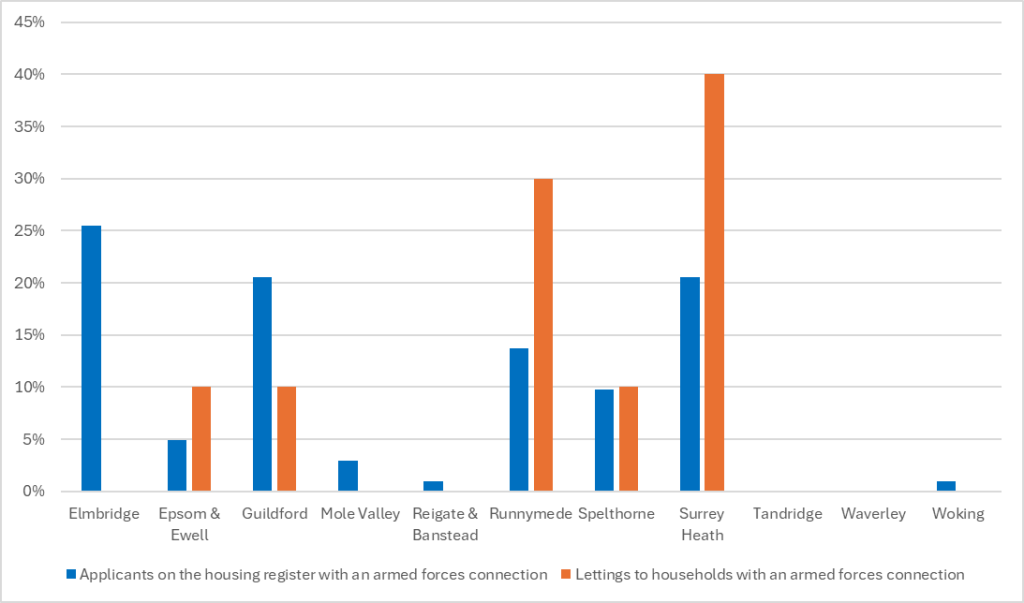
4.10 Experience of Service Spouses/Partners
A series of focus group sessions with Armed Forces spouses/partners were held, of which a large proportion of participants lived in Service provided housing. For those in privately rented or owned accommodation, the experience was generally positive. However, participants did mention some challenges, such as the higher cost of accommodation in Surrey compared to their previous locations, which affects their future planning. Quotes taken from focus groups held with partners/spouses of Serving personnel during October 2024:
- “Housing concerns play…a big role in decision-making around finances, lifestyle choices and (feelings of) security”
- “More expensive”
- “Yes I have concerns and want to make savings for post active service”
- “Not thought about it yet or made enquiries”.
- “Finding affordable, appropriate housing in Surrey can be quite challenging due to High Demand and Limited Availability.”
Awareness of housing support before moving to the area was mixed, and there was no spontaneous awareness of housing support schemes like Help to Buy for Armed Forces.:
- “…difficult but contacted authorities to find affordable housing.”
- “Feeling more supported that Covenant is in place.”
- “I have read about to find any form of support most of the support requires local connection, so the fact that I get to move frequently and I have to form new connections with every new movement. It’s been difficult. I have haven’t been able to find any support”
4.11 Welfare benefits in Surrey
Research undertaken by the British Legion via Freedom of Information requests submitted to Surrey local authorities in August 2022, highlighted how compensation that Veterans receive is treated for assessment of means tested benefits in Surrey. At this snapshot date, the approach was inconsistent across Surrey. The British Legion contacted all 11 Surrey district and boroughs to bring it to their attention and requested that they change their policies to fully disregard all military compensation as income in means tests.
Table 13: Surrey local authority means tested benefits and the exemption of military compensation from assessments (British Legion, 2022, Freedom Of Information date compilation with some additional recent updates by local authorities)
| Local Authority | Council Tax Support (CTS) | Housing Benefit (HB) | Discretionary Housing Payments (DHP) | Disabled Facilities Grants (DFG) | % |
| Elmbridge | Yes | Yes | Yes | Yes | 100 |
| Waverley | Yes | Yes | Yes | Yes | 100 |
| Spelthorne | Yes | Yes | Yes | No | 75 |
| Tandridge | Yes | Yes | Yes | No | 75 |
| Reigate and Banstead | Yes | Yes | Yes | No | 75 |
| Woking | Yes | Yes | No | Yes | 75 |
| Runnymede – do not specify what incomes re disregarded in their policies. Each case is considered on its own merits | n/a | n/a | n/a | Partially | n/a |
| Guildford | Yes | Yes | No | No | 50 |
| Mole Valley | Yes | Yes | No | No | 50 |
| Epsom and Ewell | Partially | Partially | No | Yes | 42 |
| Surrey Heath | Partially | Partially | No | Partially | 42 |
Education
“So something needs setting up now and like be permanent here because I have to think of kids that are coming up and my brother, …………..the last thing I want is for him to be coming into school and feeling this way.”
Service child voice
5.1 Number of Service children in Surrey
Currently, there are 1,642 children of Regular Armed Forces personnel living in Surrey, with 892 in the Guildford borough, 745 in Surrey Heath, and just 5 in Reigate and Banstead. Additionally, 13,365 children of veterans reside in Surrey, with numbers more evenly distributed across the county, ranging from 685 in Epsom and Ewell to 1,782 in Waverley.
However, estimating the number of Armed Forces children aged 5 years and under presents a significant challenge because existing reports and studies frequently emphasise the overall population of children without breaking down the data by specific age groups. This lack of age-specific analysis limits the accuracy and depth of understanding regarding the unique needs and circumstances of younger Armed Forces children, thereby hindering targeted support and intervention efforts.
The education landscape in Surrey includes a variety of settings from early years to higher education.
There are circa 2,000 education establishments including nurseries and pre-schools, schools, further education colleges and higher education establishments in Surrey, however, only four have currently signed the Armed Forces Covenant. Currently, school age children attend 208 different schools within the county.
Generally, Service spouses/partners reported very positive experiences of the Surrey education environment, noting that their children received “good support”, were “Doing well academically” and “Happy” with their schools. These quotes taken from spouses/partners of Serving personnel during focus groups held during October 2024.
Some noted that transitioning to a new environment could be emotionally challenging, but that they had positive experiences with caring staff. “When we came to Surrey, it was quite a little bit of an issue for my child because we had already made friends from their former location. The only issue was the emotional part where they had really created friends in the previous school. So moving them was quite an issue. […] I had also expressed that through the teachers so they took special care to actually address it.”
Figure 14: Types of education settings in Surrey
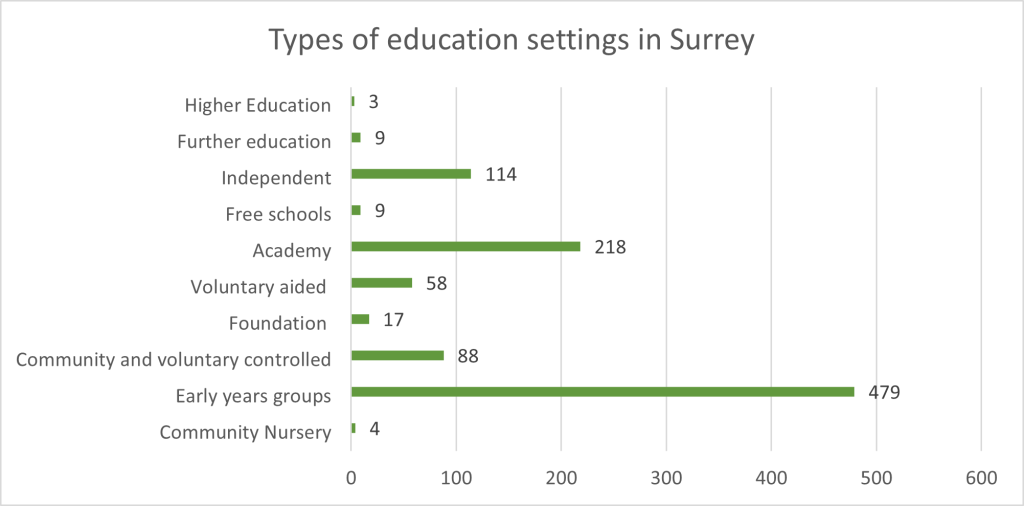
Figure 15: Education provision in Surrey
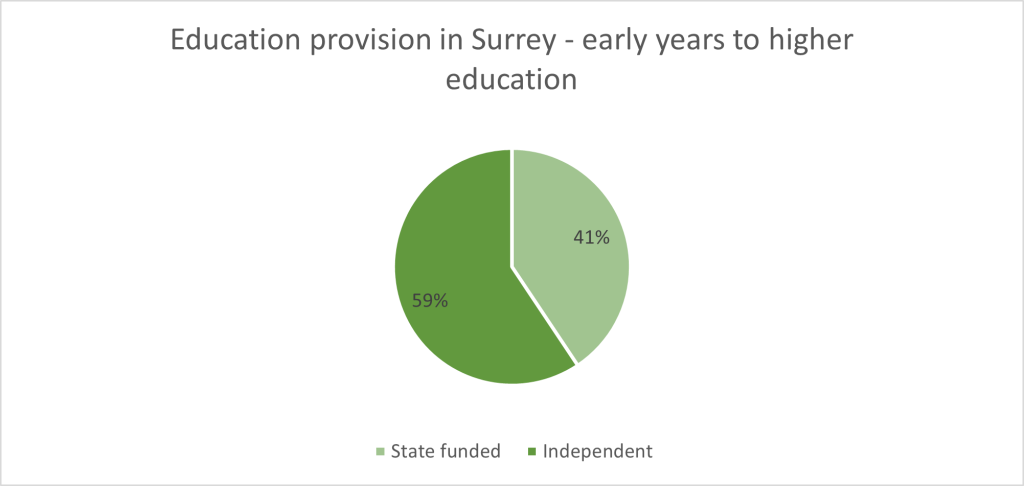
Number of early years providers who are registered with Ofsted in Surrey
There are currently a total of 1,586 Ofsted registered early years settings in Surrey. This is made up of 661 private voluntary and independent early years settings and 925 childminders.
There are also 47 maintained nursery schools and 56 nursery units in academy and independent schools.
Figure 16: Number of providers on the OFSTED Early Years Register
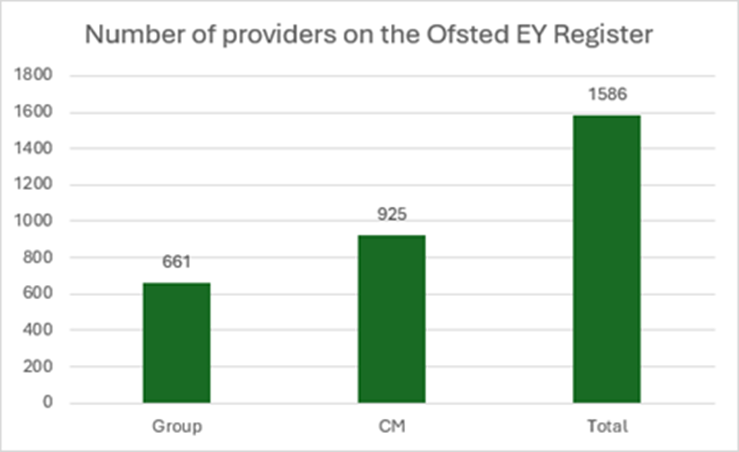
Groups are private, voluntary and independent settings (excluding maintained schools and academies) in Early Years and CM are childminders.
5.2 Identification of Service Children
“I’ve been to about six different schools, and we moved mainly during primary school”
Service child voice
We estimate that there are 1,692 service children and young people attending education settings in Surrey. These statistics are based on the Service Pupil Premium indicator, which is unlikely to include the children of Reservists. The collation of reliable data, particularly children of veterans from across the education sector, has been identified through the JSNA as an area for development.
Armed Forces children under 5 years
In April 2023, Surrey County Council’s Early Years Educational Effectiveness team began collecting data from early years settings across Surrey on a termly basis. However, this data collection relies on voluntary submissions from these early years’ settings, necessitating further efforts to encourage broader participation. Increased data submission is crucial to advancing our understanding of the unique needs of Service children and developing effective strategies to support them.
The tables below indicate that most Armed Forces children attend early years settings located in the North-west of Surrey, closely followed by South-west Surrey which aligns with the residential distribution of these families in proximity to military bases.
Figure 17: Armed Forces Children attending early years settings in Autumn 2023 in different localities
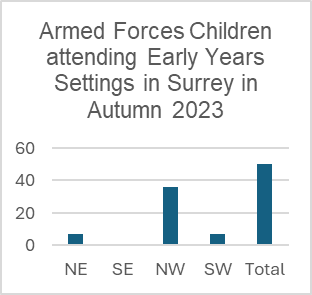
Out of the 661 early years settings that received the monitoring form, a total of 308 submitted their data, representing a response rate of 46%. In the Autumn of 2023, a total of 50 children from Armed Forces families were reported to be attending early years settings in Surrey. In the North West, (Surrey Heath, Runnymede and Woking) there were 36 children. In the South East (Mole Valley, Reigate and Banstead and Tandridge) there were no children. In the North East (Spelthorne, Epsom and Ewell and Elmbridge), there are 7 children. In the South West (Guildford and Waverley) there were 7 children.
Figure 18: Armed Forces Children attending early years settings in Spring 2024
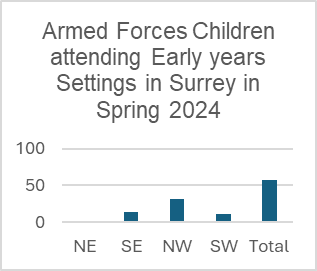
A total of 255 early years settings submitted their data, representing a response rate of 38.5%. In the Spring of 2024, 57 children from Armed Forces families were reported to be attending early years settings in Surrey. In the North West there were 31 children. In the South East there were 14 children. In the North East there are no children. In the South West there were 11 children.
Figure 19: Armed Forces Children attending early years settings in Summer 2024
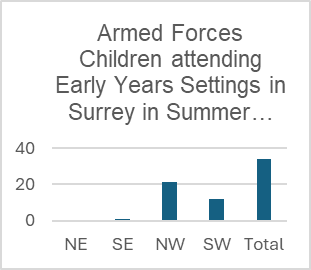
A total of 206 early years settings returned their data, accounting for a response rate of 31%. In the Summer of 2024, 34 children from Armed Forces families were reported to be attending early years settings in Surrey. In the North West there were 21 children. In the South East there were no children. In the North East there are no children. In the South West there were 12 children.
The data collected each term came from different early years settings, resulting in variations that made it challenging to accurately determine the actual number of children attending. The data was also dependent on parents disclosing to early years settings that they are currently serving in the Armed Forces. Addressing this inconsistency is an area identified for improvement.
Armed Forces Families Early Years and Childcare Survey in Surrey
In November 2021, Surrey County Council conducted a survey amongst Armed Forces families in Surrey to understand the types of early years and childcare services they were using and identify any barriers preventing access to these services. The survey ran from October 20th to November 7th, 2021, and was promoted by providers, the Early Years Bulletin, and Surrey County Council staff.
The survey received 66 responses, all from individuals who were either partners/spouses or currently serving in the Armed Forces. Of these respondents, 58 (87.9%) lived or were based in Surrey, and 57 (86.36%) had children under the age of five. Additionally, 37 respondents (56.1%) also had children over the age of five, while 29 (43.9%) did not.
When asked if they would like to access more childcare hours per week, over half (53%) of the respondents expressed interest. Since this report was published in November 2021 the government announced that they would be introducing several new measures to support working families to access early education and childcare. This included the expansion of early years funded entitlements from April 2024 onwards.
By September 2025, most working families with children under the age of 5 will be entitled to 30 hours of childcare support. For more information, please click on the link below
Expansion of Funded Early Education and Childcare – Surrey County Council.
Barriers to Accessing More Hours
When asked if they would like to access childcare or early education for their children, 87.5% indicated a desire for more access but highlighted several barriers, including:
- Cost and affordability
- Inadequate provision types
- Lack of flexibility for ad hoc hours
- Child’s age not meeting the requirements for funded early education
- Insufficient support for children with additional needs
- Lack of wraparound childcare
Due to the unique challenges Armed Forces families face, early education and childcare settings are vital in offering support and assistance. However, accessing childcare presents additional obstacles for these families as highlighted both nationally and in Surrey.
Continuity of Education
Continuity of Education Allowance (CEA) is offered by the MOD to assist with funding a place in a boarding school in order to help to provide continuity of education for a child, and to enable the spouse of a Service person to accompany them on assignments.
CEA is available for children aged eight years and over. If a child has Special Education Needs or Disability (SEND), this should not prevent their admission to a boarding school, and an allowance for SEND support may be available in some circumstances. The table below gives an indication of the numbers of some of the children in the independent sector, although Gordon’s School and the Royal Alexandra and Albert School are state boarding schools, so their figures have been included in the known figures.
Table 14: Continuity of Education Allowance (CEA) July 2024
| Schools in Surrey | CEA Pupils |
| Aldro School, Shackleford | [k] |
| Box Hill School, Mickleham | [k] |
| Cranleigh School, Cranleigh | 6 |
| Epsom College, Epsom | [k] |
| Frensham Heights School, Rowledge | [k] |
| Gordon’s School, Woking | 160 |
| King Edward’s School, Witley | [k] |
| More House School, Farnham | 13 |
| Priors Field School, Godalming | [k] |
| Reed’s School, Cobham | [k] |
| Royal Alexandra & Albert School, Reigate | 146 |
| St John’s Beaumont School, Englefield Green | [k] |
| Woldingham School, Woldingham | [k] |
| Woodcote House School, Windlesham | [k] |
| Grand Total | 338 |
Higher Education
In 2023, the UCAS (University & Colleges Admissions Service) application form was amended to include a question as to whether the young person is a Service child, which has enabled more reliable data to be collected. Within Surrey the data from the 2023 admissions cycle shows that at Royal Holloway, University of London in Egham, 161 (4.5%) students have been identified in their first year as being a Service child and 145 (<4%) students identified at the University of Surrey in Guildford. Of the Service students at the University of Surrey, 14 are from Surrey and 38 from Hampshire. UCAS also ask whether the applicant has previously served in the British Armed Forces. Data shows that 3 students who joined the University of Surrey in 2023 have previously served.
Data from the UCAS forms will continue to be collected on an annual basis to provide a more complete picture of the Armed Forces community within the county.
5.3 Admissions
“so it’s a lot of different skills you learn when moving. You’re never settled…….You can pack up any day. So it was never secure”
Service child voice
Due to the mobility of the Armed Forces and short notice postings, timely school admissions can be a challenge for Service families. Surrey County Council’s admissions policies and practices ensure that children from Armed Forces families are not disadvantaged in the application process. Armed Forces families who have a new posting can apply for a school place in Surrey four months ahead of when the place is needed (this is compared to four school weeks for civilian families). All in-year applications are processed within a maximum of 15 school days and infant/primary schools can admit a child from an Armed Forces family as an exception to the Infant Class Size legislation if that child is next in line for a place.
Some schools consider a child from an Armed Forces family under their exception social/medical criterion if that helps them to secure a place at a local school, but not all schools have this criterion in their admission arrangements. A small number of schools give priority to children who are eligible for the service premium.
If schools are full, the School Admissions team will actively work to secure a place at the nearest school with a vacancy.
The School Admissions team will seek to place Armed Forces siblings together where possible but recognise that this may not always be possible if some year groups are full. All community and voluntary controlled schools and most own admission authority schools give sibling priority.
5.4 Educational Attainment and Curriculum
“They’re supposed to be the kids that are falling behind and need extra support and all this, but not in the way that I’m in top sets for everything…………….. it’s hard to come to school and not bring home life to school.”
Service child voice
Due to the impact of Covid on the reliability of trend data, the education outcomes data contained within this report starts from 2023. Future data will take account of trends.
Early Years Foundation Stage Profile
The Early Years Foundation Stage Profile (EYFSP) is an annual statutory assessment of all funded children’s development and learning throughout the reception year and is collected during the summer term. Children are considered to have reached a Good Level of Development (GLD) if they achieve the expected level in the prime areas of learning which include: communication and language; personal, social, and emotional development; physical development, as well as specific aspects of mathematics and literacy.
Primary age pupil data
GLD (Good Level of Development) Data:
In 2023, the percentage of Service children accessing primary education in Surrey achieving GLD was 78.2, which is 5% higher than non-Service children. The percentage of Service children in Surrey in 2023 achieving GLD is 5% higher than Service children nationally and 10% higher than non-Service children nationally. However, the number of Armed Forces children is 55 compared to 12,067 non-service children in Surrey.
In 2024, the percentage of Service children in Surrey achieving GLD was 76.8 which is 2.8 % higher than non-Service children. The percentage of Service children in Surrey achieving GLD is 1.4% higher than Service children nationally and 7.8 % higher than non-Service children nationally. The number of Armed Forces children is 56 compared to 12,230 non-service children in Surrey.
Phonics national curriculum year 1
In 2023, the percentage of Service children in Surrey achieving the expected standard was 69.9% which is 12 % lower than non-Service children. Service children in Surrey in 2023 achieving the expected standard is 13% lower than Service children nationally and 10% lower than the achievement of non-Service children nationally. This is based on 69 service children and 12,628 non-service children.
In 2024, the percentage of Service children in Surrey achieving the expected standard was 83.3 % which is 0.5% lower than non-service children. Service children in Surrey achieving the expected standard is 0.5% lower than Service children nationally and 3.3% higher than the achievement of non-Service children nationally. This is based on 66 service children and 12,634 non-service children.
Key Stage 1 for 2023
Reading: The percentage of Service children in Surrey achieving the expected standard is in line with non-Service children achieving the expected standard. Service children in Surrey achieving the expected standard are achieving 1% higher than Service children nationally and 5% higher than non-Service children nationally.
Writing: The percentage of Service children in Surrey achieving the expected standard is 58.2 which is 6% lower than non-Service children achieving the expected standard. Service children in Surrey achieving the expected standard is 6 % lower than Service children nationally and 2 % lower than non-Service children nationally.
Maths: The percentage of Service children in Surrey achieving the expected standard is 74% which is in line with non-Service children in Surrey. Service children in Surrey achieving the expected standard is 1 % higher than Service children nationally and 4% higher than non-Service children nationally.
Reading, Writing and Maths combined: The percentage of Service children in Surrey achieving the expected standard is 56% which is 4% lower than non-Service children achieving the expected standard. Service children in Surrey achieving the expected standard is 2% lower than Service children nationally and in line with non-Service children nationally.
As of late 2023, Key Stage 1 SATs are no longer mandatory, so the Department For Education (DfE) no longer monitor the results of these.
Key Stage 2
The following analysis is for 2023, based on 94 service children and 13,206 non-service children.
Reading: The percentage of service children in Surrey achieving the expected standard is 66% which is 12% lower than non-Service children achieving the expected standard. The percentage of service children in Surrey achieving the expected standard is 10% lower than Service children nationally and 8% lower than non-Service children nationally.
Writing: Service children in Surrey achieving the expected standard is 10.7% lower than non-Service children in Surrey achieving the expected standard. Service children in Surrey achieving the expected standard is 10.2% lower than Service children nationally and 8.3% lower than non-service children nationally.
Maths:Service children in Surrey achieving the expected standard is 10% lower than non-Service children achieving the expected standard. Service children in Surrey achieving the expected standard is 6% lower than Service children nationally and 5% lower than non-Service children nationally.
Reading, Writing and Maths:Service children in Surrey achieving the expected standard is 11.8% lower than non-Service children achieving the expected standard. Service children in Surrey achieving the expected standard is 8.9% lower than Service children nationally and 6.9% lower than non-Service children nationally.
The following analysis is for 2024 based on 74 service children and 12,595 non-service children.
Reading: The percentage of service children in Surrey achieving the expected standard is 0.9 % higher than non-Service children achieving the expected standard. The percentage of service children in Surrey achieving the expected standard is 1.6% higher than Service children nationally and 6.9 % higher than non-Service children nationally.
Writing Teacher Assessment (TA): Service children in Surrey achieving the expected standard is 6.5 % lower than non-service children in Surrey achieving the expected standard.Service children in Surrey achieving the expected standard is 7.6% lower than Service children nationally and 4% lower than non-service children nationally.
Maths: Service children in Surrey achieving the expected standard is 3.4 % higher than non-Service children achieving the expected standard. Service children in Surrey achieving the expected standard is 3.4 % higher than Service children nationally and 8.1 % higher than non-Service children nationally.
Reading, Writing and Maths: Service children in Surrey achieving the expected standard is 3.1% lower than non-Service children achieving the expected standard. Service children in Surrey achieving the expected standard is 1.6 % lower than Service children nationally and 1.7 % higher than non-Service children nationally.
Table 15: Comparison of data between 2023 and 2024 for service children
As reflected in the table below, in 2024, results for Service in Surrey GLD dropped by 1.4%, whereas phonics screening rose by 13.7%
In 2024, in key stage 2, Reading rose by 15%, Writing by 4.8%, Maths by 14.1 and combined scores by 10%.
NB. sample sizes between Surrey County Council and national are significant.
| Surrey | Surrey data 2023 | Surrey data 2024 | National data 2023 | National data 2024 |
| GLD | 78.2 | 76.8 | 73.5 | 75.4 |
| Phonics | 69.6 | 83.3 | 83 | 83.8 |
| KS2 Reading | 66 | 81.1 | 76.1 | 79.5 |
| Writing | 62.8 | 67.6 | 73.5 | 75.2 |
| Maths | 67 | 81.1 | 73.2 | 76.0 |
| RWM | 52.2 | 62.2 | 61.0 | 63.8 |
Key Stage 4 (KS4) Data for Service Children in Surrey
The following analysis is for 2023, based on 119 service children and 11,574 non-service children.
In 2023, Surrey KS4 Service children achieved an Attainment 8 level of 52.4%, which is 1.6 percentage points higher than Surrey non-Service children, and 5.1 percentage points higher than the 2023 National Centre for Education Research (NCER) National Service child figure of 47.3%. Attainment 8 measures GCSE achievement across 8 qualifications including English and Maths.
In 2023, Surrey KS4 Service children achieved 55.5% for English and Maths level 9-5 which is 1.5 percentage points higher than Surrey non-Service children who achieved 54% and 9.5 percentage points higher than the 2023 NCER National Service children figure.
In 2023, Surrey KS4 Service children achieved an average EBacc point score of 4.72 which is 0.22 percentage points higher than Surrey non-Service children and 0.6 percentage points higher than the 2023 NCER National Service Children figure (pupil’s average point score is an average of the points scored in the 5 EBacc subject areas).
Surrey KS4 Service children achieved an average progress 8 score of +0.16 which is 0.02 lower than Surrey non-Service children +0.18, but higher than the NCER National Service child figure of 0.01 (Average Progress 8 score captures progress from end of Primary to end of Secondary).
2024 data for Key Stage 4 was not available at time of writing.
Trend data for Key Stage 2 and Key Stage 4 will continue to be collated and monitored year on year by the Pupils of Military Personnel Steering Group.
Service children in Surrey are acknowledged as disadvantaged pupils in recognition of the multiple factors they face, such as multiple school moves, changes in curriculum and associated gaps in learning that can have an impact on their educational attainment.
Surrey is committed as an education partnership to raise outcomes so that disadvantaged pupils’ achievement is as good as, or better, than national data suggests and to ensure that the curriculum fully prepares disadvantaged pupils for their next stage in education.
To deliver this commitment, the partnership will continue to ensure that all our professional learning programmes for school leaders and staff have educational equity at the heart of delivery, with Quality First Teaching for all, as a golden thread.
Most recently, Surrey Secondary School Leaders have taken part in Equity in Education action groups.
The Primary English Leader Conference in September 2023 focused on the disadvantaged gap, and the Voice 21 Priority Project is aimed at improving the oracy of our youngest pupils and provide the foundations for learning through language development.
The council continues to focus on reading to ensure that all schools focus on reading, and that direct, focused phonics is taught every day in the Early Years Foundation Stage and Key Stage one. Furthermore, that primary pupils read from books with the sounds they know, while they are learning to read, and that teachers and teaching assistants provide extra practice throughout the day for the children who make the slowest progress.
5.5 Child wellbeing
“So it was like growing up without your dad, like going to school and having to explain like that your dad’s not home, but like not being able to go out because you’re looking after siblings because your dad’s away.”
“I’ve definitely thought about going into mental health after everything I’ve been through, supporting like the families and stuff of service children or the service families.”
Voices of Service children
Due to their parents’ involvement in the Armed Forces, Surrey recognises that Service children face numerous challenges that significantly impact their lives. Research indicates that the duration of parental deployment is negatively correlated with children’s attachment, academic performance, and overall mental health and wellbeing. Moreover, non-deployment factors such as mobility also affect Service children. Frequent relocations, often unplanned and at short notice, can disrupt educational continuity, hinder the development of stable friendships, and make securing nursery placements more difficult.
Additionally, extended periods of parental separation and the frequent transition between two-parent and one-parent households introduce unique stressors for both the children and their families. The UK Armed Forces Families Strategy highlights that the difficulties associated with deployment are not limited to long overseas missions; even ’lower profile deployments’, which may involve less apparent physical danger, can have equally disruptive effects on family life. Furthermore, ’non-operational separation’, such as weekly commuting, can place significant strain on family relationships. More research needs to be carried out to be able to support armed forces families and their children aged 0-5 years to enable support to be put in place to meet their unique needs.
In Surrey, we actively promote our Surrey Healthy Schools whole system approach to wellbeing, health, inclusion and achievement. Schools in Surrey have free access to the Surrey Healthy Schools Self-Evaluation Tool. This provides school leaders with reflective evidence-based questions to assist them in identifying strengths and areas for development. It also assists services and partners in communicating their support, information, training and resources.
The Surrey Healthy Schools standards encourage leaders to consider vulnerable and disadvantaged groups. The council recognises that some Service children and children of veterans are identified as Young Carers.
5.6 Safeguarding
“And then adjusting when dad gets time off him coming home for a week, it’s really strange……Like we argue like anything because we’re not used to living together……. So it’s hard, but in a different kind of way to us.”
Service child voice
Our vision in Surrey is that every family and their child will be safe, healthy, creative, and have the personal confidence, skills and opportunities to contribute and achieve more than thought possible.
Surrey County Council is responsible for delivering frontline social care services and support for children and families, particularly the services that aim to support children and young people to be safe in their family. This includes Early Help, children in need, and children subject to child protection plans and children in care.
The council and partners are implementing the Family Safeguarding model which integrates support from different professional specialisms, to ensure children and their family have the right support at the right time.
It is essential that everyone working within the education sector understands their safeguarding responsibilities as articulated in statutory guidance. The council and partners provide regular resources, training and events for education professionals to update their skills and knowledge to ensure that children and families, including those from Service families, access the right support at the right time.
5.7 Transport
“But then it’s also really like, struggled, like settling down and like having like the stability around you and trusting the fact that you are staying where you are.”
Service child voice
Being a Service Child does not automatically entitle a child/young person to Travel Assistance.
If a child or young person is entitled to travel assistance, the most cost-effective form of assistance will be provided (appropriate to the needs of the child/young person), Statutory Guidance (Home-to-school travel – GOV.UK) explains, that as a general guide, the maximum journey time for a child of primary school age should be 45 minutes each way, and 75 minutes each way for a child of secondary school age.
Surrey County Council adheres to these guidelines where possible and acknowledges that they may be exceeded in certain situations (where traffic is particularly heavy over longer distances, or the school is out of borough for example).
Certain measures are taken to ensure timings are reasonable and enable children/young people to arrive at school ready to learn:
- If no public transport is available and contracted transport has been agreed (taxi/minibus/coach), another entitled child may not be added to the route if it is already very close to 45/75 minutes, a new route may be set up to mitigate against any child having an unreasonably long journey
- If public transport is available, the authority would generally only assign a bus/train pass if the journey time fell within the 45/75 minutes (including time taken to walk to and from public transport points, up to 1 mile). Where possible, public transport options should include no more than 1 change of bus/train
When considering applications/appeals for travel assistance for Service Children, the council’s Travel & Assessment Team consult the Armed Forces Covenant, which explains to use its discretion to provide travel assistance.
If a child is no longer entitled to assistance due to an unforeseen house move, for example, this may be considered as an exceptional circumstance. Equally, if a child is required to move schools outside of the normal admissions round due to an unforeseen move, this would be considered under extended circumstances. Holistic family circumstances are always taken into consideration when considering applications/appeals for Service Children, this encompasses factors such as siblings attending different schools, only one parent available to facilitate journeys, if any of the children have additional needs etc.
5.8 Attendance
“The best thing about coming to school is that I get to see all my friends and get to see them even though I might not see them outside of school.”
Service child voice
Due to the unique obligation and sacrifice of separation, Service families might be unable to take holidays, or spend time together, during normal school holiday periods, and may request the school’s permission to take a holiday during term-time.
The decision on whether to authorise term-time holidays for Service children is determined by the Headteacher of the school. While the educational needs of the Service child will always be a critical factor in determining whether term-time absence should be granted, the wider family impacts on Service children should be considered too.
The council acknowledges that it can be difficult for serving parents to obtain permission to take their child out of school during term-time if the school’s attendance policy and decision-making fails to take account of the nature of Service life.
It is for Service families to apply to the school in advance, presenting evidence of how operational needs of the Armed Forces have legitimately prevented a Service family from taking holiday during normal school holiday periods.
Headteachers in Surrey seek advice on applications for school absence from Unit Commanding Officers and their Welfare staff, who provide advice, verification and endorsement as required. The MOD has produced Guidance that provides advice to headteachers regarding school term-time absence for Service children. It includes contact details that can be used if head teachers are unsure how to make contact with the relevant Armed Forces unit. OFSTED categorise such term-time absences as ‘authorised absences’.
5.9 Additional Needs
“They set up an extra like an extension on the school and it’s obviously drastic, a massive thing to be done. But we could go there for like support and you could go there at any point and all the teachers there were like ones like that you were familiar with”.
Service child voice
The SEND Code of Practice provides statutory guidance for organisations which work with, and support, children and young people with special educational needs or disabilities.
Initially, it should be emphasised, that in Surrey we fully endorse that all teachers are teachers of special educational needs.
Any young person with additional needs in a school setting should be identified by the school. The school must make arrangements for that young person to receive the necessary interventions under SEND support arrangements using an ‘assess, plan, do, review’ model.
A particular difficulty for children of service personnel is that this process may be interrupted by multiple transitions between schools. Whilst records between schools are transferred the assess, plan, do, review cycle can start again at each new school with the resulting impact leading to further delay in learning or accessing the curriculum.
Should a young person not make appropriate progress, then the school, or family, are able to make a referral for an Education Health Care Needs Assessment, which is a 20-week statutory process. Once an EHC Plan is issued, this moves with the pupil, across borders, so that when a young person moves school the receiving local authority will re-issue the EHCP to ensure that the special education provision continues.
The SEND Code of Practice is clear that there are additional actions to take in respect of children of service personnel with special educational needs. The council has committed to measuring their own impact in this regard as part of our collective work for children of service families. We have established a Steering Group to discuss and promote outstanding practice to our schools and teams and to demonstrate our commitment to the Armed Forces Covenant.
For service families Surrey and Borders Partnership (SABP) Emotional Wellbeing and Mental Health (EWMH) Services commit to continuing any EWMH treatment (that has been agreed) and that children and young people are receiving in the authority/area they are moving from. They therefore seek to not disadvantage families (e.g. by honouring where they were previously in another area – now likely to be supported via the new transfer of care process if NHS to NHS). SABP may choose to complete an updated assessment of need prior to continuing treatment to ensure that what they had been receiving met their needs, and then, to continue on with the care if the Young Person/Family and Clinician are in agreement.
5.10 Use of Service Pupil Premium funding
“It was definitely really hard, like because I didn’t quite understand what was going on at the time.”
Service child voice
The DfE introduced the Service Pupil Premium (SPP) for eligible schools in England in April 2011 in recognition of the specific challenges children from Service families face, and as part of the commitment to delivering the armed forces covenant. Service children in independent schools or MOD schools are not eligible to receive Service Pupil Premium.
Eligible state schools, academies and free schools receive the SPP for service children from reception to year 11 so that they can offer mainly pastoral and emotional support during challenging times and to help mitigate the negative impact on Service children of family mobility or parental deployment. The current amount is £340 per eligible service child. Under the DfE’s ‘ever 6 measure’ (which looks at pupils who were eligible in the past 6 years), schools will continue to receive SPP for up to six years for children whose parent(s) left the armed forces, provided the children were recorded as Service children in a school census (prior to their parent[s] leaving the forces). The ever 6 measure also applies when Service parents’ divorce or separate, or when a Service parent dies in service.
Schools have flexibility over how they use the Service Pupil Premium, but it should not be used for additional tuition. Some examples of good practice include:
- Provision of counselling or nurture groups
- Introducing ‘Skype time’ clubs or developing scrapbooks and diaries on their achievements
- Paying for additional staff hours to support Service children or act as liaison with service parents
- Providing extra-curricular activities or school trips to raise awareness of the armed forces
Employment
6.1 Serving Personnel
Reservists give up their spare time to serve in the Reserve Forces, balancing their civilian life with a military career to ensure that, should their country require them, they would be ready to serve as part of the military. They make up approximately one sixth of our Armed Forces personnel and are integral to protecting the nation’s security at home and overseas, particularly providing capability in specialist areas such as medical and cyber.
In addition to the hundreds of Reserves based in Surrey, there will be many more who serve with units in the surrounding area, especially London, or with national Reserve units across the country. Reserve service brings a huge benefit to employers in wider leadership skills and professional development. In most instances, an employer’s relationship with a Reservist member of staff should be like that of any other employee. However, there are areas where a Reservist’s status may affect the operations of the organisation.
Legislation exists to define the rights and liabilities that apply to both parties:
- The Reserve Forces Act 1996 (RFA 96) which provides the powers under which Reservists can be mobilised for full-time service
- The Reserve Forces (Safeguard of Employment) Act 1985 (SOE 85) provides protection of employment for those liable to be mobilised and reinstatement for those returning from mobilised service
Mobilisation is the process of calling Reservists into full time service with the Regular Forces to support military operations. The maximum period of mobilisation will depend on the scale and the nature of the operation but is typically no longer than 12-months. Mobilisation may cause significant upheaval to the serviceperson and their family, and it is important that employers have a policy in place to manage pay, leave, pensions and other benefits while the service person is deployed, and manage their reintegration back into the business when they return.
6.2 Veterans
The MOD provides comprehensive resettlement support services for personnel leaving the Armed Forces, as they transition from their military career into employment, further education or retirement and for up to two years after leaving in the form of employment support. Such comprehensive support is dependent on their length of service. The Career Transition Partnership is the official resettlement service for the Armed Forces and brings together expert personal support, employers and training providers to help those who serve resettle into civilian life. Early Service Leavers (ESLs) are Service Personnel who leave before completing four years of service. Service Personnel that are compulsorily discharged regardless of their length of service lose any entitlement to resettlement support they may have accrued and also become ESLs. ESLs can face a challenging transition to civilian life, therefore, the services see it as important that they use the support that is available to them.
The 2021 Census found that the majority of veterans are economically inactive, both nationally (58% of veterans) and locally within Surrey (62%). These are much higher proportions than the “never served” population (38% and 36% respectively), reflecting the tendency of the veterans’ group to be older than the general population against which they are compared. Analysis by the Office of National Statistics (ONS) suggests that similar proportions of veterans and non-veterans were economically active (42.4% compared with 41.6%) and economically inactive (57.6% compared with 58.4%) following adjustments to account for differences in age, sex and region; veterans and non-veterans in each economically inactive sub-category were very similar.
Restricting our view to the economically active, veterans are more likely to be employed than those who have never served. Nationally, for every 1 unemployed veteran there are 25 in employment; amongst those who have never served there are 16 in employment for every 1 unemployed. The Surrey position for veterans is a ratio of 27 in employment for every 1 unemployed, again better than the local position for non-veterans (21:1).
The Census identified 449 unemployed veterans: 280 former Regular forces; 154 former Reserve forces; and 15 who had formerly served in Regular and Reserve forces. At a headline view, therefore, veterans locally seem to fare very well at securing employment, though of course the nature of that employment, and whether it is sufficiently rewarding, will also matter but cannot be derived from this dataset.
A report by Deloitte identified that organisations employing members of the Armed Forces community are positive about the value they bring, often in critical areas like strategic management, motivating staff, and team working. However, their analysis also identified challenges in securing appropriate civilian employment, with factors associated with poor outcomes including medical discharge, race, being female or being in the services for a long period of time. The study found, for example, that veterans who indicated they had a mental health disability were more likely to be unemployed, and female veterans were far more likely to describe their experience of finding the right job as ‘very difficult’ compared to their male counterparts. They were also more likely to find that their earning potential in the civilian job market was lower than expected (Veterans work | Deloitte UK).
The final dataset currently available describes the main occupation of each employed veteran according to the following groupings in the table below.
These categories represent a directional hierarchy of occupations in a broadly accepted view of generally “better” to “worse” job types, with an implication/assumption that income-levels and job satisfaction will generally decrease as one traverses down the list. That is of course a questionable concept.
Across Surrey, for the 12,029 veterans in employment, the proportion of veterans in each occupation type broadly matches that of the wider non-veteran population. Indeed, a greater proportion of veterans are to be found in the first three categories (63% of Surrey veterans compared to 58% of those who have never served). While there are differences in the relative proportions in individual occupation categories, there is no stark indication of additional disadvantage to veterans in job type.
Figure 20: the proportion of Surrey resident veterans and non-veterans in different occupations
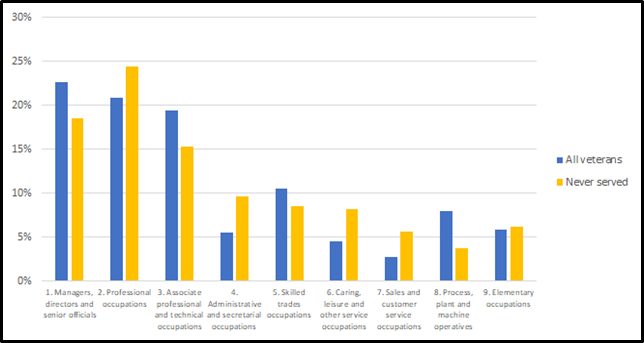
6.3 Families
According to national data, 19% of spouses/partners are in part-time employment, and 16% are unemployed (UK Armed Forces Families Strategy 2022 to 2032 – GOV.UK (www.gov.uk), accessed 22 April 2024). Responses to the latest Families Continuous Attitude Survey showed that about three in eight spouses looked for a job in the past year. Of the 38% of spouses who looked for a job, about five-eighths (63%) experienced difficulties finding suitable employment. Of those who looked for a job, Army Other Rank spouses (who make up by far the largest proportion of spouses in Surrey) were more likely to experience difficulties (70%) than those in the other Services (Tri- service families continuous attitude survey: 2023 – GOV.UK (www.gov.uk), accessed 27 June 2024).
Many of the reasons that family members of serving personnel may struggle to secure employment relate to factors associated with the demands of the service, including the time their partner spends away from home and frequent house moves resulting in gaps in their CVs, multiple short-term employment history, as well as a lack of flexible employment.
Table 16: the top reasons cited by those who reported experiencing difficulties in securing employment
| Percentage | Reason for difficulty in securing employment |
| 53% | Having a spouse who is often away |
| 50% | Partner unable to assist with care responsibilities |
| 48% | Extended family live too far away to assist with childcare |
These issues are reflective of the situation in Surrey. A common theme from the focus groups held in October 2024 with Service spouses/partners in Surrey was that many worked from home, and this type of employment remained largely unaffected by moving location regularly. However, those not in work-from-home roles faced challenges – quotes from participants included:
- “Difficult to adapt to new environment and sometimes distance too far – I think about quitting and getting a work-from-home job.”
- “Had to take a less well-paid job for two years because of a move before finding something better paid.”
- “It’s obviously quite nerve wracking. Find out or you know if we’re going to move. And I’ve got to start applying for roles and stuff and it’s difficult sometimes whereby dates change or you know you’re supposed to move by ’x’ date and then actually it’s brought forward or back and that can be quite challenging to navigate.
- “Being part of a military family can lead to specific employment challenges like Changing Roles, Preventing Career Progression. […] Frequent relocations often require individuals to switch jobs, which can mean taking on different roles that may not align with their career aspirations or expertise.”
6.4 The Defence Employer Recognition Scheme
The Defence Employer Recognition Scheme (ERS) encourages employers to support defence and inspire other organisations to do the same. The scheme encompasses Bronze, Silver and Gold awards for employer organisations that pledge, demonstrate or advocate support to defence and the armed forces community, and align their values with the Armed Forces Covenant. Both private sector and public sector organisations such as the emergency services, local authorities, NHS trusts and executive agencies are eligible to be recognised.
Employers put themselves forward for the ERS based on being armed forces-friendly and open to employing Reservists, armed forces veterans (including the wounded, injured and sick), cadet instructors and military spouses/partners. Some sectors offer their own support schemes for the Armed Forces community, for example NHS Employer’s Step Into Health programme.
Table 17: local system participation in the Defence ERS (October 2024)
| Organisation | ERS Status |
| NHS Integrated Care Boards | – |
| Frimley Integrated Care Board | None |
| Surrey Heartlands Integrated Care Board | Silver |
| NHS Trusts and Foundation Trusts | – |
| Ashford & St Peter’s | Gold |
| Frimley Health | Gold |
| Royal Surrey | Gold |
| South East Coast Ambulance Service | Silver |
| Surrey & Sussex Health | Silver |
| Surrey & Borders Partnership | Gold |
| Community Providers | – |
| CSH Surrey | Silver |
| First Community | None |
| Berkshire Healthcare NHS Foundation Trust (Frimley Community Healthcare provider) | Gold |
| Local Authorities | – |
| Surrey County Council | Gold |
| Epsom & Ewell | None |
| Elmbridge | None |
| Guildford | Silver |
| Mole Valley | Silver |
| Reigate & Banstead | Bronze |
| Runnymede | Gold |
| Spelthorne | Gold |
| Surrey Heath | Bronze |
| Tandridge | Bronze |
| Waverley | Bronze |
| Woking | Gold |
| Police | – |
| Office of the Police and Crime Commissioner | Silver |
| Surrey Police | Silver |
| SECAmB | Silver |
6.5 Op PROSPER
In 2024, the Government launched a new dedicated employment support service for members of the Armed Forces community. Op PROSPER is a wraparound employment service to support veterans and their families into work after they leave the Armed Forces. The scheme will support veterans in securing high paid jobs, where they can hone the skills that they developed in the military in key sectors that are helping to boost the economy.
While it is not yet clear exactly how Op PROSPER will support veterans, we need to build on the support already available and improve awareness of the skills and talents of veterans among industry and employers, to encourage businesses to hire veterans.
Enhanced Learning Credits
The MOD promotes lifelong learning among members of the Armed Forces and the veterans community by providing Learning Credits through the Enhanced Learning Credits scheme (ELC) and Further Education and Higher Education (FEHE) scheme.
The schemes entitle eligible service personnel and service leavers to receive financial assistance towards their learning.
Access to the ELC scheme and FEHE scheme has been extended to 10 years for veterans who left the Armed Forces between 1 April 2011 and 31 March 2016 (both dates inclusive). Veterans medically discharged on or after the 1 April 2011 and who receive a disablement pension under the War Pension Scheme, or a guaranteed income payment under the Armed Forces Compensation scheme, will have access to the ELC scheme and FEHE scheme for 10 years after discharge. Veterans who left the Armed Forces on or after the 1 April 2016 will still have access to the ELC and FEHE scheme for 5 years after discharge.
To claim, course providers need to be ELC accredited. It is possible to search for Surrey providers via the following link ELCAS – Enhanced Learning Credits Administration Services. If a provider is not registered, they must apply via the following link and meet all the criteria to gain approval. The application process can take up to four months (but providers should hear back initially within 4 weeks) and claims would not be able to be submitted until the application has been approved Provider Registration (enhancedlearningcredits.com).
Benefits
To ensure all serving personnel are receiving correct civilian benefits, the Department for Work & Pensions (DWP) offers to run clinics on military bases. This is done on the request of the local welfare team and can help with areas like housing benefits (the DWP has responsibility for any housing payments under Universal Credit), employment for military families and resettlement.
The DWP has a network of Armed Forces Champions who look at all aspects of the Armed Forces Community. Whilst the largest proportion of their work is with the veteran community, they are also there for families, spouses and serving personnel with access to Universal Credit. Any referrals for a veteran who needs assistance should be sent to the DWP South East Armed Forces Champion:
Other services for the Armed Forces community
7.1 Forces Connect App and Website
Forces Connect is a free tool for members of the Armed Forces community to use to identify organisations that can support them, or for support organisations working with members of the Armed Forces community. The app and website link users to local and national organisations offering immediate help and support across a wider range of services from crisis support to searching for an NHS dentist, starting a business to advice on housing. Forces Connect App is available to download for free on apple and android phones, as well as available via www.forcesconnect.co.uk. Agencies and charities across Surrey are encouraged to download the app or access the website to help ensure that members of the Armed Forces community they are working with can access timely support.
7.2 Military Charities
Table 18: Main Military Charities operating in Surrey (this list is not exhaustive)
| Charity | Scope |
| SSAFA | Disability support, mental wellbeing, physical and emotional support for serving personnel and veterans, transitioning from military and social care support |
| The Royal British Legion | Care and independent living, physical and mental wellbeing, financial and employment support, local community connections |
| Help for Heroes | Mental health and wellbeing, social and financial support, physical health, and life skills |
| Army Benevolent Fund | Award grants to individuals and families to support independent living, elderly care, training and education, mental wellbeing and housing |
| Royal Air Force Benevolent Fund | Provide lifelong support to serving and ex-serving RAF personnel and their families. From mobility aids and confidential counselling to financial grants, they offer a range of support tailored to the individual’s needs |
| Royal Navy and Royal Marines Charity | Provide support using funded pathways: Through Life; Fit for Life; Quality of Life; and End of Life |
| Combat Stress | Mental health support in-person, online and via phone |
| Defence Medical Welfare Services | Support when receiving medical treatment |
| Blind Veterans UK | Rehabilitation and social support |
| Blesma | Limbless support through prosthetics, grants and mobility aids |
Surrey is fortunate to have a range of local charities and community groups which support the Armed Forces community. For more information about local groups and veterans’ hubs see Armed forces – Surrey County Council (surreycc.gov.uk) or www.forcesconnect.co.uk
Military charities provide a range of support, including financial support, to the Armed Forces community. Nationally, for example, the Army Benevolent Fund paid £9M in 2023-24 to support 70,000 members of the Army family, which included 65 cases with a value of £45,000 in Surrey (Email, Surrey Grant Figures FY23/24, dated 9 May 2024). SSAFA also provides local caseworkers who provided £106,000 of assistance to Surrey residents in 2023-24. Military charities will often work together to ensure individuals receive the best possible care and support. The table below provides an example of the breakdown of grants provided by the Royal British Legion in Surrey between May 2023 and May 2024, showing the breadth of financial support that military charities can provide (Email, Demographics of Veterans, RBL, dated 18 May 2024).
Table 19: Support provided by The Royal British Legion in Surrey between May 2023 and May 2024
| Category | Volume | % |
| Annuity | 9 | 3.80% |
| Brown Goods | 38 | 16.03% |
| Crisis | 42 | 17.72% |
| Debt | 15 | 6.33% |
| Employment | 4 | 1.69% |
| Energy | 64 | 27.00% |
| Funeral | 5 | 2.11% |
| Housing | 10 | 4.22% |
| Medical | 4 | 1.69% |
| Misc | 18 | 7.59% |
| Mobility | 13 | 5.49% |
| White Goods | 15 | 6.33% |
| Total | 237 | 100% |
Generally, military charities provide a range of support, both related and not related to an individual’s service and often related to the need for equipment at home for older adults that may not be funded by local authorities. Anecdotally, charities report fewer inquiries since Covid, but tending to be more complex, including issues around school allocations and special educational needs, mental health, family break up, and contact with the criminal justice system.
Links to other JSNA Chapters
This JSNA chapter links to the following other chapters of Surrey’s JSNA:
The Surrey Context: People and Place | Surrey-i (surreyi.gov.uk)
JSNA Housing and Related Support | Surrey-i (surreyi.gov.uk)
Emotional and Mental Wellbeing in Surrey Adults | Surrey-i (surreyi.gov.uk)
JSNA Loneliness and Social Isolation | Surrey-i (surreyi.gov.uk)
Glossary of terminology and acronyms
| Term | Definition |
| Armed Forces community | Armed Forces community, collectively defined in the Act as ‘Service people’ includes: (a) Members of the Regular forces and the Reserve forces; (b) members of British overseas territory forces who are subject to Service law; (c) former members of any of Her Majesty’s Forces who are ordinarily resident in the UK; and, (d) relevant family members [of those in (a) to (c) above] (see Statutory Guidance). Although not covered by all of the same obligations under the Covenant and Armed Forces Act, members of the Cadet Forces (including adult volunteers) are considered to be members of the extended Armed Forces community, and covered by some aspects of this policy relating to leave. |
| Armed Forces Covenant | A promise by the nation ensuring that those who serve or who have served in the UK Armed Forces, and their families, are treated fairly. |
| Cadet Force Adult Volunteer (CFAV) | These are adult instructors or cadet officers who volunteer with cadet organisations affiliated to the Armed Forces (i.e., Army Cadet Force, Air Cadets, Combined Cadet Force and Sea Cadets etc). They plan and deliver the training to the Cadets. |
| Defence Employer Recognition Scheme (ERS) | The Employer Recognition Scheme recognises organisations who pledge, demonstrate, and advocate their support for the Armed Forces Community. There are Three Tiers of awareness – Bronze, Silver and Gold. For employers who advocate support to the Armed Forces Community in alignment with the Armed Forces Covenant. |
| Demobilisation | Once a Reservist’s deployment or task finishes, they are demobilised at a nominated mobilisation centre. The Reservist undergoes checks and briefings including medical, welfare and a period of post operation leave will follow. This will usually take place before the Reservist comes back into the workplace. |
| Ex-Service Personnel and or Veterans | All Ex-Service Personnel are Veterans, and these are individuals who have served as a member of the Regular Services, Voluntary Reserve and National Service. This could include an individual who has served one day or more in the UK Armed Forces. It is good to note that not all ex-service personnel will define themselves as a Veteran and prefer to be known as Ex Service Personnel. |
| Merchant Navy | The definition for a member of the Merchant Navy to come under the Armed Forces Covenant has been agreed nationally as ‘Anyone who has served on a commercial vessel at a time when it was operated to facilitate legally defined UK military operations by HM Armed Forces’ and these personnel be called “UK Merchant Seafaring Veterans”. |
| Mobilisation | Mobilisation is the process of calling Reservists into full time service with the Regular forces, to make them available for military operations. The maximum period of mobilisation will depend on the scale and the nature of the operation and is typically no longer than 12 months. (The MOD aims to give at least 28 days’ notice of the date that the Reservist will be required to report for Mobilisation, although there is no statutory requirement for a warning period prior to mobilisation). There are two types of mobilisation: voluntary and compulsory. Voluntary mobilisation involves a reservist volunteering to support the Regular Forces. An individual may volunteer for mobilisation if he or she wants an opportunity to put their training to practical use, and to experience the challenges of deployment. The employer’s consent is required before voluntary mobilisation can take place. The ICB is not obliged to consent if it would inconvenience the delivery of services. Compulsory mobilisation takes place only in circumstances where individuals or units with the required skills are not available in the Regular Forces. This is significantly less common than voluntary mobilisation: previous examples include operations in Iraq and the wider Gulf region in 2003 and in Afghanistan in 2001. Compulsory mobilisation will be accompanied by a letter for the employer included in the Reservist’s mobilisation papers. This letter will set out the date and possible duration of mobilisation, the employer’s rights and obligations – including the entitlement to apply for an exemption from mobilisation under certain circumstances where applicable. |
| National Service | Those who were called up for National Service are covered by the Armed Forces Covenant. However, an announcement was made in 1957 to abolish the National Service. The last entrants into the Service were in November 1960, with formal call-ups ending from 31st December 1960. The last Serviceperson completing National Service left the Armed forces in May 1963. |
| Regular Forces | Regular Service Personnel serving within the Regular Forces, whether that by the Army, Royal Navy, and Royal Air Force, are on a permanent full-time legally binding contract. |
| Reservist(s) | The term Reservist can be broken down into two main subcategories, Volunteer and Regular Reservists. Volunteer Reservists are civilians recruited into either the Royal Naval Reserves, Royal Marines Reserves, Army Reserves and Royal Auxiliary Air Force. Regular Reservists are ex Regular service people who may retain a liability to be mobilised depending on how long they have served in the Armed Forces. |
| Acronym | Meaning |
| 4PWRR | 4 Princess of Wales’s Royal Regiment |
| ACF | Army Cadet Force |
| AFCS | Armed Forces Compensation Scheme |
| ATC | Royal Air Force Cadets |
| ATC (Pirbright) | Army Training Centre (Pirbright) |
| CCF | Combined Cadet Force |
| CEA | Continuity of Education Allowance |
| Cobseo | Confederation of Service Charities |
| CTS | Council Tax Support |
| DHP | Discretionary Housing Payments |
| DfE | Department for Education |
| DFG | Disabled Facilities Grant |
| DMS | Defence Medical Services |
| DTS | Defence Transition Services |
| DWP | Department for Work and Pensions |
| EHCP | Education Health Care Plan |
| ELC | Enhanced Learning Credits |
| ERS | Employer Recognition Scheme |
| ESL | Early Service Leavers |
| EWMH | Emotional Wellbeing and Mental Health |
| EYFSP | Early Years Foundation Stage Profile |
| FEHE | Further Education and Higher Education |
| GIP | Guaranteed Income Payment |
| GLD | Good Level of Development |
| GP | General Practitioner |
| HB | Housing Benefit |
| HM | His Majesty |
| ICB | Integrated Care Board |
| JSNA | Joint Strategic Needs Assessment |
| MI | Management Information |
| MOD | Ministry of Defence |
| NHS | National Health Service |
| ONS | Office of National Statistics |
| RAF | Royal Air Force |
| RCGP | Royal College of General Practitioners |
| RFA | Reserve Forces Act |
| RMAS | Royal Military Academy Sandhurst |
| SABP | Surrey and Borders Partnership |
| SCC | Sea Cadet Corps |
| SCMPB | Surrey Civilian Military Partnership Board |
| SEND | Special Education Needs or Disability |
| SERFCA | South East Reserve Forces’ and Cadets’ Association |
| SFA | Service Families Accommodation |
| SLA | Single Living Accommodation |
| SNOMED | Systemized Nomenclature of Medicine |
| SOE | Safeguard of Employment |
| SPP | Service Pupil Premium |
| SSAFA | Soldiers’, Sailors’ and Airmen’s Families Association |
| SSFA | Substitute Service Families Accommodation |
| SSLA | Substitute Single Living Accommodation |
| SSSA | Single Service Substitute Accommodation |
| UCAS | Universities and Colleges Admissions Service |
| VCHA | Veterans’ Covenant Healthcare Alliance |
| VFF | Veteran Friendly Framework |
| VWS | Veterans Welfare Service |
| WIS | Wounded, Injured and Sick |
| WPS | War Pension Scheme |
Stakeholders
The following stakeholders have been engaged in writing this chapter.
Members of the Chapter Delivery Group:
| Name | Organisation |
| Andrea Newman | Armed Forces Sponsor, Surrey County Council |
| Tony Shipley | Surrey Heartlands ICB |
| James Palmer | Surrey Heartlands ICB |
| Canon Peter Bruinvels | Armed Forces Team, Surrey County Council |
| Sarah Goodman | Armed Forces Team, Surrey County Council |
| Jim Nunns | Education, Surrey County Council |
| Jane Dufton | Education, Surrey County Council |
| Russ Bourner | Population Insight, Surrey County Council |
| Kerry Gospel | Frimley Hospital |
| Marta Imig | Housing Options, Spelthorne Borough Council |
| Steph Green | Housing Options, Spelthorne Borough Council |
| Col Patrick Crowley | SERFCA |
| Tracy Evans | Army Headquarters South East |
| Pip Darby | DWP |
| Shannon Saise-Marshall | The Royal British Legion |
| Bryan Jones | SSAFA Surrey |
| Louis Hall | Public Health, Surrey County Council |
| Marcus Butlin | Public Health, Surrey County Council |
| Rebecca Matthews | Public Health, Surrey County Council |
Other contributors:
| Name | Role & Organisation |
| Beth Lambert | Op RESTORE lead, Imperial College Healthcare NHS Foundation Trust |
| Gary Sell | Group Patient Experience and Partnership Lead, St George’s and Epsom & St Helier Hospital Group |
| Karen Ross | Health & Additional Needs Specialist, Army Families Federation |
| Michaela Waspe | South East Op COURAGE lead, Berkshire Healthcare NHS Foundation Trust |
| Nick Barnett | Regional lead, Op NOVA, Forces Employment Charity |
| Tom Fox | Regional lead, RCGP Veteran Friendly Accreditation Scheme |